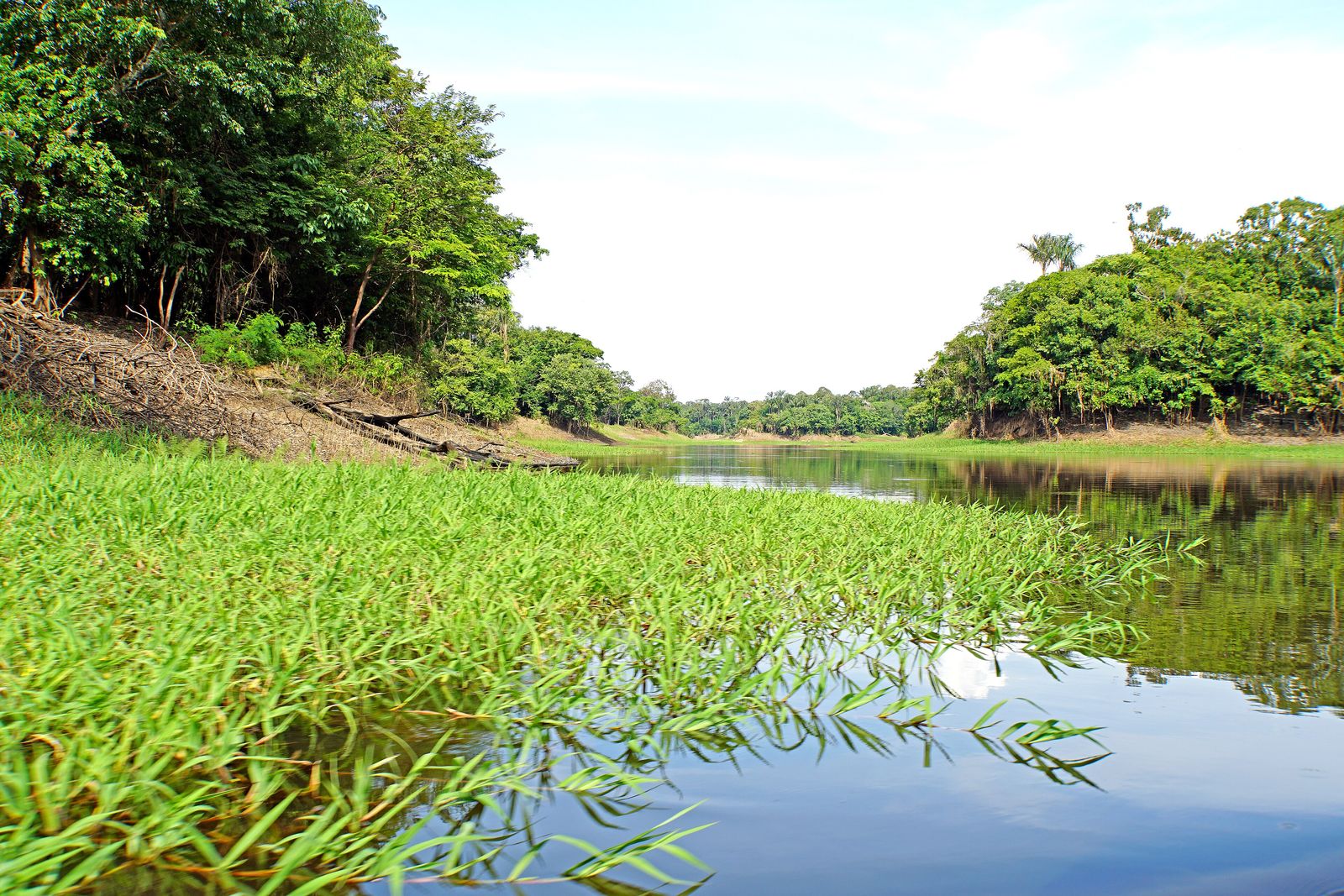
The Best Rainforest Eco-Lodges in the World
Almost every jungle lodge on earth calls itself sustainable now. It's on the sign at the gate, in the first paragraph of the website, sometimes on the soap. Most of the time it means the roof is thatched. We went looking for the places where the claim actually holds up under questions: who owns the land, where the power comes from, what happens to the money you spend there, and whether the forest around the lodge would still be standing without it. What we found is a shorter, better list than the marketing would suggest — a mix of a few whole-home rentals and, mostly, boutique lodges built or run with real intent, each checked against its own site or a source we trust before it made this page.
How we picked these
We started by throwing out the word "eco" as a filter, because on its own it filters out nothing. Instead we asked four blunt questions of every lodge and rental that made it near this list. Does someone other than a marketing team say this place is sustainable — a certification body, a conservation partner, a reforestation program with numbers attached? Who actually owns or controls the land the lodge sits on, and does the answer include the people who lived there first? Where does the power and water come from, and what happens to the waste? And does staying there put money back into the forest and the community around it, in a way you could trace if you asked. A lodge that clears three of those tests earns a spot here. A lodge that clears none, however photogenic, doesn't, no matter how many magazines have shot it.
That filter tilted the list toward boutique lodges rather than whole-home rentals, and we want to be upfront about why: most of the infrastructure that makes sustainability verifiable — a private reserve, a foundation, a certification audit, a community ownership stake — exists at the scale of a lodge with a staff and a reserve behind it, not a single rented house. We still found real whole-home exceptions, and we've flagged them clearly. If what you actually want is the full range of jungle architecture rather than this narrower sustainability cut, start with our wider ranking of the best jungle Airbnbs instead, or the best off-grid jungle cabins if living without a grid connection is the part that appeals to you.
What "sustainable" actually has to mean
Costa Rica has the clearest answer of anywhere on this list, because it built a government-run yardstick for the claim decades ago: the Certification for Sustainable Tourism, which grades hotels on everything from water and energy use to how much of their supply chain and staff comes from the surrounding community, on a scale that tops out at five leaves. Very few properties anywhere hold the top rating, and two of them are on this list. It's a useful model for what real verification looks like, even outside Costa Rica's borders — a third party checking the claim, not the lodge grading its own homework.
Brazil takes a different, land-based approach: a Reserva Particular do Patrimônio Natural, or RPPN, is a private reserve permanently and legally protected by its owner, registered with the federal government, and it cannot simply be logged or sold off for development later. A lodge built around one of these isn't just claiming to protect forest — the forest is under a legal designation that makes protection the point. Peru and Colombia's Amazon lodges lean on a third model entirely: ownership. Community-owned lodges split profits with, or are run in direct partnership with, the indigenous communities whose land the lodge sits on, which is a different and arguably more honest kind of sustainability than any certification can capture on its own.
None of these models is perfect, and we're not pretending otherwise. Certifications can be captured by good marketing budgets, private reserves can still be small, and community partnerships vary enormously in how the money actually gets split. But each is a real, checkable claim rather than a slogan, and every lodge on this list clears at least one of them with evidence we could find and link to.
Costa Rica: where the eco-lodge got invented
Costa Rica more or less wrote the modern eco-lodge playbook, and two of its properties still set the standard the rest of the industry gets measured against.
You don't drive to Pacuare Lodge. You raft in, down one of the best whitewater rivers in the world, which means the journey itself is the first activity on the itinerary rather than a chore before it. The lodge runs entirely on renewable power it generates on site — water turbines and around a hundred solar panels, with a biodigester handling waste — and it was built without cutting down a single tree, threading the suites between the trunks that were already standing. Staff are hired almost entirely from nearby communities, and it holds Costa Rica's top sustainability certification, the kind very few hotels anywhere earn. It isn't cheap and it isn't for anyone nervous about the raft-in, no-road-out arrangement, but the trade-off is a lodge that never had to compromise the forest to build itself. Verdict: the rainforest lodge that proves off-grid and genuinely comfortable aren't opposites.
Lapa Rios sits on its own private reserve at the southern tip of the Osa Peninsula, acting as a wildlife corridor into Corcovado National Park next door — a stretch of lowland tropical rainforest that's genuinely rare at this point on the map. It was one of the first lodges in the country to earn the top five-leaf sustainability rating, back in 2003, and Rainforest Alliance separately recognized it as a standard-setter for the wider hospitality industry. The seventeen bungalows are built from local materials with ocean and jungle views from the same window, and the reserve's bird list alone runs past three hundred species, alongside scarlet macaws, sloths and several endangered primates. It's reached by a short flight to Puerto Jiménez and a lodge-run shuttle from there, which keeps the last leg simple even though the destination feels properly remote. Verdict: a genuine pioneer, still performing at the level that made it one.
A lodge that had to protect the forest to build itself in the first place is a different kind of sustainable than a lodge that added solar panels afterward for the brochure.
Peru's Amazon: package lodges done right
The Peruvian Amazon around Puerto Maldonado and Iquitos has more community-linked, conservation-backed lodges per square kilometre than almost anywhere else on this list, mostly because two things happened here early: indigenous communities got direct ownership stakes in tourism, and the region's biodiversity — the Tambopata clay licks especially — gave lodges a genuine, non-negotiable reason to protect what surrounds them.
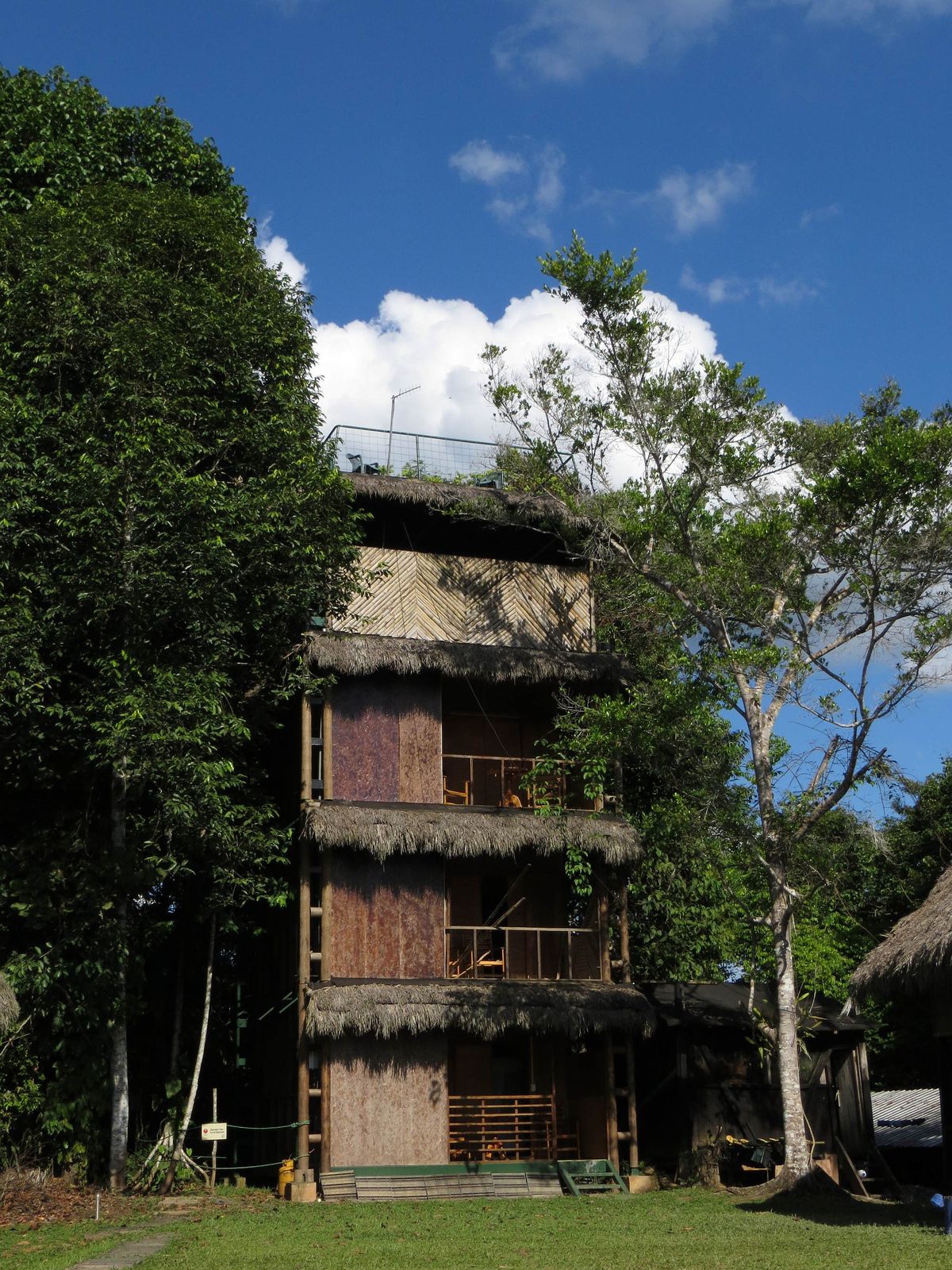
Posada Amazonas sits inside 9,500 hectares of reserve owned outright by the indigenous Ese-Eja community of Infierno, run in partnership with the operator Rainforest Expeditions rather than by an outside company alone. The roughly thirty rooms are open-walled — no glass, just mosquito netting between you and the forest — so the night sounds are simply part of what you booked. A canopy tower handles the dawn birding, and the package rate folds in transfers, meals and guided activities, so there's nothing left to plan once you land in Puerto Maldonado. It's sold as a two- or three-night package rather than a nightly rate, and it isn't the most polished lodge in Tambopata. It's the one where the money most visibly stays with the people who live in the forest. Verdict: book this one first if community ownership is the whole point of the trip for you.
Refugio Amazonas is the same operator's family-oriented option, and it earns that reputation partly by being harder to reach: a boat run of around four hours up the Tambopata River into a couple of hundred hectares of private reserve, deeper into the buffer zone than Posada Amazonas. The thirty-two rooms are comfortable without pretending to be a resort, and the payoff for the longer boat ride is clay-lick access — macaws and parrots arriving in loud, colorful waves, best watched from the property's canopy tower at first light. Like its sister lodge, it's sold as an all-inclusive package rather than a nightly stay, which suits families who'd rather not manage logistics on top of jet lag. Verdict: choose this one over Posada Amazonas if the clay licks and a longer river approach both sound like features, not drawbacks.
Inkaterra is the polished end of the same stretch of forest: thirty-five wooden cabañas built to echo Ese'Eja design, in a private reserve right beside the Tambopata National Reserve, reached by a forty-five-minute boat ride from Puerto Maldonado that's long enough to feel like arrival without being an ordeal. National Geographic Traveler has named it among the world's best eco-lodges, and the property's canopy walkway puts you up among the birds and howler monkeys rather than craning your neck from the forest floor. Rates are all-inclusive of meals and guided excursions, and the top Tambopata suite even comes with its own plunge pool for watching the forest at dusk. Verdict: the comfortable, certain Amazon choice for travelers who want the ecosystem without roughing it.
Further along the Manu road, well above the lowland heat, Manu Cloud Forest Lodge is the small, quiet stop most travelers only see as one night on a longer Manu itinerary. Around ten private bungalows sit among cloud-forest slopes near a roughly four-hundred-foot waterfall on the Unión creek, each with a hot-water bath — not a given at this altitude — and a veranda that does most of the scenic work for you. It's a six-to-seven-hour drive from Cusco, so nobody ends up here by accident, and the payoff is genuinely excellent cloud-forest birding straight from your door, plus a sauna that's more welcome than you'd expect in the damp mountain air. Verdict: a calm, well-run staging post that turns a transit night into one of the trip's better ones.
Twelve treehouses on stilts, thirty-five to seventy-five feet up, connected by suspended walkways above the Yarapa River near the Pacaya-Samiria Reserve — National Geographic has listed it among the world's more unusual hotels, and it's easy to see why once you're standing on your own private deck at canopy height. Getting there takes a car from Iquitos (a city with no roads in or out, so you were always traveling by water eventually) followed by a boat ride of around two and a half hours. The all-inclusive package covers meals, transfers and guided excursions — piranha fishing, canopy walks, a decent shot at pink river dolphins — and each treehouse has its own bathroom, which up here counts as genuine luxury. Verdict: the Amazon treehouse the brochures promise, and one of the very few that actually delivers it.
Brazil: a private reserve you can sleep in
Brazil's Amazon lodges tend to measure themselves in hectares of protected land rather than amenities, and the country's private-reserve law gives that measurement real legal teeth.
Cristalino Lodge helped establish the first private nature reserve, or RPPN, in northern Mato Grosso back in 1997, and that reserve has since grown to nearly 11,400 hectares — close to twice the size of Manhattan — which, combined with the neighboring Cristalino State Park, forms a genuine wildlife corridor rather than an isolated patch of green. A portion of every guest's rate funds the Cristalino Foundation, which runs research and education work with partners that include Kew Gardens and the Wildlife Conservation Society. The reason people fly into this particular corner of the southern Amazon is the birding: somewhere around six hundred species have been recorded on the reserve, close to a third of every bird species found anywhere in Brazil, alongside butterflies, howler monkeys, tapirs and the occasional jaguar sighting. Verdict: if a lodge's conservation credentials matter as much to you as its birdlife, this is the one to book.
This is the whole-home exception on this list, and it earns its place on merit rather than a technicality. Praia do Bonete is a fishing-village beach on the wild south coast of Ilhabela with no road in at all — you arrive by boat or a three-to-four-hour rainforest trail past waterfalls, which keeps the beach genuinely uncrowded. The house itself won first prize for Built Work from Brazil's Institute of Architects: recyclable materials, permaculture systems worked into the design, bedrooms that open up to merge with the living space by day, and a bio-septic loop that feeds a banana grove on the property. It runs on solar power with deliberately limited electricity, sleeps six across two bedrooms, and days revolve around surfing, hiking in the state park, diving and birdwatching. Verdict: proof that a single rented house can hit the same sustainability bar as a lodge with a staff of forty, if it's actually built to.
Colombia: from the Amazon to the Caribbean coast
Colombia's range on this list is the widest of any single country here — an Amazon River lodge, a permaculture retreat in the coffee-and-cloud-forest hills, and a national park bungalow, each sustainable in a different way.
Calanoa is the design-led lodge of the Colombian Amazon, set inside its own private reserve about an hour and a half by boat from Leticia — roughly sixty kilometres, every bit of it on water, because that's simply how distance works out here. The cabins were drawn by the architect Diego Samper using woven-palm roofs and natural materials throughout, and they read as considered rather than out of place against the forest around them. The all-inclusive rate buys two guided activities a day plus every meal, and the operation leans deliberately into sustainability and local culture rather than treating either as scenery for the photos. It's remote, it isn't cheap, and the boat ride is non-negotiable — which is more or less the point of coming this far into the Colombian Amazon in the first place. Verdict: the thinking traveler's Amazon lodge, wildlife and intent in equal parts.
Mundo Nuevo sits about a thousand metres up in the hills above Minca, high enough to catch Caribbean Sea views over the treetops — a genuinely strange and good thing to take in from a jungle lodge. The whole operation runs on a permaculture and sustainability ethos that reads as lived-in rather than marketed, and the birdlife around it rewards a slow morning with binoculars. Accommodation ranges from private rooms to larger suite-style "homes" to dorms, so it works whether you're a couple after quiet or a backpacker counting pesos, with prices scaled to match. It's a real climb to get up here, and the view is the reward for making it. Verdict: an easygoing, genuinely eco-minded base above Minca, at a fraction of the Amazon lodges' prices.
Ecohabs Tayrona is the only lodging actually inside Tayrona National Park, and that exclusivity accounts for most of the price. The palm-thatched, native-wood bungalows climb a hillside in the park's Cañaveral sector, their design borrowed directly from the indigenous Tayrona, with sea and forest views from the top units. Set your expectations correctly: this is dry tropical forest, scrubbier and more open than the rainforests elsewhere on this list, so come for the park, the beaches and the trails rather than dense canopy. Monkeys and a serious cast of birds turn up along the park paths, and sleeping inside the gates means you get the place before the day-trippers arrive and after they've left. Verdict: worth the premium only if sleeping inside Tayrona itself is the whole point of the trip.
Sri Lanka: on the edge of Sinharaja
Sri Lanka's rainforest, concentrated around the UNESCO-listed Sinharaja Forest Reserve, has produced one of the more genuinely inventive eco-lodges anywhere on this list.
This lodge has a backstory you can see from your own terrace: the chalets are built partly from repurposed shipping containers, set on former tea land right on Sinharaja's southwest fringe. It sounds like a gimmick and isn't — each unit has a private terrace with panoramic views over forest and old tea rows, and the containers disappear into the design once you're inside. It was a pioneering property by Sri Lankan standards when it opened, and it's run today by Aitken Spence Hotels, which brings a level of polish that's rare among the rougher jungle camps elsewhere on the island. The real draw is the birding: Sinharaja's endemic species are the prize, and the lodge's guided rainforest walks put you directly among them. Verdict: the comfortable way to do Sinharaja, with the birds and the tea-country views as the dividend.
Good to know
Almost everything on this list is booked as a multi-day, all-inclusive package rather than a nightly room rate — a boat transfer, meals and a guide are usually baked into the price rather than optional extras. Budget for that structure rather than comparing per-night numbers directly against a city hotel, and check cancellation terms carefully: getting to most of these places involves a river, a runway, or both, and weather can move a departure by a day either way.
What separates the real ones from the greenwash
Ask who owns the land, not just who manages it
The strongest claim any lodge on this list can make isn't a certification sticker, it's land tenure: a reserve that's legally protected against future development, or ownership shared directly with the community whose forest it is. A management company can lose its lease or change its policies. A registered private reserve or a community ownership stake is much harder to undo, which is exactly why Posada Amazonas, Cristalino Lodge and Lapa Rios all lead with it rather than burying it in a footnote.
Follow the power and the water
Off-grid solar, water turbines and biodigesters, as at Pacuare Lodge, are a genuine commitment — they cost more upfront and require real engineering discipline to maintain in a rainforest climate. A generator running quietly behind a "sustainable" sign is not the same thing, and it's worth asking directly what powers the lodge and where the sewage goes, because plenty of properties will happily dodge the question if you don't.
Check whether the money stays local
Community-owned lodges in Peru's Amazon split profits with the indigenous communities on whose land they operate, which is a fundamentally different economic model than a foreign-owned resort employing local staff at minimum wage. Neither model is automatically bad, but they're not the same claim, and a lodge that's vague about which one it is usually has a reason to be.
Small numbers are usually a feature
Almost every lodge on this list caps itself at somewhere between a dozen and thirty-five rooms. That's not an accident of remoteness — it's a design decision, because a jungle lodge that scales up to resort size puts real pressure on the wildlife, water and waste systems a small property can manage responsibly. Treat a jungle "eco-resort" with two hundred rooms as a claim that needs a lot more scrutiny than one with twenty.
Common questions
What actually makes a lodge an "eco-lodge" rather than just a jungle hotel with green branding?
A real one clears at least one verifiable test: a third-party sustainability certification, land under permanent legal protection like Brazil's RPPN designation, direct community ownership, or genuinely off-grid power and waste systems. A thatched roof and the word "eco" in the name aren't enough on their own, which is exactly why we filtered on evidence rather than branding for this list.
Are these lodges more expensive than an ordinary jungle stay?
Generally yes, though the range is wide. Mundo Nuevo Eco Lodge in Colombia runs from around $25 a night, while Pacuare Lodge and Treehouse Lodge sell multi-day all-inclusive packages that run into four figures. The premium usually reflects genuinely higher operating costs — off-grid power, boat or raft transfers, a smaller footprint — rather than pure markup.
Do I need to be an experienced hiker or paddler to stay at these?
No, though a few involve real physical access: Pacuare Lodge is reached by whitewater raft, and Praia do Bonete's ecohouse requires either a boat or a three-to-four-hour jungle trail. Most of the Amazon lodges are reached by a straightforward boat transfer arranged by the lodge itself, and none require technical skill, just a tolerance for humidity and an early alarm.
Is a whole-home rental ever really as sustainable as a certified lodge?
It can be, but it's rarer, because the infrastructure that makes sustainability verifiable — a protected reserve, an audited certification, a community ownership stake — usually needs a staff and budget behind it. The Bonete ecohouse on this list is the exception that proves it's possible: an architecture-award-winning, solar-powered, permaculture-built house that a single owner runs to the same standard as any lodge here.
Which of these has the strongest wildlife-watching, if that's my main goal?
Cristalino Lodge in Brazil, for the sheer density of recorded bird species, and Refugio Amazonas in Peru, for direct access to the Tambopata clay licks where macaws gather in numbers. Both are built around ecosystems the lodges themselves helped keep intact.
Can I combine a couple of these into one trip?
Within Peru, yes — Manu Cloud Forest Lodge and Treehouse Lodge or the Tambopata lodges are often stacked into a single longer Amazon itinerary out of Cusco or Puerto Maldonado. Across countries it's a bigger undertaking, since most of these are deliberately remote, but pairing Costa Rica's Pacuare Lodge or Lapa Rios with a wider trip through the country is straightforward given how compact Costa Rica is.
The pattern, and where to go from here
Look back across these thirteen and the pattern holds up: none of them treat sustainability as a finishing touch applied after the design was already decided. The reserve, the ownership structure or the power system came first, and the guest experience was built to work around it — open walls instead of air conditioning, a raft instead of a road, a profit share instead of a wage. That's the real dividing line between a lodge that got this right and one that's just decorated the idea. If you came to this list already sold on a boutique lodge over a private rental, most of the picks above are ready to book directly through their own sites. If a whole-home stay still appeals more, our best off-grid jungle cabins and best jungle Airbnbs with a private pool guides cover that ground without the sustainability filter narrowing the field. Couples planning around two of these lodges specifically should also see the best jungle Airbnbs for couples, and families weighing Refugio Amazonas against the rest can check the best jungle Airbnbs for families for more context. Otherwise, start with the full destination directory and work outward from whichever forest is calling loudest.
- Lapa Rios, official site — reserve size, Rainforest Alliance recognition and CST five-leaf certification.
- Pacuare Lodge — Sustainability — off-grid power sources, no-tree-cut construction and local staffing.
- Cristalino Lodge, official site — RPPN reserve history, size, and Cristalino Foundation conservation partnerships.
- Rainforest Expeditions — Posada Amazonas — community ownership structure and reserve size in Infierno, Tambopata.
- Inkaterra — Reserva Amazónica — cabaña count, reserve location and canopy walkway.
- Calanoa Amazonas, official site — reserve location, architecture and all-inclusive activity structure.
- Ecohabs Santa Marta — Ecohabs Tayrona — location inside Tayrona National Park and bungalow design.
- The Rainforest Ecolodge, official site — shipping-container construction and location on the Sinharaja fringe.
More from the Journal.
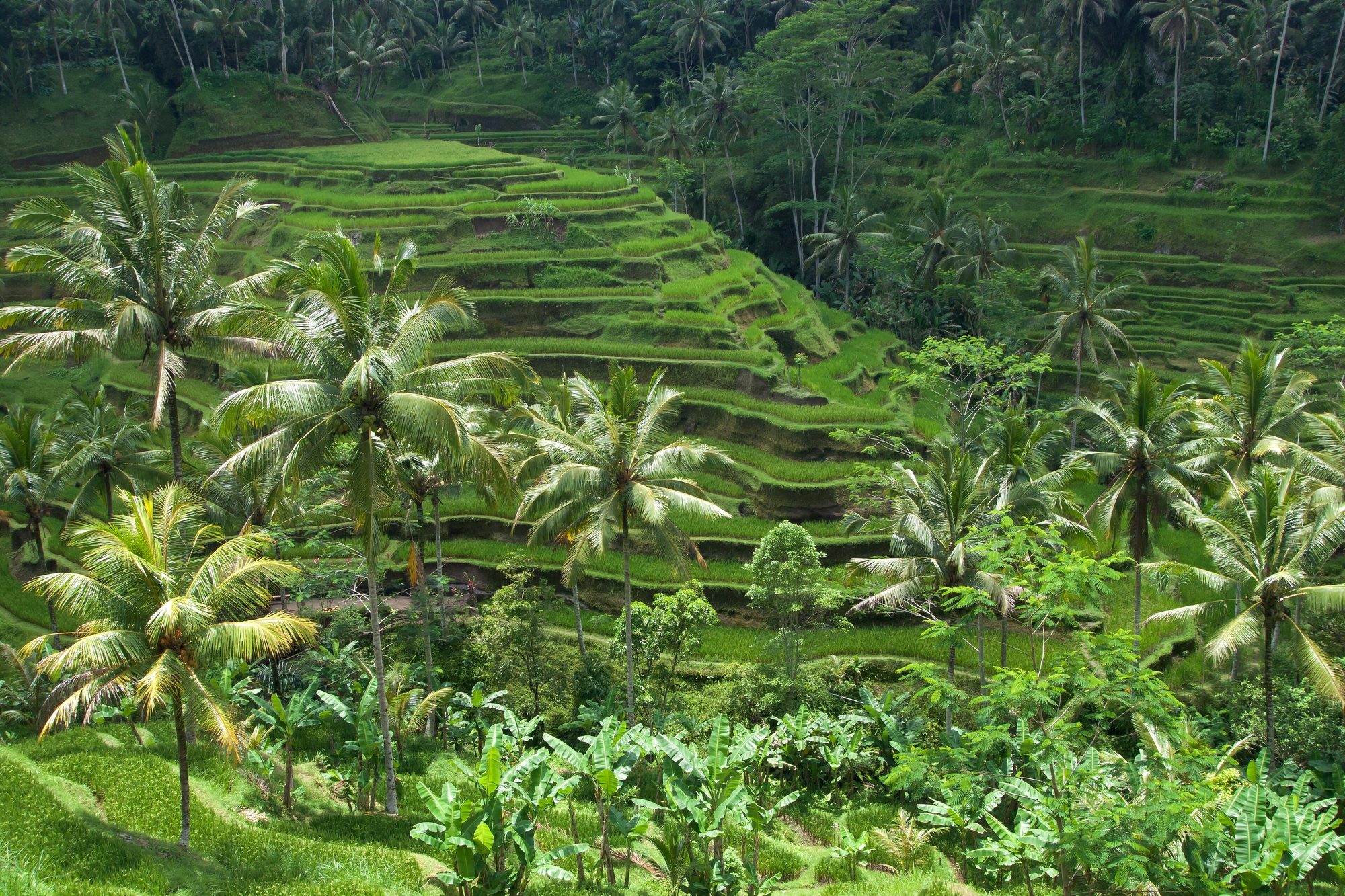 Photo: Vyacheslav Argenberg, CC BY 4.0
The Best Jungle Airbnbs in the World
Our honest, unpaid ranking of the jungle stays that changed what a night in the forest can be — from Bali's bamboo masterpieces to the floating bungalows of Thailand.
 Photo: AlaskaDave, CC BY-SA 3.0
The Best Jungle Airbnbs in the USA
Real rainforest, no passport required — the best treehouses and bamboo houses across Hawai‘i, Puerto Rico and Florida.
 Photo: Bernard DUPONT from FRANCE, CC BY-SA 2.0
The Best Treehouse Airbnbs in the World
Our honest ranking of the treehouses worth crossing an ocean for — from canopy platforms in the Amazon to stilted glass boxes above the rainforest floor.
 Photo: Derek Ramsey (Ram-Man), CC BY-SA 4.0
Find your own piece of the canopy.
Treehouses, bamboo houses and rainforest villas across 17 destinations — found, vetted and written up honestly.
Browse all destinations