Jungle Rivers & Wild Swimming Holes
A jungle hike has a rhythm: heat builds, sweat soaks through by the second kilometer, and somewhere around the point where you start negotiating with yourself about turning back, the trail drops toward the sound of moving water. That's the whole appeal of a jungle swimming hole in one sentence — it's the reward built into the landscape itself, not something a lodge invented to sell a day tour. But "jungle swimming hole" covers a lot of very different water: a limestone cenote in the Yucatan is nothing like a blackwater tributary in the Amazon, and a cave pool in Bahia behaves nothing like a tidal river pool in Hawaii. Some of this water is safe to swim in every day of the year. Some of it is safe for six months and dangerous for six. This is a guide to the real places, the real risks — currents, bacteria, and a few animals worth respecting — and how to actually get in the water without being reckless about it.
What makes a great jungle swimming hole
Every river running through tropical forest is, in principle, swimmable. What separates a genuinely good jungle swimming hole from a stretch of river you'd rather not get into comes down to three things: clarity, current, and access. Clarity is mostly about geology. Rivers that run over limestone — the Yucatan, Guatemala's Alta Verapaz, Bahia's interior — pick up dissolved calcium carbonate that scatters light and produces the startling turquoise or milk-blue color that makes so many of these places look retouched in photos. Rivers running off volcanic or granite terrain, by contrast, often carry more suspended sediment and run a duller green-brown, which doesn't make them worse to swim in, just less photogenic. And blackwater rivers, common across the Amazon basin, run the color of strong tea because they're stained by tannins leaching out of decomposing leaf litter upstream — water that's often more comfortable to swim in than it looks, since the same acidity that darkens it also makes it inhospitable to a lot of the mosquito larvae and parasites that thrive in clearer, more neutral water nearby.
Current is the part people underestimate. A pool that looks calm on the surface can be moving hard a foot below it, especially anywhere a river narrows, drops over a ledge, or feeds into or out of a cave system. Cenotes and limestone cave pools are usually the safest water in this guide precisely because so many of them are enclosed or slow-moving by nature; open river pools, especially anything downstream of a waterfall or upstream of a narrows, deserve real caution and a look at recent rainfall before anyone gets in.
Access is the least romantic of the three factors and probably the most decisive for planning an actual trip. Some of the best jungle swimming holes in the world sit a five-minute walk from a parking area with a ticket booth. Others require a guide, a permit, a boat, or all three. None of that makes the harder-to-reach ones better — a lot of travelers have a genuinely great swim at a well-run, popular site — but it does mean the planning question isn't just "is it beautiful," it's "what does actually getting there and back involve."
Mexico's cenotes: swimming inside the Yucatan's underground rivers
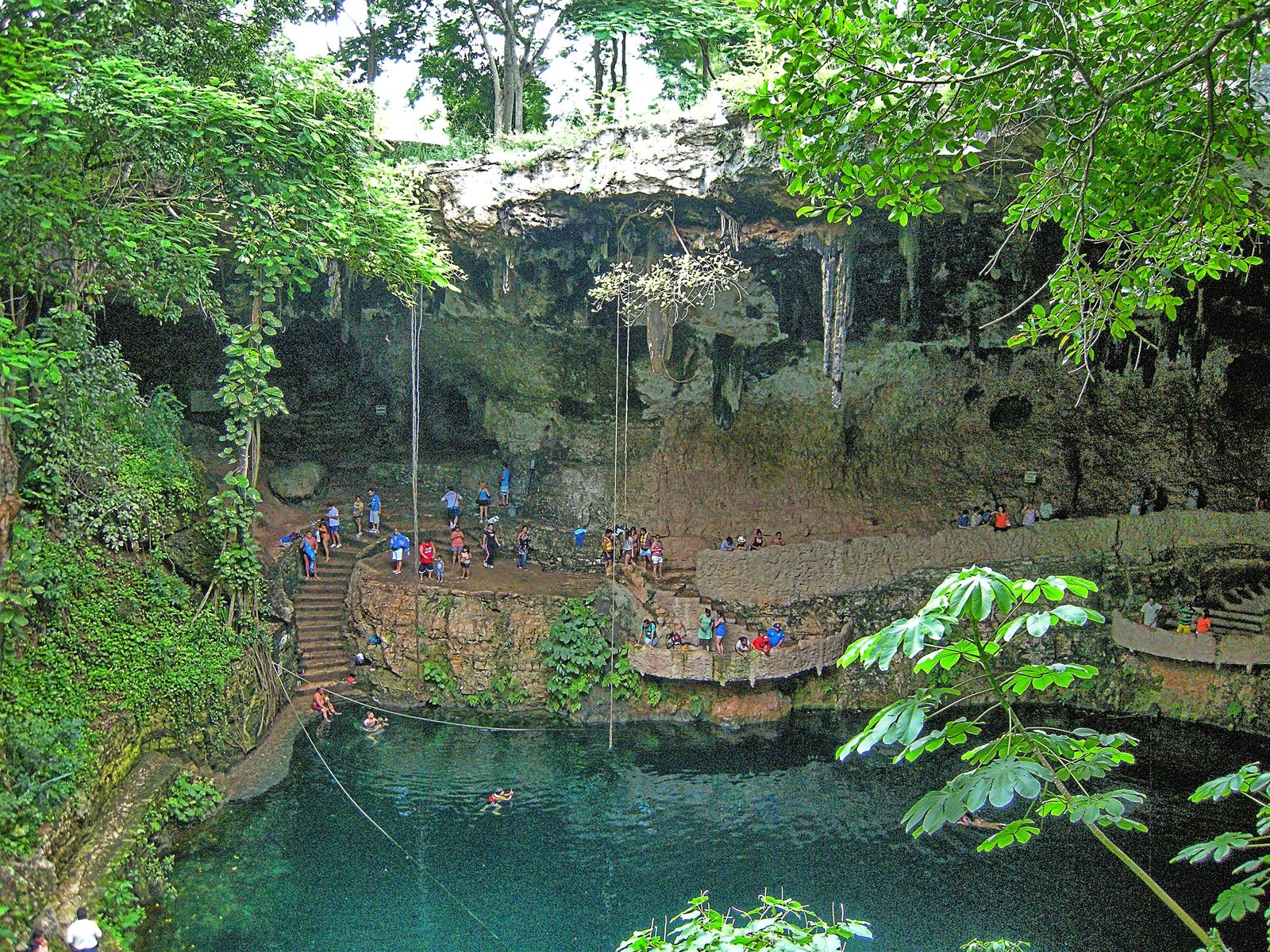
Nowhere on Earth has built a bigger tourism identity around freshwater swimming than the Yucatan Peninsula, and the reason is geological. The whole peninsula sits on a limestone shelf riddled with sinkholes and collapsed cave systems, formed as rainwater slowly dissolved the porous rock over millions of years and, in some spots, is widely believed to trace back to the crater rim of the Chicxulub impact that many scientists link to the extinction event that ended the dinosaurs. Those sinkholes are cenotes, and there are thousands of them across the Yucatan, ranging from wide open pools ringed by jungle to fully enclosed caverns you descend into by ladder, lit only by a shaft of daylight from above.
Gran Cenote and the Tulum cluster
Gran Cenote, about four kilometers outside the town of Tulum, is one of the most visited in the region and a good example of what makes a cenote different from a normal swimming hole: it isn't one pool but a connected string of them, linked by wooden walkways and partially submerged passages, with a winding, river-like open section that's genuinely pleasant for a slow swim or a snorkel over exposed tree roots and small turtles. It's shallow enough in places to stand, deep enough elsewhere to need a life vest for less confident swimmers, and it's close enough to town to fold into an otherwise beach-focused trip along Mexico's Tulum and Maya jungle coast without giving up a full day.
Dos Ojos and the cave-diving cenotes
Dos Ojos, meaning "two eyes," takes its name from a pair of nearly circular sinkhole openings that mark the entrance to one of the longest mapped underwater cave systems in the world, with more than 82 kilometers of surveyed passages threading beneath the jungle north of Tulum. Most visitors never go past the entrance chambers, where the water is calm, clear, and well within snorkeling range, but the site is also a serious technical cave-diving destination, and the two uses coexist: casual swimmers stick to the lit, shallow zones near the entrance while certified cave divers head deeper into passages that keep expanding every time a new section gets surveyed. It's a useful reminder that a lot of these cenotes are simultaneously tourist swimming holes and genuine scientific frontiers, which is part of why local guides take the rules around them — no sunscreen before entry, no touching the rock formations — seriously rather than as tourist theater.
Costa Rica and Central America's river pools
Costa Rica's volcanic geology and heavy rainfall build a river system dense enough that a genuinely good swimming hole is rarely more than an hour from wherever you're staying. Around La Fortuna and the Arenal region, rivers running off the volcano's slopes cut a series of pools that range from easy roadside dips to longer hikes through forest reserve land, and the area's dense concentration of rainforest lodges means a morning swim is realistically a before-breakfast plan rather than a full excursion. Near Dominical, on the Pacific side, the twin waterfalls at Nauyaca drop into a wide pool that's become one of the country's most popular swimming spots precisely because it combines real natural drama with an approach — usually by guided horseback or 4x4 rather than on foot — that most visitors can manage without technical hiking experience.
Further north, across the border in Guatemala's Alta Verapaz region, Semuc Champey does something no other site in this guide quite matches: a natural limestone bridge roughly 300 meters long carries a staircase of stepped turquoise pools above the main channel of the Cahabón River, which runs mostly underground beneath it. The pools are connected by short cascades rather than one dramatic drop, and swimming across the calm upper terraces while the Cahabón roars invisibly below is one of the more surreal experiences on this list. It sits inside a jungle canyon near the town of Lanquín that's remote enough to keep crowds real but manageable, and it's usually visited with a local guide who knows which pools are running calm on a given day, since heavy rain upstream can change the character of the whole system fast.
A cenote in Mexico, a limestone staircase in Guatemala, and a cave pool in Bahia are all, technically, "jungle swimming holes." What they actually ask of you — a snorkel, a guide, a life vest, a flashlight — is different every time, and that's worth knowing before you plan around a single photo.
Brazil's blue pools: the Chapada Diamantina
In the interior of Bahia state, several hundred kilometers inland from Brazil's Atlantic beaches, the Chapada Diamantina National Park protects a landscape of sandstone plateaus, canyons, and a set of underground pools that rank among the strangest swimming holes anywhere in the tropics. Poço Azul and Poço Encantado, both near the town of Nova Redenção, are flooded caves rather than open rivers, and the two behave in almost opposite ways despite sitting close together.
Poço Azul
Poço Azul — "blue well" — is a cave pool roughly 40 meters long and 20 meters wide, fed by flowing groundwater rather than standing still, which is the detail that makes it swimmable at all: because the water keeps moving, human activity in it doesn't cloud the visibility the way it would in a static pool. Visits are run with a life jacket, mask, and snorkel included, and the appeal is straightforward — floating in water clear enough to see the cave floor well below you, in light filtering down from an opening in the rock overhead.
Poço Encantado
Poço Encantado — "enchanted well" — is the more dramatic and more strictly protected of the two: larger and deeper, at roughly 98 meters long and 49 meters wide, and completely off-limits to swimming to preserve the stillness and clarity of its water. Between April 1 and September 10, roughly between 10 a.m. and 1:30 p.m., sunlight enters through a narrow opening in the cavern roof at an angle that lights the pool from below in an intense blue that's become one of the most photographed sights in the park. It's a look-but-don't-touch counterpart to Poço Azul just down the road, and visiting both back to back is a genuinely useful way to understand how differently two nearly identical cave pools can be managed depending on how fragile their water actually is.
Good to know
The reason Poço Encantado bans swimming and Poço Azul doesn't isn't bureaucratic inconsistency — it's water chemistry. Poço Azul's water is constantly refreshed by groundwater flow, so a swimmer's presence doesn't linger. Poço Encantado is closer to a sealed pool, and any disturbance to the sediment or the water's mineral balance can cloud it for a long time. When a site restricts swimming and a nearby one doesn't, it's worth assuming the local guides know something about the specific pool that a quick glance wouldn't tell you.
Thailand and Southeast Asia's tiered river pools
Southeast Asia's limestone belts build a different style of swimming hole: not a single sinkhole but a staircase of connected pools climbing up a hillside, each one separated from the next by a short cascade. Erawan National Park, in Kanchanaburi province west of Bangkok, is built around exactly this — a seven-tiered waterfall system that turns a visit into a hike from pool to pool rather than a stop at one fixed spot. The lower tiers are easy walking and correspondingly busy; the upper tiers take real effort to reach and thin the crowd out fast. Several of the pools are home to small fish that will nibble gently at bare feet and ankles if you stand still for more than a minute or two — the same species used in commercial fish-spa treatments elsewhere, doing the job here for free in the wild, which catches most first-time visitors off guard the moment it happens.
Bali runs on the same limestone logic in its volcanic northern highlands, where rivers cutting down from the interior toward the coast form pools and short gorges that are a completely different trip from the island's beach towns. Basing a few nights in Bali's highland interior rather than only the south coast is generally what turns a single rushed river stop into an actual couple of unhurried mornings in the water, and it's worth checking conditions locally before committing to any specific pool, since the same rivers that run gentle and clear through the dry season can rise fast once the rains set in.
Hawai'i and Puerto Rico: jungle pools you can reach in a day
Two U.S. destinations put genuine tropical rainforest swimming within easy reach of a domestic flight, and both are worth planning around carefully rather than casually.
Maui's Pools of 'Ohe'o
On Maui, in the Kīpahulu district of Haleakalā National Park, a series of stepped pools along 'Ohe'o Stream — long marketed as the "Seven Sacred Pools," a tourism-era name the National Park Service doesn't use, since there are considerably more than seven and none of them hold particular religious significance — sit just off the end of the long, winding Hana Highway, reached on foot from a park visitor area. It's one of the more accessible jungle-adjacent swimming stops in the United States, but also one where the National Park Service closes the pools outright during and after heavy rain, because 'Ohe'o Stream is a genuine flash-flood hazard: water levels well upstream in the surrounding rainforest can rise and reach the pools with very little warning at the site itself. Hawai'i's steep, wet volcanic terrain makes this kind of flash flooding a real and recurring risk across the islands, not a rare exception, and it's the single biggest reason to check current conditions and posted closures before assuming a pool that was open yesterday is open today.
El Yunque, Puerto Rico
El Yunque National Forest, the only tropical rainforest in the U.S. National Forest System, holds several swimmable spots along its rivers, most visited in combination with the trail to La Mina Falls, whose plunge pool draws enough traffic on weekends and holidays that the Forest Service now runs a timed-entry permit system to manage it. What makes El Yunque a genuinely easy add to a trip is the location: about an hour from San Juan, no long-haul flight, no visa requirement for U.S. travelers, and a real, dense, wet tropical forest despite technically being a U.S. territory rather than a foreign destination. Puerto Rico's combination of accessibility and authentic rainforest is a big part of why it works so well as someone's first jungle river trip.
Colombia, Peru, and the wild rivers of the Amazon
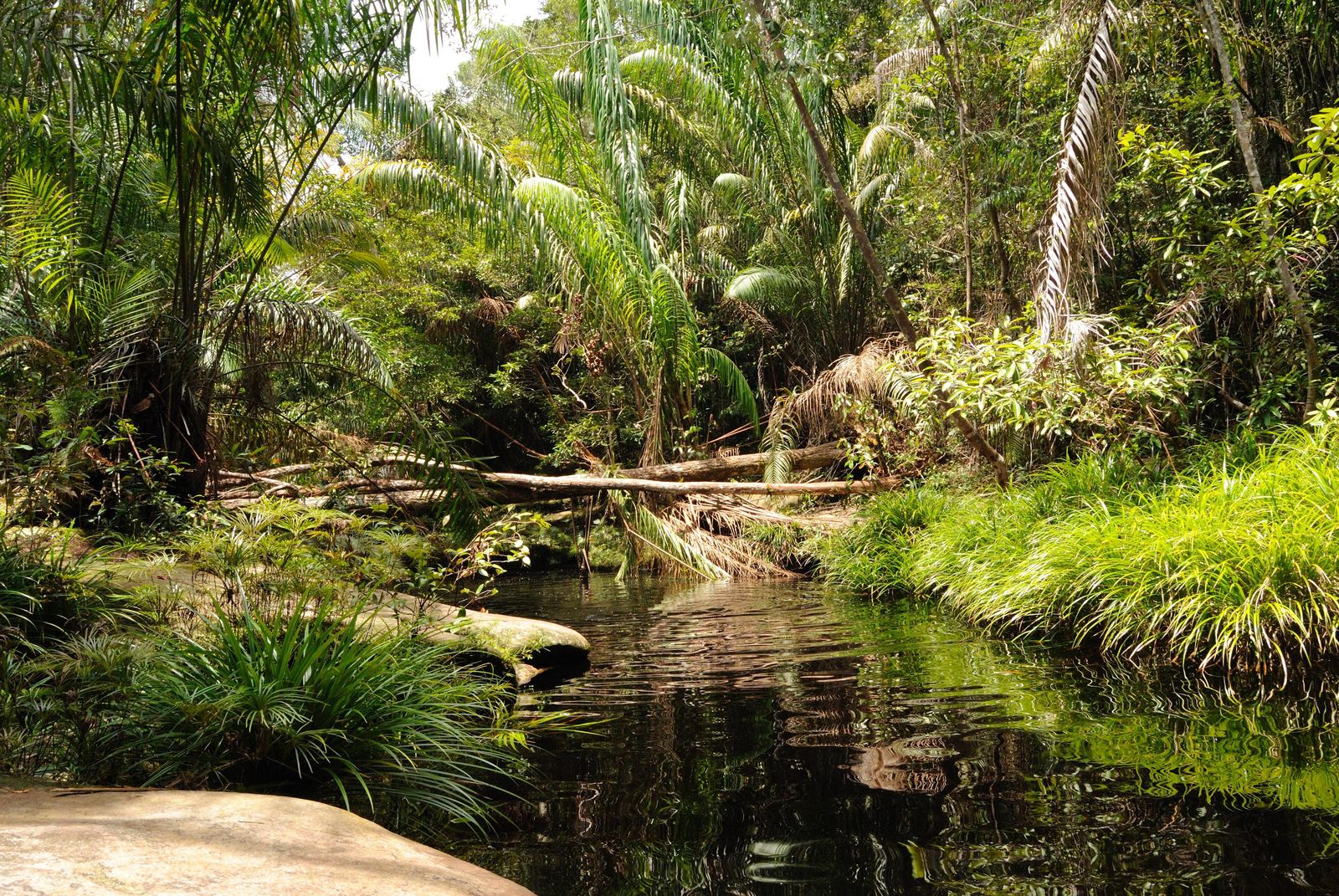
The Amazon basin is the largest river system on Earth, and it doesn't behave like a single kind of water. Whitewater rivers, like the Amazon's main channel and many of its Andean-fed tributaries, run cloudy with sediment washed down from the mountains and are generally treated with more caution for swimming, partly for visibility and partly because they're more likely to carry larger wildlife along their banks. Blackwater rivers, tea-colored and stained by dissolved tannins from decomposing forest leaf litter, are common across the basin and tend to be more acidic — inhospitable enough to a lot of parasites and mosquito larvae that some lodges specifically favor a blackwater stretch for guests who want to actually swim rather than just look. Regional lodges across Peru's Amazon lowlands know their own stretch of river well enough to tell guests, on any given day, whether it's a swimming day or not — a call worth taking seriously rather than working around.
Caño Cristales, Colombia
In Colombia's Serranía de la Macarena, Caño Cristales has earned a reputation as one of the most visually striking rivers in the world, its bed streaked with red, yellow, green, and blue during a seasonal window roughly from mid-year into the fall, when a riverweed called Macarenia clavigera blooms across the rock. The river is often called the "River of Five Colors" for exactly that reason. Because the plant itself is fragile and the site sits in a formerly conflict-affected region that's only become broadly accessible to travelers in recent years, access is tightly managed: visits go through a local guide, follow marked routes, and swimming is limited to specific, approved sections rather than open river access anywhere along the banks. It's a good example of a swimming hole where the restriction exists to protect something genuinely rare, not to inconvenience visitors, and it's worth treating the guide's boundaries as non-negotiable rather than a suggestion.
Sri Lanka's hill-country and wet-zone pools
Sri Lanka's central highlands, where tea estates give way to remnant rainforest, and its southwestern wet zone, anchored by the Sinharaja Forest Reserve, cut a different kind of river system than anything in the Americas — smaller, steeper, and generally quieter with visitors, since the island's tourism has historically concentrated more on beaches and cultural sites than river swimming specifically. Streams through Sinharaja, a UNESCO World Heritage rainforest, are typically seen on guided forest walks rather than as a standalone swimming destination, which keeps them close to untouched but also means casual, unguided access is neither easy nor advisable given the reserve's conservation status. In the hill country further east, rivers running off the tea-growing plateau feed a mix of accessible pools near towns and steeper, less-visited stretches that reward a local guide's knowledge of current conditions, much the way they do everywhere else on this list — the pattern holds even where the specific geology doesn't.
The real risks, and how to swim safely and responsibly
It's worth being straightforward about this rather than treating it as a footnote: jungle rivers are genuinely more hazardous, in a few specific and avoidable ways, than a hotel pool or a supervised beach, and the risks aren't evenly distributed across the places in this guide.
Leptospirosis
The single most underrated risk in freshwater jungle swimming is leptospirosis, a bacterial infection carried in the urine of infected animals — rodents, cattle, pigs, dogs, and a wide range of wildlife — that contaminates soil and water and can enter the body through a cut, a mucous membrane, or simply swallowing contaminated water. It's found worldwide but is markedly more common in tropical climates, and the U.S. Centers for Disease Control and Prevention specifically flags swimming, rafting, kayaking, and canoeing in freshwater as risk activities, with the danger rising sharply after heavy rainfall or flooding, when runoff carries more contamination into rivers and pools. The practical takeaway isn't to avoid jungle rivers — it's to avoid swimming in visibly murky water after a big storm, to keep cuts covered, and to avoid swallowing river water on purpose or by accident, which is good general practice everywhere in this guide, not just at any one site.
Currents and flash floods
Nearly every fatality or serious rescue at a jungle swimming hole traces back to the same underlying cause: a current stronger than it looked, or a water level that rose faster than anyone expected. Storms well upstream, out of sight from a pool that looks calm and the sky above it clear, can raise a river's level within minutes at a swimming spot with zero local warning — exactly the mechanism behind the flash-flood closures at Maui's 'Ohe'o pools and a real risk at nearly every open river pool in this guide, cenotes and other enclosed cave pools being the notable exception. Treat any posted closure, ranger call, or local guide's judgment as the actual safety system it is, not caution to route around.
Wildlife worth respecting
Crocodilians share river habitat with people across large parts of the tropics, and local guides are the actual authority on which specific stretch of river is safe on a given day — this varies enormously by species, region, and season, and it's exactly the kind of local knowledge that's worth asking about directly rather than assuming from a guidebook. The Amazon's candiru, a small parasitic catfish with a genuinely alarming reputation in traveler folklore, is a real fish but the more dramatic stories about it are wildly overstated relative to actual documented cases — worth knowing about, not worth losing sleep over. In parts of Africa and Asia, some freshwater systems carry a risk of schistosomiasis, a parasitic infection from freshwater snails, though it isn't generally a concern at the well-touristed jungle swimming spots covered in this guide; it's a useful thing to check specifically if a trip range extends into rivers or lakes further off this list.
Doing right by the water
Reef-safe, biodegradable sunscreen and insect repellent matter here just as much as they do in the ocean — plenty of these rivers and pools feed drinking water for downstream communities, and standard sunscreen chemicals don't simply disappear once they rinse off. At sites like Dos Ojos and Poço Azul, where guides ask visitors to rinse off or skip sunscreen entirely before entering the water, it's a real conservation measure rather than theater. Stick to marked trails and designated swimming zones rather than cutting across fragile bank vegetation for a better angle, pack out everything brought in, and hire the local guide where one is customary — at sites like Semuc Champey, Caño Cristales, and Sinharaja, guiding fees are often the actual mechanism by which the community living alongside the water benefits at all from the visitors coming to see it.
Practical field tips
A few habits carry across every destination in this guide. Water shoes or a real trail shoe with grip beat sandals on wet rock and riverbed, every time. Arriving early — before tour groups from the nearest town — routinely means the difference between a packed pool and a quiet one, especially at well-known stops like Gran Cenote, Erawan, or Poço Azul. A simple dry bag protects a phone or camera better than a death grip while scrambling over wet rock, and it's worth having both hands free for that scramble rather than holding a phone out for one more photo. And building a rest day into a trip that includes more than one of these stops keeps the experience a genuine pleasure rather than a grind — a lesson every guide in this guide's destinations has learned from tired, overambitious travelers at some point.
Which jungle stays put you closest
Basing a trip at the actual edge of the forest, rather than commuting in each day from a beach town or a city hotel, is what turns "we found a swimming hole" into a trip built around several of them. In the Yucatan, staying inland from the coastal resort strip and closer to the cenote-dense stretch between Tulum and Valladolid cuts the drive to sites like Gran Cenote and Dos Ojos down to a short hop rather than a planned excursion. In Costa Rica, the dense lodge scene around La Fortuna and the wider Arenal region puts both river pools and waterfall trailheads close enough that an early swim is realistically a before-breakfast activity. And in Bahia, basing near the town of Lençóis or elsewhere inside the Chapada Diamantina National Park boundary, rather than commuting from the coast, is really the only practical way to see both Poço Azul and Poço Encantado without losing most of a day to driving.
If wild swimming is one stop on a longer trip built around rivers and rainforest wildlife, a few other guides in this Journal round it out well — the great waterfalls of the jungle covers the dramatic drops that often feed the pools in this guide, and pink river dolphins of the Amazon is worth reading before any Amazon basin river trip, since a surfacing dolphin is a genuine possibility on the same blackwater stretches covered here. For the bigger picture on why this kind of trip has become so much more common, our piece on why jungle stays are booming is useful context. For an actual stay, browse vetted jungle properties by country on our full destinations directory. JungleBnB doesn't hold inventory or take payment for placement, so what's there is the same shortlist we'd hand a friend, not a sponsored one.
Common questions
Are cenotes safe to swim in?
Generally yes, and often safer than an open river, since most tourist-accessible cenotes are calm, clear, and either enclosed or slow-moving. The bigger risks at sites like Dos Ojos are more about respecting boundaries — staying in lit, shallow zones unless certified for cave diving — than about the water itself.
What is leptospirosis, and how big a risk is it really?
It's a bacterial infection spread through water or soil contaminated by infected animal urine, more common in the tropics and specifically flagged by the CDC as a risk during freshwater swimming, rafting, and kayaking, especially after heavy rain. It's a real risk worth taking seriously — avoid visibly murky water after storms, keep cuts covered, don't swallow river water — but not a reason to avoid jungle rivers altogether.
Can you swim at Caño Cristales in Colombia?
In specific, guide-approved sections, yes, during the river's colorful season roughly from mid-year into the fall. Open, unguided swimming anywhere along the river isn't permitted, since the aquatic plant that produces the color is fragile and the site is managed accordingly.
Why is swimming banned at Poço Encantado but allowed at Poço Azul?
It comes down to water movement. Poço Azul is fed by flowing groundwater, so a swimmer's presence doesn't cloud it. Poço Encantado is closer to a sealed pool, and disturbing it can affect its clarity for a long time, so it's preserved as a viewing-only site.
What's the best time of year to visit jungle swimming holes?
It depends on the destination's own dry and wet seasons rather than a single global calendar — dry season generally means calmer, clearer water and safer access, while wet season brings higher, more powerful rivers that are often more dangerous to swim in even when they look dramatic. Check the specific region before planning around a date.
Do I need a guide to visit these swimming holes?
It's required at some — Caño Cristales, Poço Azul and Poço Encantado, Semuc Champey — and strongly advisable at nearly all the rest. Guides know current water conditions, closures, and which pools are actually safe that day, which a guidebook or a website, including this one, can't tell you in real time.
- Lonely Planet — Secret Swims: The Cenotes of Mexico's Yucatan Peninsula — the Yucatan's limestone geology and general cenote character.
- Best Cenotes Near Tulum: Gran Cenote, Dos Ojos & Sacred Swimming Holes — Gran Cenote's connected, river-like layout and Dos Ojos's twin-opening cave system.
- Atlas Obscura — Poço Azul (Blue Pool) — Poço Azul's flowing-water swimming conditions in the Chapada Diamantina.
- Guia Chapada Diamantina — Poço Encantado — pool dimensions, the seasonal light window, and the no-swimming preservation rule.
- Raízes da Chapada — Poço Azul + Poço Encantado — comparative sizing and swim gear provided at Poço Azul.
- CDC — About Leptospirosis — transmission through contaminated water and soil, and elevated tropical risk.
- CDC Yellow Book — Leptospirosis — freshwater recreation as a specific travel risk activity, especially after heavy rainfall.
- Emory Healthcare — Schistosomiasis (Bilharzia) & Other Freshwater Hazards — regional context on schistosomiasis risk in freshwater systems outside the Americas.
More from the Journal.
 Photo: shankar s. from Dubai, united arab emirates, CC BY 2.0
Where to See Sloths in the Wild
The internet's favourite animal is real, wild and findable — where to reliably see sloths, how to spot them, and the stays that put you closest.
 Photo: Michael Barera, CC BY-SA 4.0
The Monkeys of the Rainforest
Howlers waking you at dawn, capuchins raiding the deck — a field guide to the primates you will meet on a jungle stay, and where to meet which.
 Photo: Charles Miller from Basingstoke, United Kingdom, CC BY 2.0
Toucans & the Tropical Birds You'll See
The rainforest is the richest bird habitat on earth. Toucans, macaws, quetzals and hummingbirds — what to look for, and the best places to look.
 Photo: Derek Ramsey (Ram-Man), CC BY-SA 4.0
Find your own piece of the canopy.
Treehouses, bamboo houses and rainforest villas across 17 destinations — found, vetted and written up honestly.
Browse all destinations