Khao Sok National Park Guide
Most rainforests get compared to the Amazon. Khao Sok is older than it — a tangle of limestone peaks and dripline jungle in southern Thailand that's been standing, by most estimates, for more than 160 million years, which puts it among the oldest rainforest ecosystems on the planet. At its center is Cheow Lan Lake, a reservoir threaded between karst towers that look like they were lifted out of Guilin, and on that lake float a small number of raft houses where your floor is the water and your neighbors are hornbills. This is a practical guide to Khao Sok: what it actually is, how to get in, where to base yourself, what to do with your days on land and on the lake, and the honest tradeoffs of a park that's increasingly hard to keep quiet about.
What Khao Sok is, and why go
Khao Sok National Park sits in Surat Thani Province, in the narrow waist of the Malay Peninsula that makes up southern Thailand, roughly between the Andaman coast at Khao Lak and the Gulf coast at Surat Thani town. The park protects what's generally described as the largest remaining area of virgin rainforest in southern Thailand, built up over tens of millions of years of tectonic movement, erosion and sediment accumulation into a landscape of steep limestone massifs, dense triple-canopy jungle and a river system that eventually feeds into the Phum Duang River basin. The comparison to the Amazon isn't marketing copy — Khao Sok's rainforest predates it, and the age shows in the density of the place: fig trees with trunks the width of a small car, lianas thick as rope, a canopy that blocks enough light that the forest floor stays cool even at midday in the tropics.
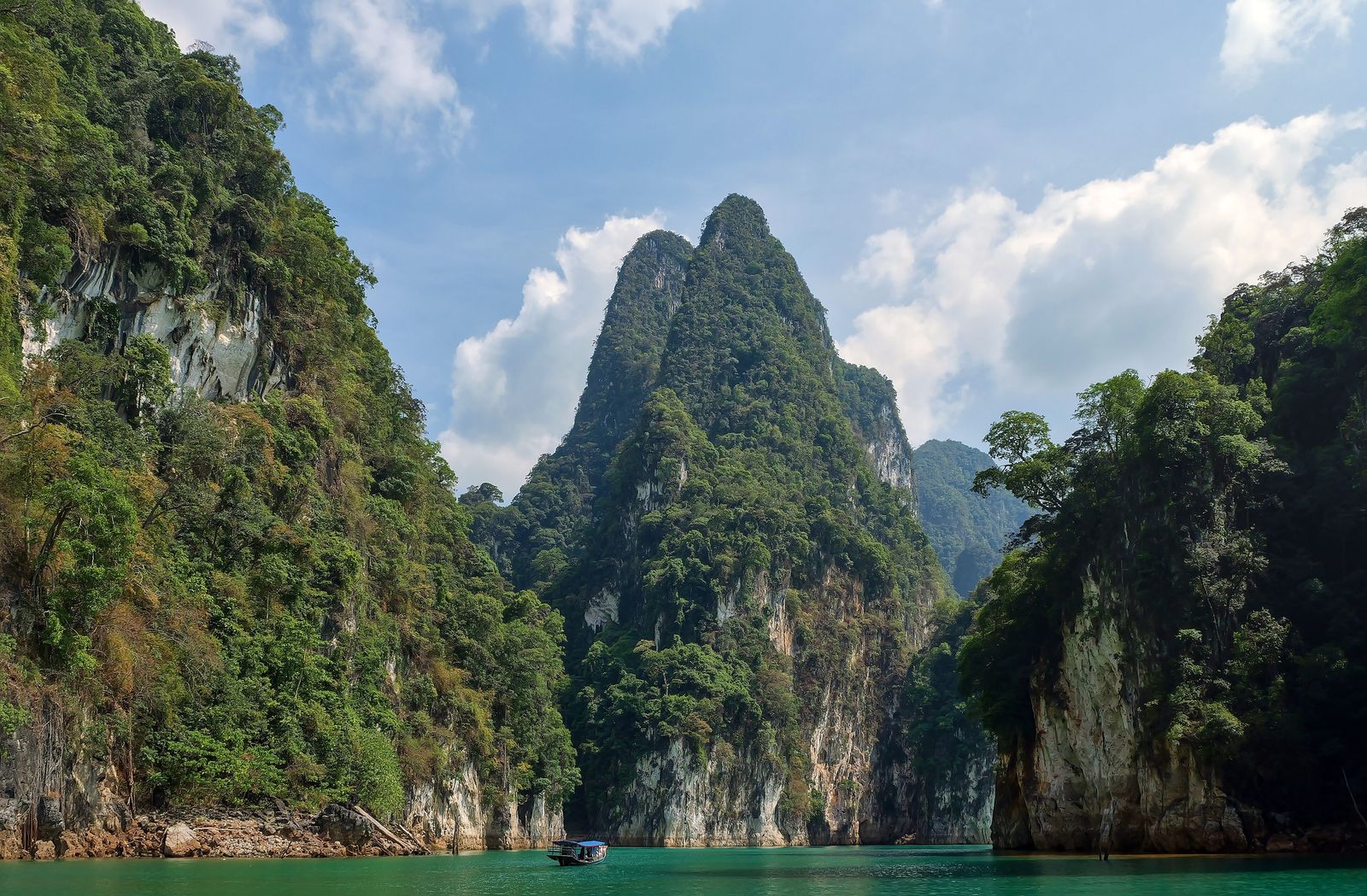
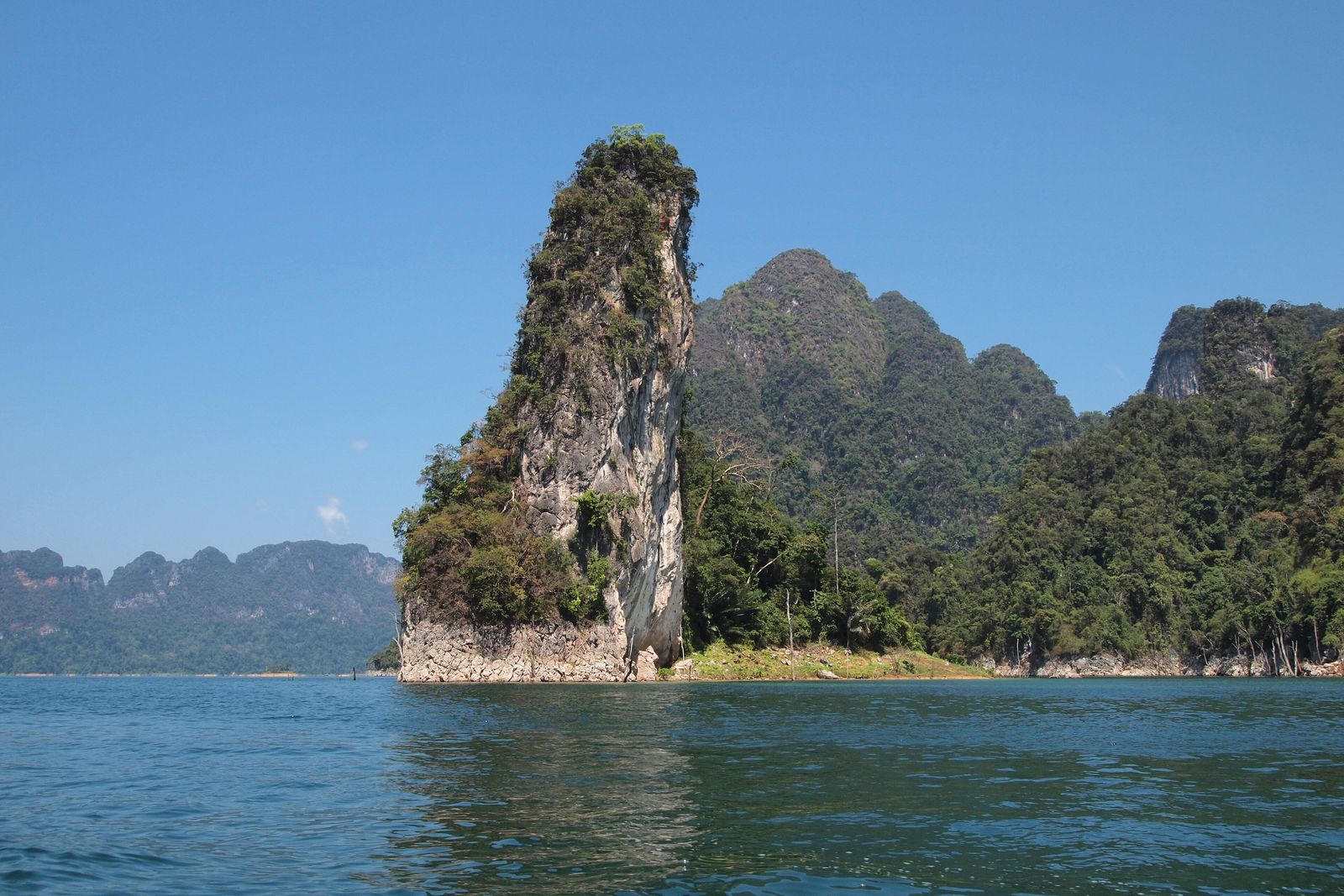
What makes Khao Sok distinct from Thailand's other national parks, and the reason it belongs on a very short list of the world's great jungle destinations, is Cheow Lan Lake. In 1982 the state utility EGAT completed the Ratchaprapha Dam — a 94-meter-high concrete structure across the Klong Saeng River, a tributary of the Phum Duang — flooding a valley of limestone karst to create a reservoir of around 165 square kilometers. What could have been an ordinary hydroelectric lake turned out, by accident of geology, to be one of the most photogenic bodies of water in Southeast Asia: sheer limestone towers rising straight out of jade-green water, densely forested to their summits, with a small archipelago of raft houses tucked into the coves between them. It's routinely, and fairly, compared to Guilin in China or Halong Bay in Vietnam, except this one is fresh water, ringed by protected jungle, and reachable on a normal international itinerary through Phuket or Krabi rather than requiring a dedicated trip to China.
The pitch, in short: a rainforest with a genuine claim to being older and more biodiverse than the Amazon, a lake landscape that looks unlike anywhere else most travelers will have been, and — if you time it right — a night on a floating platform with no light pollution and no road noise, just the sound of the jungle and the water moving under the boards. It's a serious trekking and wildlife destination in its own right, not just a lake to photograph, and it rewards travelers who give it more than a rushed overnight.
Getting there
Surat Thani is Khao Sok's gateway, both the provincial town and its airport (code URT), which has direct domestic flights from Bangkok on several carriers. From Surat Thani Airport, a shared van service — the main operator running the route is Phantip Travel — leaves through the day roughly between 8:15am and 4:15pm, taking about two and a half hours to reach Khao Sok village, with tickets bought at booths just outside baggage claim for somewhere in the range of 250–300 baht depending on whether you're dropped at the bus station or taken into the park area itself. A private taxi covers the same route faster, in around an hour and thirty-five minutes under normal traffic, at a proportionally higher fare — worth it if you're arriving late or traveling as a group where the cost splits down to van-ticket territory anyway.
Khao Sok is also a realistic stop for travelers routing between Thailand's Andaman and Gulf coasts. It sits roughly midway between Khao Lak and Phuket to the west and Surat Thani to the east, which makes it a natural add-on for anyone already island-hopping — Krabi, Phuket and Koh Samui all run minivan transfer services to Khao Sok village, typically in the two-and-a-half to three-hour range depending on the specific route and where on the island you're being picked up. If your plan is to go straight to the lake rather than basing in the village first, note that Cheow Lan Lake itself is accessed from a separate point — Ratchaprapha Pier — which sits about 65 kilometers from Khao Sok village and roughly an hour and a half further by road; most floating-raft-house operators build that transfer into their package rather than leaving you to arrange it independently.
There's no rail line into Khao Sok and no meaningful public bus network beyond the shared vans described above, so a van transfer, a private taxi, or a self-driven rental car (Thailand drives on the left, and the roads in from Surat Thani are well paved and well signed) are the realistic options. Once you're in Khao Sok village, the main strip is walkable, but reaching the park headquarters, trailheads, and the pier for the lake requires a vehicle each time — most guesthouses and tour operators handle this as part of a booked activity.
Good to know
Khao Sok village and Cheow Lan Lake are not the same stop. The village — sometimes labeled Nong Talab on maps — sits along the Sok River near the park headquarters and rainforest trailheads. The lake, and its floating raft houses, are a separate hour-and-a-half drive further east to Ratchaprapha Pier, then a longtail boat beyond that. Many first-time visitors assume they're minutes apart; build the actual transfer time into your itinerary rather than assuming you can do both in a single easy day.
Where to stay: the village or the lake
Khao Sok essentially offers two different trips depending on where you sleep, and the honest answer is that the best visits combine both rather than choosing one.
Basing in Khao Sok village
The village strip along the Sok River, close to the park headquarters, is where most travelers spend their first nights — a cluster of guesthouses, treehouse-style lodges and small resorts set directly against the jungle, many built up on stilts or tucked into the limestone cliffs that frame the valley. Our Jungle House, a treehouse resort that's been running guided jungle and lake trips out of the village for more than three decades, is a good example of the type: rooms built into the forest itself, with the trekking trailheads, the river for tubing, and the park visitor center all within a short walk or a quick tuk-tuk ride. This is the right base if you want a few days of jungle trekking, waterfall hikes and river time before or after your lake trip, and it's generally the more budget-flexible of the two options, with everything from simple fan rooms to higher-end jungle lodges along the same short stretch of road.
Basing on Cheow Lan Lake
The floating raft houses on Cheow Lan Lake are their own distinct experience and are covered in full in the next section — but as a lodging decision, know going in that a lake stay is usually sold as a packaged overnight or multi-day trip rather than booked independently, transfers, meals, guiding and boat time bundled together. Elephant Hills, which describes itself as Thailand's first luxury tented jungle camp and has run its ethical elephant camp near the park for more than twenty years, is a well-known operator that packages a jungle camp stay with a night on the lake as part of a single multi-day itinerary — a useful example of how the village-and-lake combination typically gets sold as one trip rather than two separate bookings.
For a shortlist of vetted stays across both the village and the lake, see our Thailand destination page, and browse the full directory if you're weighing Khao Sok against other jungle regions in the region or beyond.
Cheow Lan Lake and the floating raft houses
This is the image most people have of Khao Sok before they've been anywhere near it: a wooden or bamboo platform floating on still, jade-colored water, limestone cliffs rising straight up on either side, and nothing else in view. It's a real place, not a composite — there are around a dozen or so raft house operations spread across coves on Cheow Lan Lake, ranging from simple bamboo rooms with shared open-air bathrooms to more developed en-suite bungalows, all built on floating platforms rather than fixed piers, which means the whole structure gently rises and falls with the water level through the year.
Access is entirely by longtail boat from Ratchaprapha Pier, and it isn't a do-it-yourself trip — the lake sits inside the national park, and activity on it is required to run through a licensed local guide, which in practice means booking through a raft house operator or tour company rather than arriving independently and arranging a boat on the spot. Most raft houses are somewhere between one and two hours by boat from the pier, deep enough into the lake's coves that the pier itself disappears from view well before you arrive, which is very much the point.
Once there, the standard rhythm is simple: a late-afternoon boat cruise along the karst shoreline as the light softens, dinner on the platform, and an early wake-up for the best wildlife-watching window, when hornbills, gibbons and — with real luck — elephants coming down to drink are most active near the water's edge. Kayaking directly from the raft house is usually included or available to rent, and swimming off the platform is one of the simple pleasures of a lake stay, the water cool enough to be genuinely refreshing in the tropical heat. Most visitors do one night on the lake as part of a broader Khao Sok trip; if the lake itself is the draw rather than a box to check, two nights gives you real free time to kayak, swim and just sit with the view rather than moving straight from one scheduled activity to the next.
The lake doesn't announce itself gradually. You round a bend in the longtail boat, the pier long gone behind you, and the karst towers are just suddenly there — vertical, forested to the top, doubled in the water's reflection. It's the rare view that actually looks like the photo.
Trekking, waterfalls and wildlife on land
Away from the lake, Khao Sok's land-based rainforest is a serious trekking destination, threaded with trails from short, family-friendly walks near the park headquarters to longer treks that push deeper into the karst interior. The park headquarters area has several marked trails of varying length, most following the Sok River past a sequence of named waterfalls, with the option to keep going further for travelers with more time and sturdier footwear — river crossings and slick, uneven ground are standard on the longer routes, and a local guide is worth having both for wildlife spotting and for reading a trail system that isn't always clearly signed once you're well in.
Wildlife here is genuinely wild rather than staged, which means sightings aren't guaranteed on any given walk, but the roster is real: gibbons calling through the canopy at dawn, hornbills flying between fruiting trees, macaques, langurs, and — mostly at night or at a real distance — the more elusive residents of the deeper forest. A guided night walk or night safari, typically run from the village in an open vehicle or on foot along quieter stretches of trail, is the best way to see nocturnal species that never show themselves in daylight, from civets to the park's slow lorises. None of this is a zoo circuit; patience and a decent guide matter more here than at parks built around near-guaranteed sightings.
Tubing on the Sok River is the other classic Khao Sok village activity, and it's exactly what it sounds like — a slow drift downriver on an inflated tube, jungle and limestone cliff on both banks, arranged easily through any guesthouse in the village for a low-key half-day that works well paired with a morning trek.
Caves: Nam Talu and the lake's karst interior
Khao Sok's limestone geology means caves as well as cliffs, and the best-known is Nam Talu, sometimes called the Cheow Lan cave system, roughly 12 kilometers from the park headquarters and reached by a combination of walking and wading. Nam Talu is a genuine adventure rather than a boardwalk tour — much of the route runs through an underground river, meaning stretches of wading and, at higher water, swimming through darkness lit only by headlamp, past stalactites, stalagmites, flowstone columns and delicate curtain formations built up by centuries of calcium carbonate deposits. It's not a trip for anyone uncomfortable in tight, dark, wet spaces, and water levels vary meaningfully by season, so it's worth confirming current conditions with a guide before committing — during and just after heavy rain, some cave routes close outright for safety.
Elsewhere around the lake, Diamond Cave and Khang Kao (Bat) Cave are two more of the park's better-known cave systems, both typically visited as part of a lake-based itinerary rather than from the village, and both easier going than Nam Talu's wading route — worth asking your raft house or tour operator which caves are included, since itineraries vary and not every lake package covers the same set.
Good to know
All cave visits inside the park run with a licensed guide — there's no independent access, and for good reason: the routes involve genuine underground river crossings, uneven footing in the dark, and water levels that can change quickly. Closed-toe shoes that can get wet, a dry bag for anything electronic, and a willingness to get properly soaked are the practical requirements.
Elephants, done right
Khao Sok's forests are part of the historic range of wild Asian elephants in southern Thailand, and sightings of wild elephants — usually at a real distance, most often near the lake's edge at dawn or dusk — are one of the park's genuine highlights, though never guaranteed on any single visit; dry-season months toward the end of the season, roughly February through May, tend to improve the odds as animals come down toward water sources.
For a closer, guaranteed encounter, the region is also home to ethical elephant camps built around observation and care rather than rides or performance tricks. Elephant Hills, near the park, is the best known of these — a camp with no riding, no chains and no circus-style shows, where visitors walk with, feed and observe rescued and retired elephants going about an ordinary day, run by an operator that's kept the same welfare-first model in place for more than two decades. It's worth actively seeking out camps built on this model and avoiding anywhere in the region still offering elephant rides or performances, which remain widely available in Thailand but are increasingly recognized, including by much of the responsible-travel industry, as incompatible with the animals' welfare.
This is one part of a Khao Sok trip where doing a small amount of homework on an operator's actual practices — not just its marketing language — makes a real difference to the animals involved.
Food and practicalities
Khao Sok village runs on a short strip of guesthouse restaurants and simple family-run kitchens rather than a dedicated dining scene — expect solid Thai staples (pad thai, green curry, stir-fried river fish, plenty of fresh tropical fruit) alongside a handful of places doing reasonable approximations of Western comfort food for travelers moving between multi-day treks. On the lake, meals come with the raft house package, usually a set Thai menu cooked on the platform itself; don't expect much choice, but the setting does a lot of the work.
Cash is worth carrying — ATMs exist in Khao Sok village but thin out fast once you're headed toward the pier or out on the lake, and raft houses generally settle extras (drinks, kayak rental beyond what's included) in cash. Mobile signal is workable in the village, spottier on the approach roads, and effectively gone once you're out on Cheow Lan Lake itself — treat a lake stay as a genuine, unavoidable digital break rather than something to fight against.
English is spoken at guesthouses, tour operators and raft houses without much difficulty, thinner at local food stalls, where a few basic Thai phrases go over well. Modest, quick-dry clothing works best for the combination of trekking, wading and boat time that a full Khao Sok visit involves, and a dry bag is genuinely useful gear here, not an overcautious extra, given how much of the park's best activity involves getting wet one way or another.
When to go
Khao Sok runs on Thailand's tropical wet-and-dry pattern rather than four distinct seasons. Dry season, roughly December through April, is generally considered the best stretch to visit — rainfall is less frequent, skies are clearer, trekking trails are in better condition, and the lake's water is at its clearest for swimming and kayaking. December through February tends to bring the most comfortable temperatures and the lowest humidity of the dry stretch.
Wildlife-watching odds shift slightly within that window — the later dry-season months, roughly February through May, are often cited as the better stretch specifically for elephant sightings near the lake, as animals move toward remaining water sources before the rains return. Wet season, roughly May through November, brings heavier and more frequent rain, occasional closures of the more exposed cave routes, and a lusher, deeper green across the whole park — a genuinely different, quieter version of Khao Sok that some repeat visitors prefer, with the tradeoff of less predictable trekking and boating conditions.
Whichever season you land in, book raft houses and multi-day lake packages ahead rather than on arrival — availability on the lake is limited by the number of platforms, and the better-known operators fill up during the December–February peak.

The honest caveats
Khao Sok is not a secret, and it's worth going in with that expectation rather than the one sold by the more breathless corners of the internet. Cheow Lan Lake's raft houses are a well-established stop on southern Thailand itineraries, and the better-known operators book out well ahead in peak season — this is not an undiscovered lake you'll have to yourself, particularly at the pier and on the more popular boat routes during December and January.
The logistics also take real planning rather than showing up and figuring it out. The village and the lake are genuinely separate destinations with a real transfer between them, most lake access runs through packaged tours rather than a la carte booking, and the caves, treks and night safaris all require a licensed guide rather than independent access — which is good policy for a park this ecologically sensitive, but it does mean less spontaneity than a destination where you can just rent a scooter and go.
Weather is the other honest variable. Even in dry season, southern Thailand sees rain, and a poorly timed downpour can close cave routes, cancel a lake crossing, or simply flatten a trekking day — build slack into a Khao Sok itinerary rather than scheduling every activity back to back, especially if the lake and a cave trek are both on the list. None of this changes the basic case for going: a genuinely ancient rainforest, a lake landscape that looks like nowhere else most travelers will have seen, and wildlife that's actually wild rather than staged. It just isn't a trip to wing.
Common questions
How many days do you need for Khao Sok?
Three to four days is a reasonable minimum — a night or two based in Khao Sok village for trekking, waterfalls and tubing on the Sok River, plus at least one night on Cheow Lan Lake in a floating raft house. Five or more days gives real breathing room to add a cave trek like Nam Talu and an ethical elephant camp visit without rushing any of it.
Can you visit the floating raft houses as a day trip?
Yes, day-trip packages to Cheow Lan Lake exist and include the boat transfer, a cruise along the karst shoreline and usually one cave or viewpoint stop, but an overnight stay is the better way to experience the lake — the early-morning and late-afternoon hours, when wildlife is most active and the light is best, are exactly the hours a day-tripper misses on the drive back to the pier.
Is Nam Talu Cave suitable for everyone?
Not really — it involves genuine wading and, at higher water, swimming through an underground river in the dark, and it's not the right choice for anyone uncomfortable in tight, wet, low-light spaces. Confirm current water levels with a guide before booking, since the route can close after heavy rain, and choose one of the lake's easier caves, like Diamond Cave, if Nam Talu sounds like too much.
Do the floating raft houses have electricity and hot water?
It varies by operator and by how developed a particular raft house is — some run on generator power for a set number of evening hours with simple en-suite bathrooms, while more rustic bamboo platforms may have shared, open-air facilities and no power after dark. Check the specifics with whichever operator you book rather than assuming a resort-standard setup.
Can you see wild elephants at Khao Sok?
Wild elephant sightings do happen, most often at a distance near the lake's edge at dawn or dusk, and the odds improve somewhat in the later dry-season months, roughly February through May, as animals move toward remaining water sources. Sightings are never guaranteed. For a reliable, close encounter, an ethical elephant camp near the park that doesn't offer rides or shows is the better bet.
How do you get from Khao Sok to the lake?
By road from Khao Sok village to Ratchaprapha Pier, about an hour and a half, followed by a longtail boat from the pier to your raft house, typically one to two hours further depending on which cove it's in. There's no independent access to the lake — this transfer is normally arranged as part of a booked raft house or tour package.
Where to go from here
Khao Sok rewards a trip built around both halves of the park — real jungle trekking and river time based in the village, and at least one night on Cheow Lan Lake to see why the raft houses get photographed as much as they do. Start with our Thailand destination page for a shortlist of vetted stays across the village and the lake, or browse the full directory if you're still weighing Khao Sok against other jungle regions. If Khao Sok is one stop on a longer Thailand trip, our Chiang Mai jungle guide covers the country's northern jungle highlands, a genuinely different mountain-and-hill-tribe version of Thai rainforest travel. And for a wider view of why floating, treehouse and jungle-canopy stays like Khao Sok's raft houses keep turning up on more travelers' lists, our features on the best jungle airbnbs in the world and why jungle stays are booming are worth a read, alongside our Sri Lanka and Bali destination pages if you're comparing Asia's jungle regions more broadly before you book.
- Wikipedia — Khao Sok National Park — rainforest age, Ratchaprapha Dam construction and specifications, Cheow Lan Lake size, cave locations.
- Khao Sok Lake — Floating Bungalows: Complete Guide to Raft Houses — raft house count, construction, access by longtail boat, guide requirements.
- Khao Sok Accommodation — Cheow Lan Lake: Your Ultimate Travel Guide — distances from Ratchaprapha Pier, boat travel times, on-lake activities.
- Khao Sok Riverside Cottages — Surat Thani to Khao Sok Travel Guide — airport transfer options, van and taxi times and pricing.
- Welcome Pickups — Surat Thani Airport to Khao Sok: All Transport Options — shared van operator and schedule details.
- Elephant Hills — ethical elephant camp model, no-riding policy, jungle camp and lake package structure.
- Our Jungle House — village-based treehouse resort, guided jungle and lake trip history.
- Tamara Like Camera — Best Time to Visit Khao Sok: Dry vs Rainy Season — seasonal weather patterns and wildlife-sighting windows.
More from the Journal.
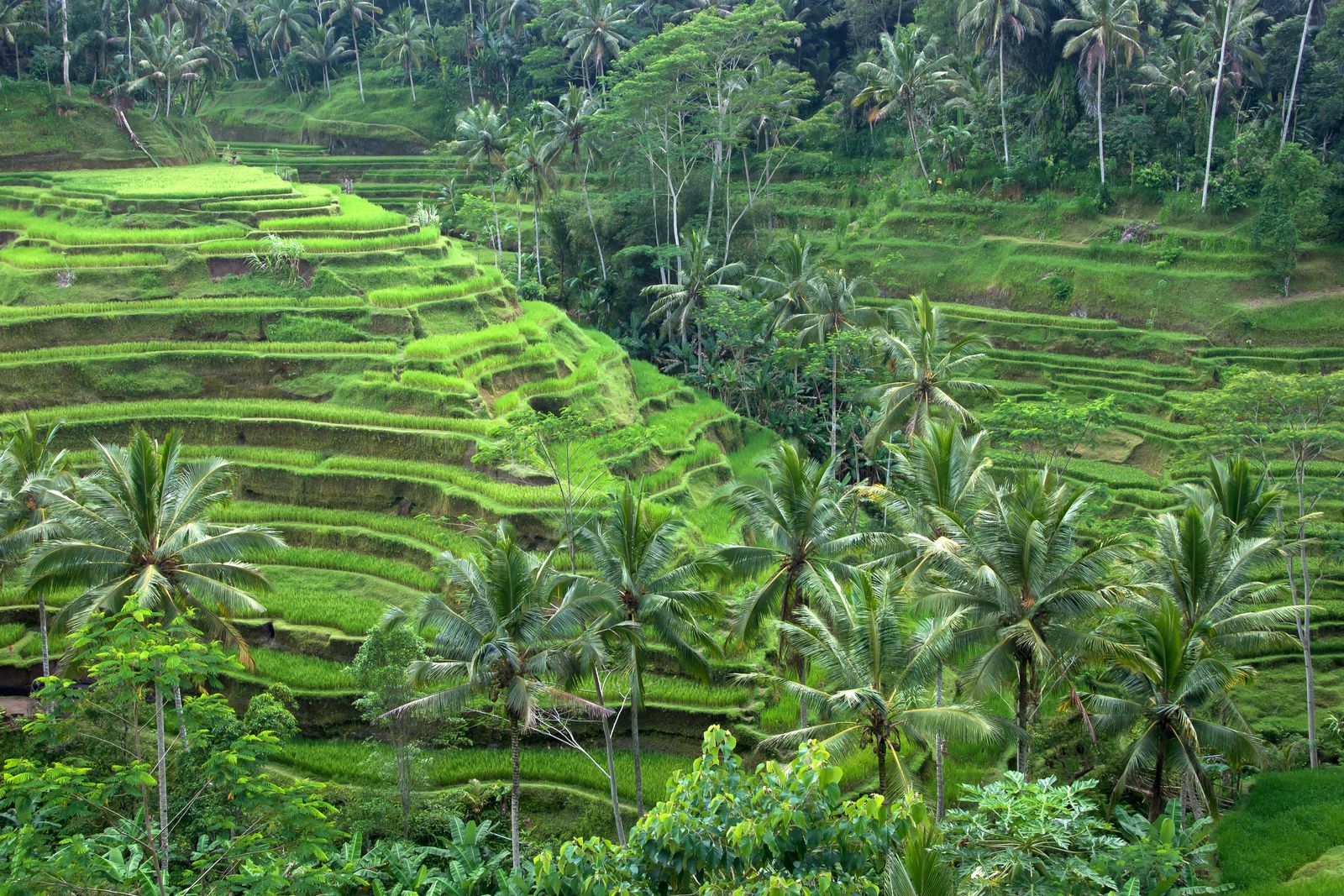 Photo: Vyacheslav Argenberg, CC BY 4.0
Ubud Jungle Guide
Bali's cultural heart is ringed by river gorges and terraced forest. Where to stay in the Ubud jungle, what to do, and how to escape the crowds.
 Photo: Adimelali Bali, CC BY-SA 3.0
Sidemen, Bali: The Quiet Valley Guide
An hour from Ubud and a decade behind it — Sidemen is the rice-terrace valley under Mount Agung where Bali's best bamboo houses hide.
 Photo: Stefan Fussan, CC BY-SA 3.0
Munduk & North Bali Highlands Guide
Bali's cool, waterfall-laced highlands — coffee country, twin lakes and jungle ridges two hours from the beach crowds.
 Photo: Derek Ramsey (Ram-Man), CC BY-SA 4.0
Find your own piece of the canopy.
Treehouses, bamboo houses and rainforest villas across 17 destinations — found, vetted and written up honestly.
Browse all destinations