La Fortuna & Arenal Volcano Guide
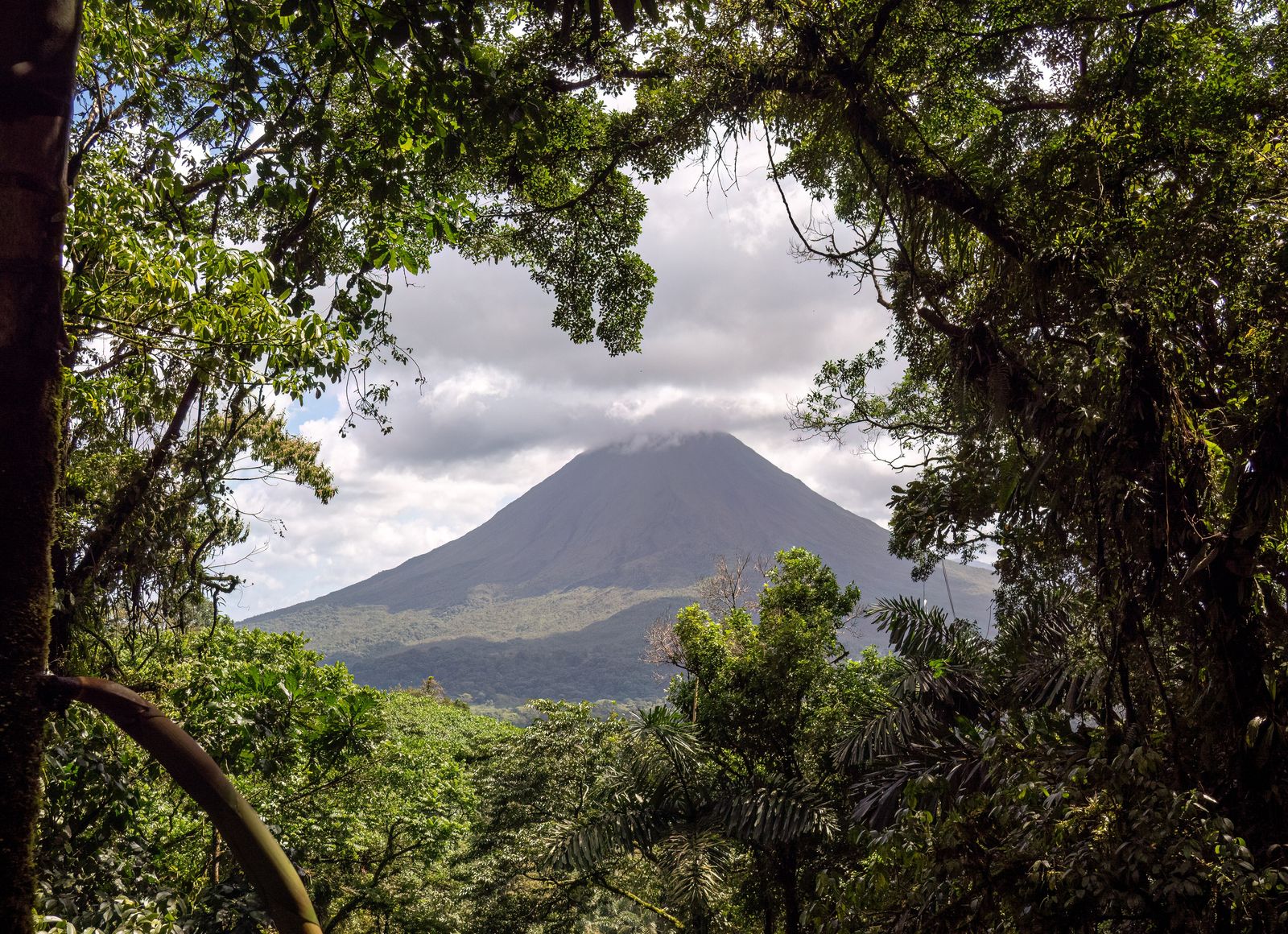
Arenal is the volcano most people picture when they picture Costa Rica: a near-perfect cone rising out of rainforest, often wrapped in a collar of cloud, with a lake at its feet and a town at its base that has spent decades figuring out how to live comfortably next to something that could, in theory, erupt again. La Fortuna is that town, and it has turned itself into the country's most convenient jungle base — close enough to San José for a weekend, easy enough to get around without much planning, and packed with enough waterfalls, hot springs and hanging bridges that a first-time visitor to Costa Rica could spend a week here and never feel like they'd run out of things to do. This is a working guide to getting there, picking a base, and building a few honest days around the volcano.
What La Fortuna is, and why it's the easy jungle base
La Fortuna sits in the northern lowlands of Alajuela province, in the shadow of Arenal Volcano, in a stretch of the country warm enough for shorts year-round and wet enough to stay green through most of it. The town itself is small and unpretentious — a central park, a church, a handful of streets lined with tour agencies, sodas and souvenir shops — but its location is the whole story. Arenal is one of the most recognizable volcanoes in the Americas, a symmetrical cone that looks like a child's drawing of a volcano, and La Fortuna grew up specifically to serve travelers who came to see it.
The town's modern identity is inseparable from the volcano's history, and that history is more recent than most visitors assume. Arenal had been quiet for roughly 450 years, dismissed by geologists as extinct, when it erupted without warning on July 29, 1968. A new crater blew open on the western flank, a pyroclastic flow tore down the slope at well over a hundred kilometers an hour, and the eruption destroyed several nearby villages and killed people who had no reason to expect it. From that date until around 2010, Arenal stayed almost continuously active — glowing at night, throwing the odd shower of rock and ash, occasionally sending lava flows down its flanks — making it one of the most closely watched volcanoes on Earth for four decades. It has been in a resting phase since, with no eruptive activity, but the cone, the lava fields from that stretch, and the town built to watch it all are still very much here.
That's the part worth sitting with for a second: the reason La Fortuna exists as a tourism town at all is a natural disaster that reshaped this corner of the country within living memory. Locals will talk about it plainly if you ask, not as a dark chapter to avoid but as the origin story of the place — the volcano that built the town by nearly destroying it. What's left is a genuinely unusual travel base: warm lowland rainforest, an active volcanic system now dormant enough to hike around, hot springs heated by the same geothermal system, and a lake created by a hydroelectric dam that turned the whole area into one of Costa Rica's most reliably scenic regions.
Getting there
La Fortuna is a genuine draw from both of the country's main international airports, and unlike some of Costa Rica's more remote jungle destinations, it doesn't require a boat, a 4x4, or a full day to reach.
From San José
The standard route from Juan Santamaría International Airport or downtown San José runs north on the Pan-American Highway toward Naranjo, then climbs and drops through Zarcero and Ciudad Quesada (also called San Carlos) before flattening out into the lowlands around La Fortuna. Plan on roughly three hours by car or shuttle in normal conditions, longer if you hit rain or the truck traffic that builds up through Ciudad Quesada. The road is paved the whole way and considerably easier than the mountain routes into Monteverde, which is part of why La Fortuna gets recommended so often to first-time visitors.
From Liberia and the Guanacaste coast
Flying into Liberia's Daniel Oduber Quirós International Airport, or coming from the Guanacaste beach towns, the drive runs south and east along the shore of Lake Arenal through Tilarán and Nuevo Arenal — a scenic route with the volcano visible across the water for long stretches, though the road narrows and winds in sections. Figure on two and a half to three hours depending on where along the coast you start, which makes La Fortuna a realistic second stop on a Guanacaste beach trip rather than a destination that requires backtracking through the capital.
By bus and shuttle
Direct public buses run between San José and La Fortuna a couple of times a day, taking around four to four and a half hours and costing a fraction of a private transfer — the cheapest option by far, though the least flexible on timing. Private and shared shuttle vans, bookable through almost any hotel or tour desk, are the middle ground most visitors land on: door-to-door pickup, no navigating unfamiliar roads, and a price that's usually worth it once you weigh it against a rental car and gas.
Good to know
If you're combining La Fortuna with Monteverde, the jeep–boat–jeep transfer across Lake Arenal is the move — a van to the lakeshore, a short boat crossing, and a van on the other side, connecting the two towns in a few hours instead of the long loop back through San José. Our Monteverde Cloud Forest guide covers that side of the pairing.
La Fortuna town and where to stay
The town of La Fortuna is compact and genuinely walkable, built around a small central park with a distinctive blue-domed church that has become the default backdrop for a volcano-view postcard shot, since the cone is often visible rising directly behind it on a clear day. Restaurants, tour operators, pharmacies, ATMs and a busy little grocery scene are all within a few blocks of the park, which makes staying in town the easiest option for anyone without a rental car — most tours will pick you up from a downtown hotel with no extra arrangement needed.
Outside the town center, the road running toward the national park and the lake is lined with the region's larger hotels and lodges, many of them built specifically to face the volcano — properties here trade in volcano-view rooms, private hot spring pools and proximity to the park entrance, at the cost of needing a car or a hotel shuttle to reach dinner in town. Further along, past the park entrance and toward the lake itself, sits a scattering of quieter lodges and cabins with a genuinely different feel: more forest, less foot traffic, and in some cases a private trail network of their own.
Because La Fortuna draws such a wide range of travelers — honeymooners chasing a hot spring soak, families doing the waterfall and the bridges in the same day, backpackers stringing together a Costa Rica loop — the range of stays runs from simple in-town guesthouses to full resort-style lodges with volcano-facing infinity pools. For a shortlist of vetted jungle stays in the area, see our Costa Rica destination page, or the wider directory if La Fortuna is still competing with other volcanic or lowland destinations on your list.
Arenal Volcano National Park
Arenal Volcano National Park protects the cone itself along with the lava fields left behind by its four decades of activity, and it's the reason most visitors come to this part of the country in the first place. The park opens early in the morning, and most guided hikes on its main trails run two and a half to three hours, weaving between old lava flows and dense secondary rainforest that has reclaimed the ground around them.
The main trails
The most walked route is Las Coladas, a shorter loop of about two kilometers out to the edge of a 1992 lava flow, its black rock now half-swallowed by ferns and pioneer trees — a good option if your time or stamina is limited. The Colada 1968 trail, a longer and moderately more demanding hike, leads out across lava fields left by the eruption that started it all, with some of the clearest open views of the cone anywhere in the park on a clear day. A third route, Bosque 1968, threads through meadows and forest before reaching its own stretch of lava field and volcano viewpoints, and tends to see fewer visitors than the other two.
None of the park's official trails climb the volcano itself — Arenal's slopes are too loose and too steep, and the summit crater is off-limits for safety reasons regardless of the volcano's current resting phase. What you're hiking through instead is the aftermath: fields of solidified lava from specific, dated eruptions, with the cone itself as a constant backdrop rather than a destination you reach on foot.
You don't climb Arenal. You walk its old lava flows instead, which is honestly the better version of the experience — you get four decades of eruption history laid out under your feet, with the cone smoking gently overhead the whole time.
A short drive from the main park entrance, the privately run Arenal Observatory Lodge maintains its own trail network on land that was, for a period, an actual volcano-monitoring station — a detail that shows up in the lodge's name and in a few of its viewpoints, which sit closer to the cone than almost anywhere else visitors are allowed. Several tour operators also run guided night walks and separate hikes up nearby Cerro Chato, a dormant volcano next to Arenal with a crater lake at its summit; access and trail conditions here change more often than at the main park, so check current status with a local operator before you build a day around it.
The hot springs
La Fortuna's hot springs exist because of the same geothermal system that powers the volcano, and the area has built an entire tier of its economy around them. Three major hot spring resorts anchor the scene: Tabacón, built directly along a natural hot river with landscaped pools set into the rainforest; Baldi Hot Springs, the largest and most party-oriented of the three, with dozens of pools at different temperatures and a lively bar scene; and Ecotermales, smaller, quieter and limited to a set number of visitors per session, which keeps it from ever feeling crowded. Several hotels in the area also maintain their own smaller hot spring pools for guests, and there are free natural soaking spots along public stretches of the same rivers for travelers who'd rather skip the entrance fee.
Good to know
The resort hot springs are geothermally heated but not identical in mineral content or temperature range — Tabacón and Ecotermales both draw on naturally hot river water, while some of the larger resort complexes blend and regulate pool temperatures more heavily. If you only have time for one, ask your hotel which best matches what you want: a quiet soak, a social scene, or something in between.
Whichever pool you land in, the pairing is the point: a warm soak after a sweaty hike through the national park or a day on the hanging bridges is one of the more genuinely satisfying travel rhythms in the country, and it's a big part of why La Fortuna has such repeat appeal even among travelers who've already done Costa Rica's more famous rainforest circuits, from Manuel Antonio to the Osa Peninsula.
La Fortuna Waterfall
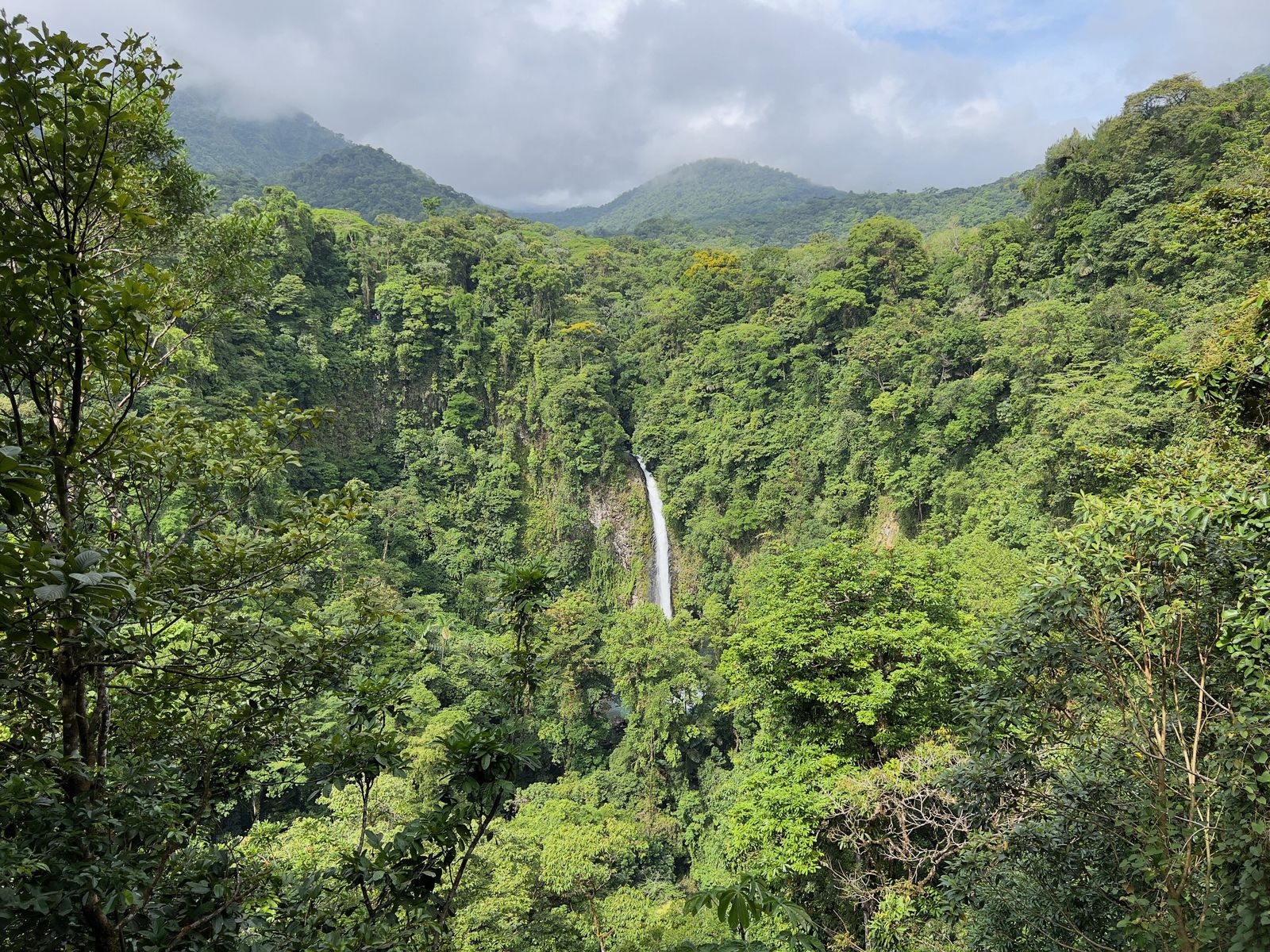
La Fortuna Waterfall drops roughly seventy meters down a sheer, forested cliff face into a deep pool ringed by huge volcanic boulders, and it's one of the most photographed single spots in the country for good reason — the setting is dramatic even by Costa Rican standards, with mist rising off the pool and thick rainforest climbing the canyon walls on both sides. Getting down to the water means descending a steep staircase of around five hundred steps cut into the hillside, which is manageable for most fitness levels but genuinely tiring on the way back up, especially in the area's midday heat.
The pool at the base is open for swimming, and on a hot lowland afternoon a swim here is one of the better ways to cool off in the whole region — though the current near the falls themselves can run strong, and posted safety guidance about how close to swim is worth taking seriously rather than treating as a suggestion. A separate, longer trail from the same entrance climbs up toward a mirador with wider views back across the falls and the forested canyon, a worthwhile add-on if your legs have anything left after the five hundred steps.
Hanging bridges and canopy tours
Mistico Park runs the best-known hanging bridge network in the La Fortuna area, a private reserve where a roughly three-kilometer trail crosses six suspension bridges and ten fixed ones through mature rainforest, with the volcano visible from several points along the walk. A guided visit runs about two and a half hours at an easy pace, and a naturalist guide makes a real difference here — sloths, toucans, poison dart frogs and a long list of smaller, easy-to-miss wildlife are far more findable with someone who knows where to look than they are on a self-guided walk.
The appeal of the bridges is the same logic that applies in every cloud or rainforest destination that has them: they put you at canopy height instead of looking up at it from the trail below, which changes what's actually visible. Epiphyte-loaded branches, birds working the mid-canopy, and the general architecture of a mature rainforest are all far easier to take in from a bridge deck swaying gently over a ravine than from the forest floor.
Beyond the fixed bridges, La Fortuna is one of the country's most established zip-line towns, with several operators running canopy tours through the forest around the park and along the lower slopes of the volcano. Combination packages that bundle a bridge walk, a zip-line circuit and sometimes a hot spring stop into a single day are common and, for travelers short on time, a genuinely efficient way to cover the region's highlights without stringing together separate bookings.
Day trips beyond town
La Fortuna's location makes it a strong base for a handful of day trips that would be a stretch from almost anywhere else in the country. Rio Celeste, inside Tenorio Volcano National Park, is the best known: a hike through rainforest to a waterfall and a river running an almost unreal turquoise-blue, a color caused by a mineral reaction where two clear rivers meet at a spot locals call Los Teñideros, "the dyers." It's a full-day trip from La Fortuna, typically five to six hours round trip on the road plus the hike itself, so it's worth committing a whole day rather than trying to bolt it onto something else.
The Venado Caves are a closer, shorter outing — a wet, hands-on cave system with stalactites, stalagmites and a resident bat colony, explored by wading and scrambling through with a guide and a headlamp rather than walking a paved path. It's not a trip for anyone claustrophobic or unwilling to get properly wet, but it's a genuinely different kind of adventure from the rest of the region's above-ground itinerary.
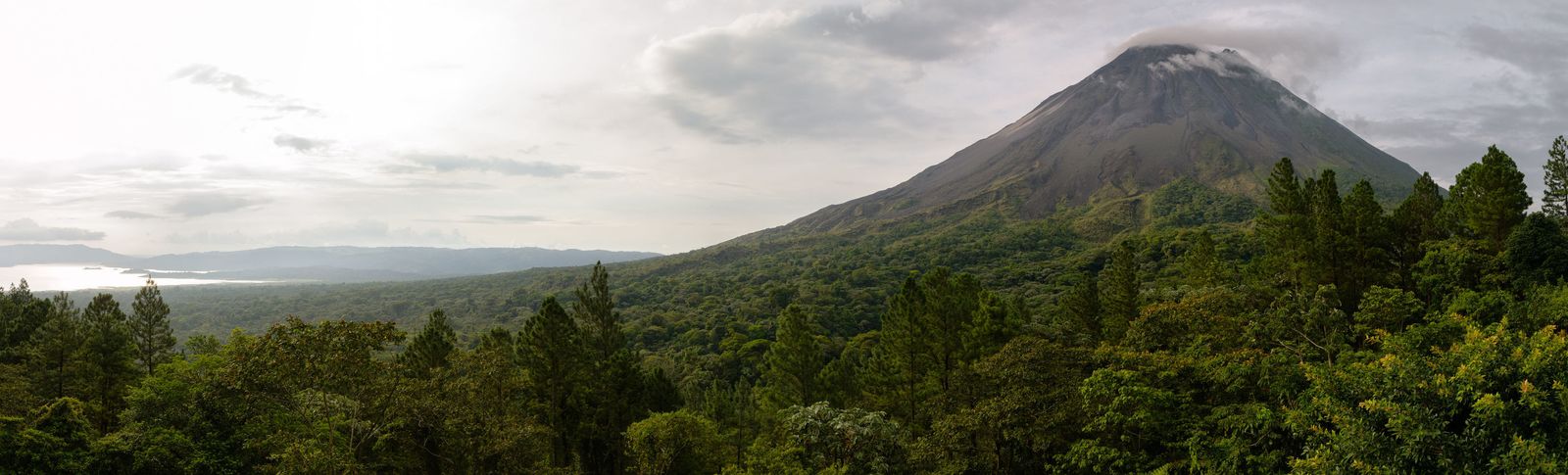
Lake Arenal itself is worth a half-day even without a specific activity attached. The lake is artificial, created by a hydroelectric dam completed in the late 1970s that flooded a valley and, in the process, gave the region both a major source of renewable power and one of Central America's most scenic reservoirs, with the volcano's cone visible across the water from dozens of points along the shore road. The western end of the lake, near Tilarán and Nuevo Arenal, has a real reputation among windsurfers and kitesurfers, who come for reliable, strong winds that pick up especially in the dry season.
For travelers with more time, La Fortuna also works as a launch point toward destinations further afield — south toward the Pacific rainforest of Manuel Antonio, or west across Lake Arenal toward the cool cloud forest of Monteverde, a genuinely different climate and ecosystem only a few hours away.
Food and practicalities
La Fortuna's restaurant scene is bigger and more varied than most Costa Rican towns its size, a direct result of decades of steady tourism. Sodas — the local term for a family-run diner — serve rice, beans, plantains and the daily casado plate at prices well below the tourist-facing restaurants clustered around the central park, several of which lean toward wood-fired pizza, steakhouse fare and the occasional fusion menu aimed squarely at visitors staying at the volcano-view hotels. Given the lowland setting, expect genuine heat and humidity most of the year — pack light, breathable clothing rather than the layers you'd bring to Monteverde's cooler highlands, and drink more water than feels necessary.
Costs sit in the middle of Costa Rica's already mid-to-upper price range for Central America. National park entry runs in the range of ordinary Costa Rican park fees per person; the hot spring resorts vary widely, with the larger complexes charging considerably more than a hotel's private pool or a free public soak. Combination tours bundling a hike, a bridge walk and a hot spring visit typically cost more than any single activity but less than booking each separately, and are worth it for travelers on a tight schedule. Hotel rates in town run noticeably lower than the volcano-view resorts strung along the road toward the park, and self-catering is limited outside of a well-stocked supermarket or two, so most visitors eat out for the bulk of their stay.
Cell signal and WiFi are reliable in town and at most established hotels, but coverage thins out on national park trails and along stretches of the road around the lake — a reasonable practice to carry from here to any remote jungle base, whether that's the Peruvian Amazon or the highlands of Colombia.
When to go
Costa Rica runs on a broad two-season calendar — dry season roughly mid-November through mid-April, green or rainy season the rest of the year — and La Fortuna, sitting in the warm northern lowlands, follows that pattern more predictably than higher-elevation destinations like Monteverde.
- Mid-November–mid-April (dry season): the most reliable weather for clear volcano views and dry trails, and correspondingly the busiest and most expensive stretch of the year, particularly around the December and Easter holiday weeks.
- December–April (windsurfing season): the strongest, most consistent winds on Lake Arenal's western end, drawing a dedicated windsurfing and kitesurfing crowd to Tilarán and Nuevo Arenal independent of the rest of La Fortuna's tourist calendar.
- May–November (green season): heavier and more frequent rain, thinner crowds, lower hotel rates, and a forest and set of waterfalls that, if anything, look more dramatic with more water running through them. Volcano views get less reliable as cloud cover thickens, especially in the afternoons.
- September–October: the wettest months regionally, with the fewest visitors and the deepest discounts, but also the highest odds of a rained-out afternoon plan — build flexibility into any itinerary timed for these months.
There's no genuinely bad month to visit La Fortuna — the hot springs work in any weather, and a rainy afternoon is as good an excuse as any to sit in one — but travelers chasing a clear, unobstructed view of the cone should lean toward the dry season, since Arenal has a real habit of wrapping itself in cloud for days at a time regardless of the official forecast.
The honest caveats
La Fortuna earns its reputation as Costa Rica's easiest jungle base, but it's worth going in with a few things clear. The volcano is the biggest one: Arenal has been dormant since around 2010, and there is no indication of imminent activity, but it remains an active volcanic system rather than an extinct one, and the summit and immediate crater area are permanently off-limits to hikers for exactly that reason. Don't expect, or ask a guide to arrange, a summit attempt — it isn't offered, and for good reason.
Crowds are the second honest caveat. La Fortuna is one of the most visited towns in the country, and the marquee attractions — the waterfall, the main hanging bridge parks, the biggest hot spring resorts — can feel closer to a theme park than a wilderness experience during the middle of a busy dry-season day. Arriving early, choosing a smaller operator like Ecotermales over the largest resort, or shifting your visit toward the shoulder or green season are all real ways around this, and most local guides will steer you the same way if you ask.
Views of the cone itself are genuinely inconsistent. Arenal generates its own weather to some degree, and it isn't unusual to spend two or three days in town without ever seeing the summit clear of cloud, particularly outside the dry season. That's simply the nature of a rainforest volcano and not a sign you're doing the trip wrong — build in more than one day if a clear volcano photo matters to you, and treat any clear view as a bit of luck rather than a guarantee.
Common questions
How many days should I spend in La Fortuna?
Three full days is a realistic minimum: one for the national park and its lava trails, one for the waterfall and the hanging bridges, and one for a hot springs soak paired with either a day trip or genuine downtime. Four or five days gives you room to add Rio Celeste or the Venado Caves without rushing anything else.
Can I hike to the top of Arenal Volcano?
No. The summit and crater are permanently closed to hikers regardless of the volcano's current resting phase — the national park's trails take you across old lava fields and through rainforest at the base of the cone, not up it.
Is Arenal Volcano still active?
Arenal erupted almost continuously from 1968 until around 2010 and has been in a resting phase since, with no eruptive activity in recent years. It's still classified as an active volcanic system rather than an extinct one, which is part of why summit access remains closed.
Which hot springs should I choose?
It depends on what you want. Baldi Hot Springs is the largest and liveliest, with dozens of pools and a bar scene. Tabacón sits along a natural hot river with a more landscaped, rainforest setting. Ecotermales is smaller, quieter and caps its visitor numbers, which suits travelers who want a soak rather than a scene.
Do I need a rental car in La Fortuna?
Not necessarily. The town itself is walkable, and most hotels and tour operators offer or arrange pickup for the national park, waterfall, hot springs and hanging bridges. A car adds flexibility for day trips like Rio Celeste, but shuttles and organized tours cover the core attractions easily.
How does La Fortuna compare to Monteverde?
They're different climates built around different draws, and pairing them is common if time allows. La Fortuna is warm lowland rainforest built around an active volcano, hot springs and waterfalls; Monteverde, a few hours away by the Lake Arenal jeep-boat-jeep transfer, trades that for cool, misty highland cloud forest and canopy walks. Our Monteverde Cloud Forest guide covers that side of the pairing in full.
Where to go from here
La Fortuna rewards travelers who treat the volcano as the backdrop to a full few days rather than a single photo stop — a hike through old lava fields, a swim below a seventy-meter waterfall, and an evening soak all fit comfortably into one trip here. Start with our Costa Rica destination page for a shortlist of vetted stays across the country, or the full directory if you're still weighing La Fortuna against another jungle or volcanic destination. If you're building a longer Costa Rica loop, our guides to Monteverde Cloud Forest and the Osa Peninsula and Corcovado National Park cover the highland and lowland-rainforest sides of the same country, and our roundup of the best jungle Airbnbs in the world is a good next stop if you're still comparing destinations before booking anything.
- Wikipedia — Arenal Volcano — the July 29, 1968 eruption, the destruction of nearby villages, and the 1968–2010 period of near-continuous activity.
- My Tan Feet — Arenal 1968: Hike, Lava Fields and View Points — the Las Coladas, Colada 1968 and Bosque 1968 trails, distances and timing.
- James Kaiser — Guide to Arenal Volcano National Park — park hours, trail conditions, and current volcano access rules.
- Arenal.net — La Fortuna Waterfall — waterfall height, the roughly 500-step descent, and swimming conditions.
- Mistico Park — Tours and Attractions — the hanging bridge network, trail length and bridge count.
- Viator — Rio Celeste Full-Day Hiking Tour — Tenorio Volcano National Park, Rio Celeste and the Los Teñideros river confluence.
- Under30Experiences — Travel Guide to La Fortuna and Arenal — town layout, hot spring resorts and general trip planning.
- One More Step Travels — Things to Do in La Fortuna — activity overview including Venado Caves and Lake Arenal.
More from the Journal.
 Photo: Vyacheslav Argenberg, CC BY 4.0
Ubud Jungle Guide
Bali's cultural heart is ringed by river gorges and terraced forest. Where to stay in the Ubud jungle, what to do, and how to escape the crowds.
 Photo: Adimelali Bali, CC BY-SA 3.0
Sidemen, Bali: The Quiet Valley Guide
An hour from Ubud and a decade behind it — Sidemen is the rice-terrace valley under Mount Agung where Bali's best bamboo houses hide.
 Photo: Stefan Fussan, CC BY-SA 3.0
Munduk & North Bali Highlands Guide
Bali's cool, waterfall-laced highlands — coffee country, twin lakes and jungle ridges two hours from the beach crowds.
 Photo: Derek Ramsey (Ram-Man), CC BY-SA 4.0
Find your own piece of the canopy.
Treehouses, bamboo houses and rainforest villas across 17 destinations — found, vetted and written up honestly.
Browse all destinations