Treehouses Explained: History & Modern Design
Everyone thinks they know what a treehouse is because everyone built one, or wanted one, before they were ten. The version you can actually book as an adult is a different animal: a real structure, engineered to move with a living tree instead of fighting it, wired for solar power, and — if it's any good — built by someone who has thought hard about what happens when that tree sways eight inches in a storm with a mortgage-sized guest inside it. This guide covers where treehouses actually came from, how the good ones are built and held up, what it's honestly like to sleep forty feet up, and which real ones are worth knowing about.
What actually counts as a treehouse
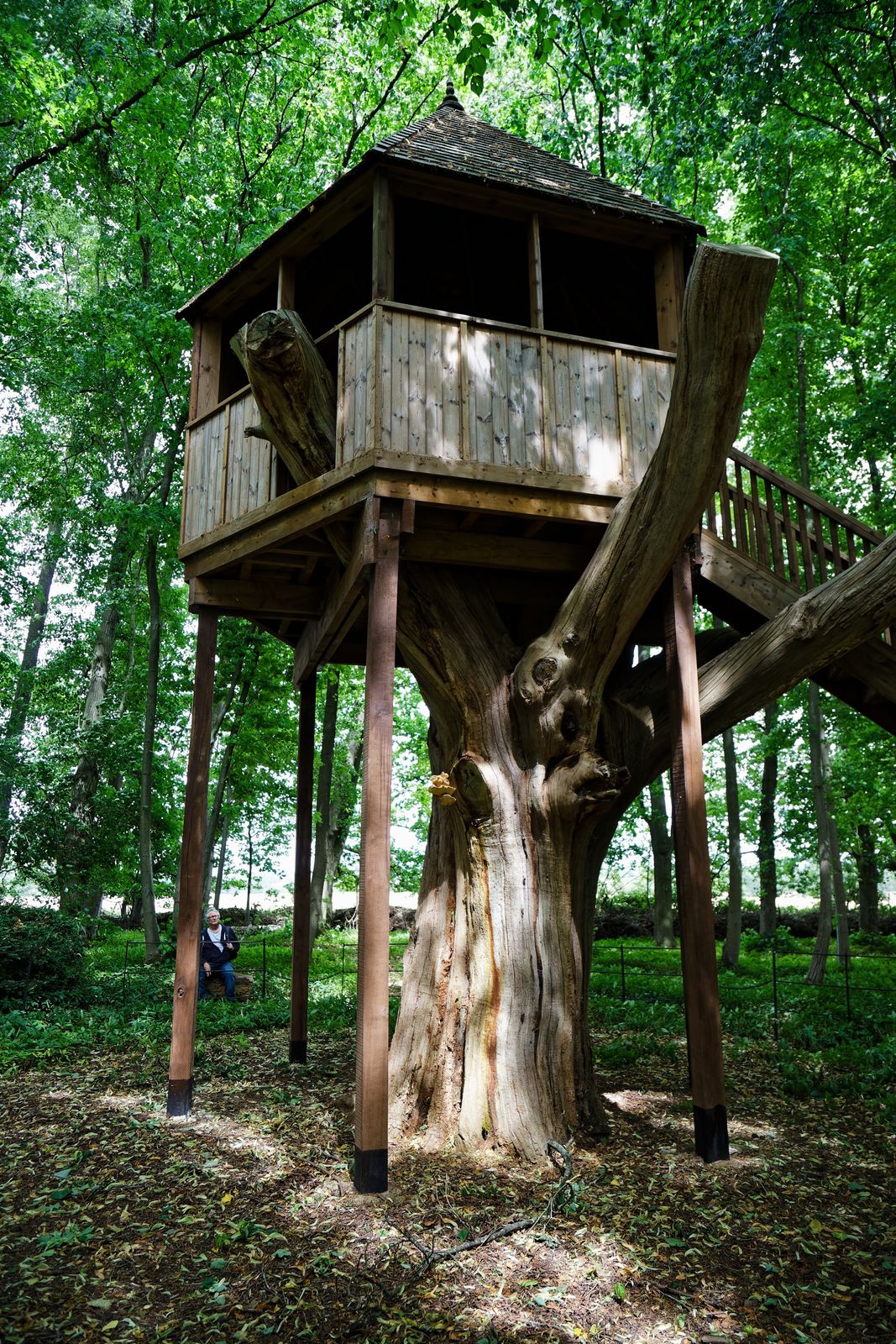
Start with the definition, because the word gets stretched further than it should. A treehouse is a structure whose weight is carried, at least in significant part, by one or more living trees — through bolts, brackets or a platform resting in the crotch of the trunk. That's it. It doesn't have to be small, and it doesn't have to look rustic. It does have to actually depend on the tree for support, which rules out a surprising number of buildings marketed as treehouses.
What gets ruled out: a stilt house built among trees but standing on its own posts, a cabin on tall pilings with a tree trunk passing decoratively through the deck, or an elevated bungalow whose structure would stand fine if every tree around it vanished overnight. Those are good buildings and some of them are genuinely beautiful — a lot of the best jungle stays anywhere are stilt houses, not treehouses, and there's no shame in that distinction. It's just a different engineering problem. A stilt house fights gravity with a fixed foundation. A treehouse fights gravity by partnering with something that's alive, growing, and moving in the wind whether you like it or not.
That live-load relationship is what makes treehouse building its own specialty rather than a branch of ordinary carpentry. Anyone who frames houses for a living can nail two boards together. Far fewer people know how much a hundred-year-old Ceiba or oak can flex before something in the connection between tree and structure needs to give, or which species can take a bolt through their heartwood without inviting rot in behind it. That knowledge is recent, mostly built up over the last thirty-five years by a small community of specialist builders, and it's the reason a well-built modern treehouse bears almost no resemblance to the plywood platform most of us grew up with.
Where the idea comes from
People have been building in trees for a very long time, for reasons that had nothing to do with vacation. Hunting platforms lashed into trees to get above a animal's sightline are ancient and appear independently across cultures on several continents. Military observation posts used the same logic: get high, see farther, stay hidden in the foliage. Plantation-era hunting parties in colonial India and parts of Africa built semi-permanent tree platforms for exactly the same reason people build deer stands today. None of that was recreational. It was a practical answer to the question of how to get a good vantage point without building a tower.
The recreational treehouse — the one built purely because being up in a tree is a good feeling — has its own separate lineage, and it runs through children's forts and through fiction. Swiss Family Robinson, first published in 1812, gave generations of readers a shipwrecked family living comfortably in an enormous tree, and the image stuck hard enough that Disneyland built a walk-through version of it in 1962 that's still standing today, just recast a few times to match whichever franchise owns the branding that decade. Wealthy estate owners in eighteenth- and nineteenth-century Britain occasionally built genuine architectural treehouses as garden follies — small, decorative, built to be seen from the lawn rather than lived in.
The version that matters for a guide like this one is much newer. The modern treehouse-as-real-building movement traces most directly to two threads that happened to converge in the 1990s and 2000s. One is engineering: builders in Oregon, working with actual structural engineers, solved the problem of how to bolt real load-bearing weight into a living tree without killing it or getting thrown off in the first storm — more on that in the next section, because it's the whole ballgame. The other is Pete Nelson, an American builder who turned a childhood fascination with tree forts into a career, wrote a run of books under titles like New Treehouses of the World, opened Treehouse Point near Seattle in 2006, and later hosted the Animal Planet series Treehouse Masters, which put professionally engineered treehouses in front of a mainstream television audience for the first time. Between the engineering breakthroughs and the television exposure, "treehouse" stopped meaning a kid's fort and started meaning a legitimate category of small-scale architecture — one hospitality operators in genuinely tropical places were quick to adopt, because a jungle canopy is about the most dramatic setting a treehouse can have.
Good to know
A lot of what gets called a treehouse in jungle hospitality marketing is actually a stilt house with a tree nearby, or an elevated bungalow with a trunk passing through the deck for effect. That isn't a scam — those buildings can be wonderful, and in flood-prone or termite-heavy jungle terrain a stilt foundation is often the smarter, more durable choice than a real tree mount. It's just worth knowing which one you've booked before you show up expecting to feel a tree move under you at 3am.
How a treehouse stays up
The core engineering problem is straightforward to state and hard to solve well: a tree grows, sways, and flexes constantly, and a rigid structure bolted straight into it will eventually either crush the tree's cambium layer where the bolt passes through, or crack under stress the tree transmits into it during wind. Nail a normal house frame to a trunk the way you'd frame a wall to a foundation, and you get one of two failures — slow damage to the tree, or a structure that eventually splits at every joint.
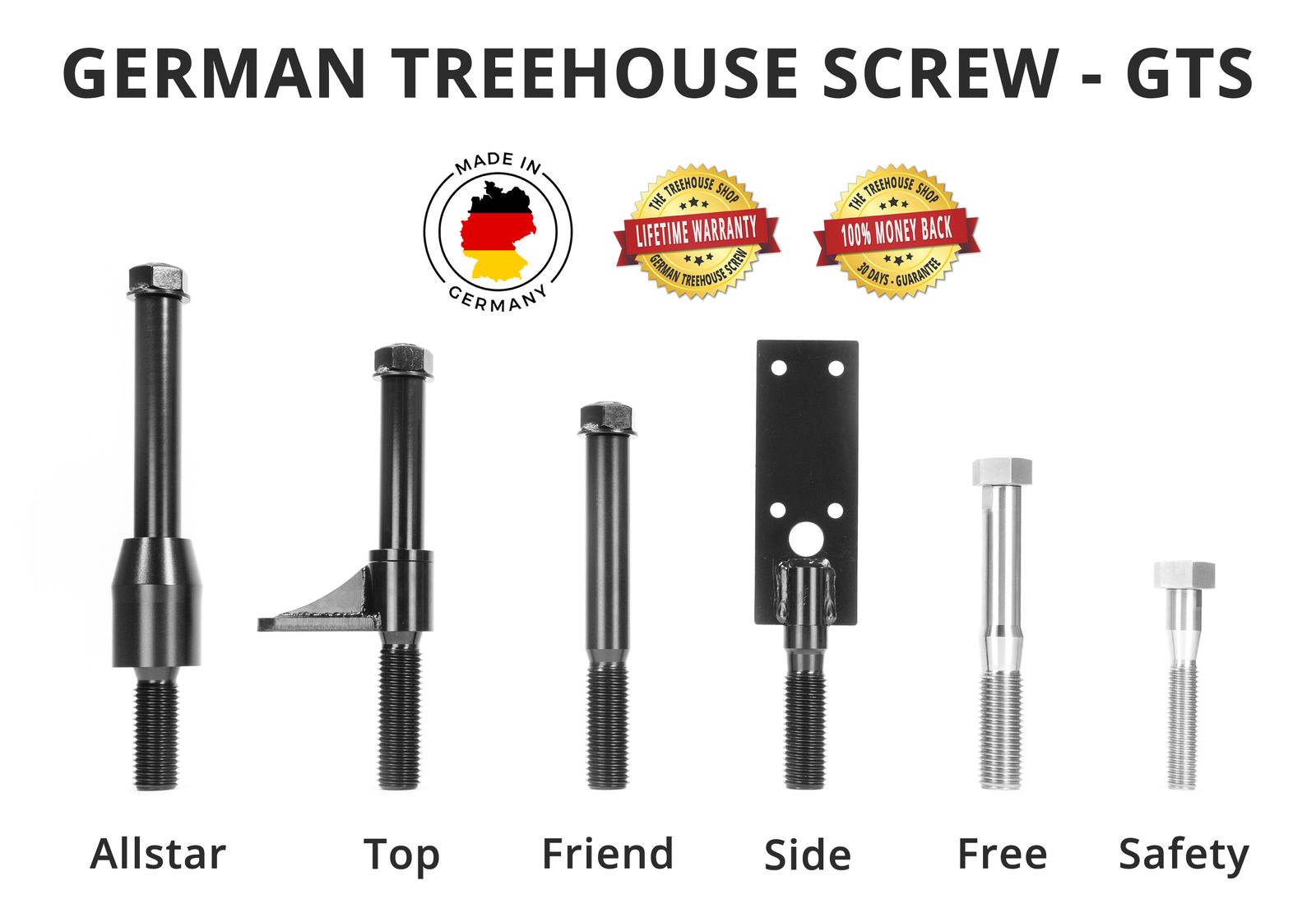
The fix that made modern treehouse building possible is a piece of hardware most guests never notice: the treehouse attachment bolt, usually still called a Garnier Limb after Michael Garnier, the Oregon builder who developed it in the early 1990s with engineer Charley Greenwood and machinist Michael Birmingham. It's a heavy steel bolt with a wide collar that spreads the load over more of the tree's surface, threaded deep into the trunk, with a long perch extending outward that the treehouse frame actually rests on. Properly installed in a healthy hardwood, a single one of these bolts can carry something in the range of 8,000 to 10,000 pounds. The tree keeps growing around the collar rather than being girdled by it, and because the perch — not a rigid weld — is what the frame sits on, paired with sliding brackets at other connection points, the whole structure can shift with the tree instead of against it. Builders size the gap at every one of those sliding joints deliberately, so a tree can sway in a storm without transmitting a snap of force into the platform above.
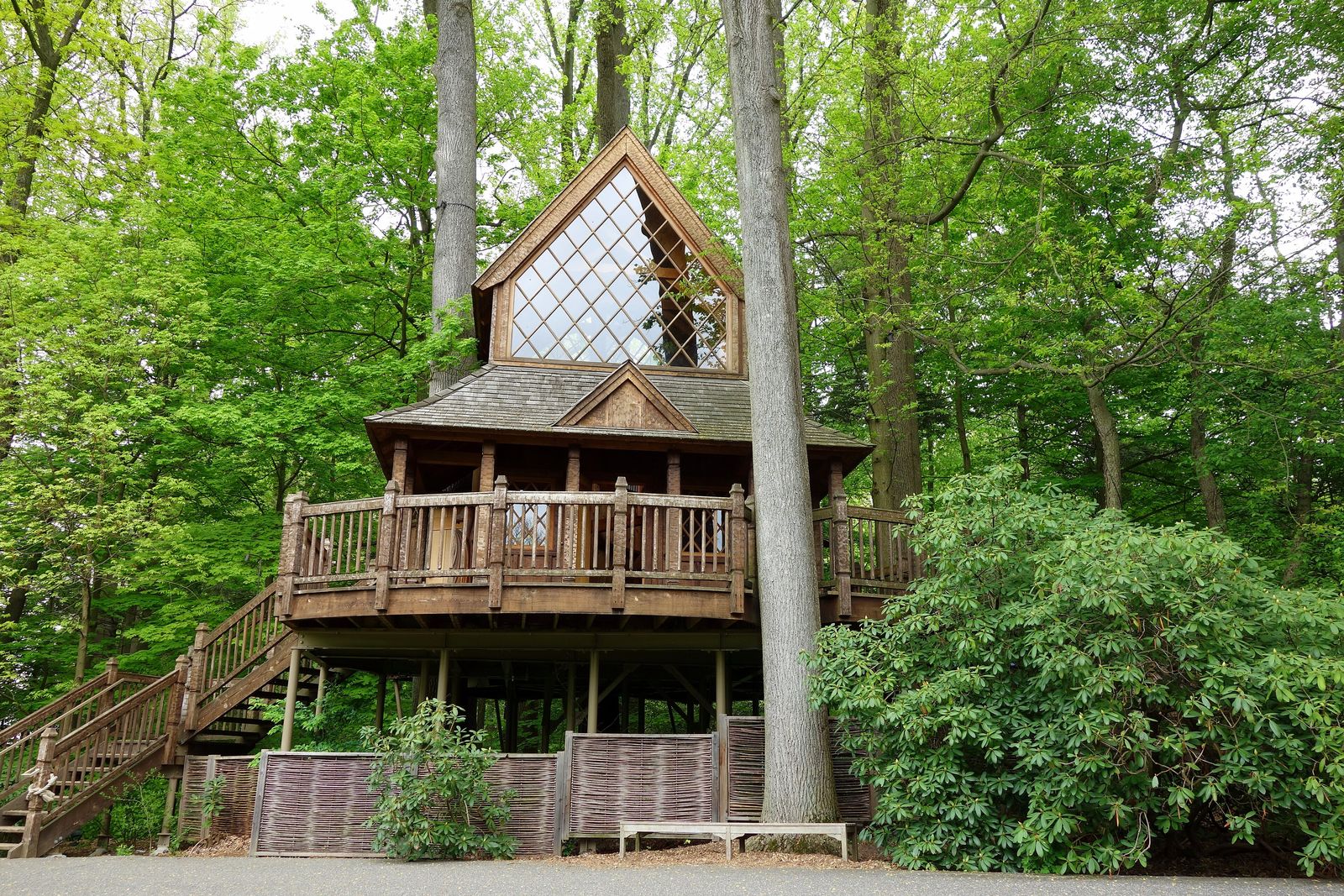
From there, the actual platform gets built one of a few ways. A single sturdy tree can sometimes carry a small structure on its own, especially if part of the load is shared with a ground-set post disguised as a support beam — a hybrid a lot of "pure" treehouses quietly use once the structure gets larger than a single room. Bigger builds usually span two, three or four trees, tying a platform across all of them so the load and the movement are distributed rather than concentrated on one trunk. And when the design gets ambitious enough — Northumberland's Alnwick Garden treehouse, opened in 2005, is the standard example — the trees stop being structural at all and become scenery: Alnwick's building is actually held up by a hidden network of timber posts and two concealed concrete towers, because no tree on the property could safely carry a structure that size. Species matters too. Builders favor hardwoods with deep, stable root systems and dense wood that resists rot around a bolt hole — oaks and beeches are classic choices in temperate climates — and every serious build starts with a certified arborist assessing the specific tree's health, not just its size, before anyone drills a hole in it.
Building in the jungle specifically
Temperate-forest engineering doesn't transfer to the tropics without changes, because a jungle throws a different set of problems at a structure. Humidity near 100% for months at a time accelerates wood rot at exactly the connection points — bolt holes, joints, anything with exposed end-grain — that a treehouse depends on most. Termites are a serious, constant threat in a way they simply aren't in a Pacific Northwest fir forest. And a lot of tropical hardwoods that look imposing are actually poor structural choices, because their root systems are shallow and spread wide to cope with thin rainforest topsoil rather than anchoring deep the way a temperate oak does — a tree that looks unshakeable can come down in a single storm if its roots never had to grow deep.
That's a large part of why so much of what gets marketed as a "jungle treehouse" is really a stilt structure standing on its own concrete or hardwood posts near mature trees, sometimes with a trunk built through the deck for the view and the photograph, without actually depending on it for support. It isn't a lesser building for that — in flood-prone river terrain, which describes a lot of the best jungle stays in Costa Rica, the Amazon basin and Southeast Asia, a fixed post foundation set above the highest recorded water line is frequently the more honest, more durable answer than a genuine tree mount, and a good builder will tell you plainly which one you're getting rather than let the marketing photos do the talking.
Off-grid systems are the other place jungle building diverges hard from anywhere else. Running conventional plumbing and heavy electrical service up into a canopy structure is expensive and maintenance-heavy, so most jungle treehouses and canopy stays lean on solar panels sized for a genuinely light load — LED lighting, a fan, device charging, sometimes a small water pump — rather than air conditioning, which the loads usually can't support and the open-air design usually doesn't call for anyway. Water tends to come from a rainwater catchment system feeding an elevated tank, gravity-fed back down to a shower or sink, sometimes supplemented by a line run up from a ground well. Composting or low-flush toilets are standard, because pumping wastewater down from height reliably is its own engineering headache. None of this is a downgrade so much as a different design brief: build light, build for airflow instead of sealed climate control, and plan for a canopy that's alive with moisture, insects and wind in a way a temperate forest mostly isn't. For the fuller version of how that off-grid logic works across jungle stays generally, not just treehouses, see how off-grid jungle homes handle solar and rainwater.
A jungle treehouse doesn't get air conditioning because the load can't support it and the design doesn't want it. Open sides and a steady canopy breeze are doing the job a compressor would do anywhere else.
What it's actually like to sleep in one
The appeal is real and it's simple: you are up where the canopy lives, at the height where birds actually fly past instead of below you, with a view no ground-floor room can match and a sense of being a guest in the forest rather than a visitor looking at it through glass. Waking up level with a bird's flight path, or watching a storm move across a valley from a platform that's swaying gently with the trees around it, is a genuinely different experience from any hotel room, and it's the reason people keep booking these instead of the equivalent villa on the ground.
The honest trade-offs are worth stating plainly rather than glossing over. Access usually means stairs, a ladder, or a suspension bridge, sometimes a long one, which matters if you have mobility limitations, are traveling with small children, or just don't love the idea of a nighttime bathroom trip forty steps up in the dark. Open or minimally glazed walls — common in genuinely tropical builds, both for airflow and because full glazing is expensive to run up a tree — mean insects, humidity and jungle noise are part of the package, not a flaw in it; a person who wants a sealed, climate-controlled room shouldn't book a treehouse and then complain about a moth. Privacy varies a lot by design: some platforms are screened by dense foliage and feel completely private, while others, especially in the dry season when leaf cover thins, can feel more exposed than the photos suggested. And weather is a real consideration — a well-engineered treehouse is built to move safely with wind, but "safely" still means noticeable sway in a real storm, which some guests find thrilling and others find they'd rather have skipped. None of this is a reason to avoid treehouses. It's a reason to book with your eyes open about what an elevated, partly open-air structure actually delivers, which is different from — not worse than — a conventional room.
The treehouses that changed the field
A handful of real, verifiable projects did more than any others to turn treehouse building into a legitimate discipline rather than a novelty.
Treehouse Point, near Fall City, Washington, outside Seattle, is Pete Nelson's own bed-and-breakfast, opened in 2006 and grown since to seven treehouses plus additional ground-level rooms. It's less a single dramatic building than a proof of concept: a working, bookable, code-compliant hospitality business built entirely around structures anchored in living trees, run by the person most responsible for popularizing the modern approach to building in them. One of its houses is even framed as a small woodland riff on the Parthenon, which tells you something about how far the discipline has come from a plywood platform and a rope ladder.
The Alnwick Garden Treehouse, in Northumberland, England, opened to the public in 2005 as part of the restored Alnwick Gardens and is one of the largest treehouse structures in the world — big enough that, as covered above, its actual weight is carried by hidden timber framing and two concealed concrete towers rather than by the surrounding trees. It's worth knowing precisely because it shows the honest limit of tree-supported construction: past a certain scale, no living tree can safely carry the load, and a good design says so rather than pretending otherwise.
Treehotel, in Harads, in northern Sweden, took a different approach entirely: rather than one signature building, it commissioned a roster of different architects to design a series of distinct rooms suspended in the same stretch of pine forest, each a different concept, each raised roughly four to ten meters above the ground. It's a useful counterexample to the idea that a treehouse has to look rustic — several of its rooms are minimalist, geometric, almost nothing like the traditional image of a treehouse at all, and it draws guests specifically for the Northern Lights in winter and near-endless daylight in summer.
Free Spirit Spheres, on Vancouver Island in British Columbia, Canada, took the concept further still: handcrafted wooden spheres, suspended on webs of rope between trees rather than resting on a bolted platform, designed around the idea that a rounded form sits more naturally among trees than a boxy one. It's one of the clearest examples of a treehouse abandoning the rectangular-cabin template altogether.
Finca Bellavista, in Costa Rica's southern Pacific rainforest, is the project most directly relevant to a jungle-focused guide like this one: a full treehouse community built into the canopy, functioning less like a single hotel and more like a small off-grid village of individually designed tree-mounted homes, set in rainforest biologically rich enough to be a genuine draw for birding and wildlife on its own. It's the clearest real-world demonstration that the discipline Pete Nelson and the Garnier Limb made possible in temperate forests works, at real scale, in the tropics too — and it's worth reading about directly if you're weighing a jungle treehouse stay in Costa Rica specifically.
Treehouses in and near the jungle
Genuinely tropical treehouses are rarer, as a category, than the marketing around jungle travel would suggest, for the structural reasons already covered — shallow tropical root systems, relentless humidity, and termite pressure all push builders toward stilt foundations more often than temperate-forest builders need to. Where real tree-mounted structures do work, they tend to cluster in a handful of regions with the right combination of mature hardwood cover, stable ground, and a hospitality culture willing to build small and slow rather than pour concrete fast.
Costa Rica is the clearest example, anchored by Finca Bellavista's canopy community and echoed in smaller lodges around the country's Pacific and Caribbean rainforest, many of them built by the same wave of North American and European builders who came up through the temperate treehouse movement and brought the engineering south with them. Brazil's Atlantic Forest and Amazon lodges lean more heavily toward stilt and platform construction than true tree mounts, for the flood and root-depth reasons already discussed, but the canopy-level experience — sleeping above the forest floor, waking to birdsong at eye level with the mid-story — is the same draw whether the legs under you are a tree or a post; Brazil is worth exploring on those terms rather than insisting on a strict definition. Bali runs a related but distinct tradition, where bamboo rather than tree-mounting does most of the elevated, organic-feeling architecture — worth its own look in our guide to Bali's bamboo houses if the appeal is the canopy feeling rather than the tree-engineering specifically. Peru's Amazon basin runs a strong canopy-lodge tradition built mostly on platforms and walkways rather than individual tree mounts, useful context if what you actually want is elevation and a wildlife-level view rather than a structure literally bolted into a trunk.
The throughline across all of these regions is that "treehouse" and "elevated jungle stay" overlap heavily in practice but aren't identical, and a traveler who cares about the distinction should ask directly — is this bolted into a living tree, or standing on its own posts near one — rather than assume the word on the listing settles it.
What separates a good one from a gimmick
After looking at enough of these, the difference between a treehouse that's worth the trip and one that's mostly a photo prop comes down to a short list of things, most of them structural rather than cosmetic.
- Honest engineering, disclosed plainly. A good operator will tell you straightforwardly whether your room is genuinely tree-mounted, a hybrid, or a stilt structure near trees. If a listing is cagey about which one you're getting, that's worth noting.
- A visible, considered relationship to the specific trees involved. The best builds respond to the actual trees on site — their species, their health, their spacing — rather than dropping a standard cabin design onto whatever's available and bolting it in regardless.
- Railings and window placement that actually use the height. A treehouse with small windows and a solid railing is wasting the one thing it has that a ground room doesn't. The good ones are designed to put your eyeline at canopy level, not just your address.
- Sensible, load-appropriate systems. Solar sized for the actual power draw, water gravity-fed or pumped sensibly, and no attempt to force full air conditioning or heavy plumbing into a structure that was never going to support the weight or the maintenance access.
- A realistic approach to access. Stairs, ladders and bridges are part of the deal, and the good operators design them to be sturdy and lit rather than treated as an afterthought once the "impressive" part of the build was finished.
None of this is exotic knowledge, and it doesn't take an engineering degree to ask the right questions before you book. It just takes remembering that a treehouse is a real structure solving a real physics problem, not a theme applied to an ordinary room.
Common questions
Is it actually safe to sleep in a tree that's swaying?
Yes, in a properly engineered treehouse. The sway is the point of the engineering, not a flaw in it — sliding brackets and attachment bolts like the Garnier Limb are specifically designed to let the structure move with the tree so stress doesn't build up and snap something. A treehouse that felt perfectly rigid in a strong wind would actually be the more worrying sign, since it would mean the tree's movement was being fought rather than absorbed.
How do you tell a real treehouse from a stilt house marketed as one?
Ask, or look closely at listing photos for where the main structural posts land. If thick support posts run straight to the ground independent of any trunk, with a tree merely passing through or standing nearby, it's a stilt structure. A genuine tree mount will show visible bolts or brackets where the frame meets the trunk itself, often with a sliding connection rather than a rigid weld.
Do treehouses damage the trees they're built into?
Done well, minimally. Modern attachment bolts are designed to spread load over a wide collar rather than concentrate it, and the tree continues growing around the hardware rather than being girdled by it. Done badly — old-fashioned nailing straight through the trunk, for instance — it can absolutely hurt or eventually kill a tree, which is exactly why the engineering shift of the 1990s mattered so much.
Why don't jungle treehouses usually have air conditioning?
Mostly load and design. Solar systems sized for a small elevated structure typically can't support a compressor-based AC unit, and most jungle treehouse design leans on open sides and cross-breeze for cooling instead of sealed climate control, which also suits the whole point of staying somewhere open to the canopy in the first place.
What should I actually pack or expect that photos don't show?
Stairs or a ladder as your only way in and out, insects and jungle sound coming through open or screened walls, no guaranteed air conditioning, and — depending on the season — thinner leaf cover and less privacy than dry-season photos might suggest. None of it should be a surprise if the listing is honest, but it's worth expecting before you arrive rather than after.
Are treehouses more expensive than an equivalent ground-level jungle stay?
Often, yes, because the engineering, the specialist labor and the access infrastructure — stairs, bridges, sometimes a winch for supplies — all cost more than building the same square footage on a slab. It varies a lot by operator and region, so it's worth comparing directly rather than assuming.
Where to go from here
Treehouses are one piece of a much wider pattern in how jungle hospitality has evolved away from standard hotel blocks toward structures that respond to the specific site they're built on — the same instinct that produced Bali's bamboo houses, canopy walkways strung between mid-story platforms, and stilt villas built to survive a flood season. If the appeal for you is height and canopy views specifically, our guide to canopy walkways and sky-bridges covers the connective-tissue version of the same idea. If it's the elevated, open-air feel more than the literal tree engineering, Bali's bamboo architecture and A-frame jungle cabins are worth a look too. And if you're trying to decide what kind of jungle stay actually suits your trip before you get fixed on any one structural type, eco-lodges versus jungle Airbnbs is a good place to sort that out, alongside our wider list of the best jungle Airbnbs in the world. Whichever direction you go, the full spread of where to look is in our destination directory, covering everywhere from Bali to Costa Rica to Brazil and beyond.
- Pete Nelson — Wikipedia — biography, background on Treehouse Masters and the modern treehouse movement.
- Treehouse Point — About Us — history and details of Pete Nelson's Fall City, Washington treehouse bed-and-breakfast, opened 2006.
- Treehouse attachment bolt — Wikipedia — engineering detail on the Garnier Limb / TAB system, its development and load capacity.
- Garnier Limb History — Out 'n' About Treesort — origin of the Garnier Limb, credited to Michael Garnier, Charley Greenwood and Michael Birmingham.
- The Treehouse Guide — Alnwick Garden Treehouse — construction details on how the Alnwick treehouse's scale required concrete towers rather than tree support.
- Finca Bellavista — official site for the Costa Rica treehouse community used as the jungle-specific case study.
- 9 Tree Houses You Can Actually Sleep In — National Geographic — background on Treehotel (Sweden) and Free Spirit Spheres (Canada).
More from the Journal.
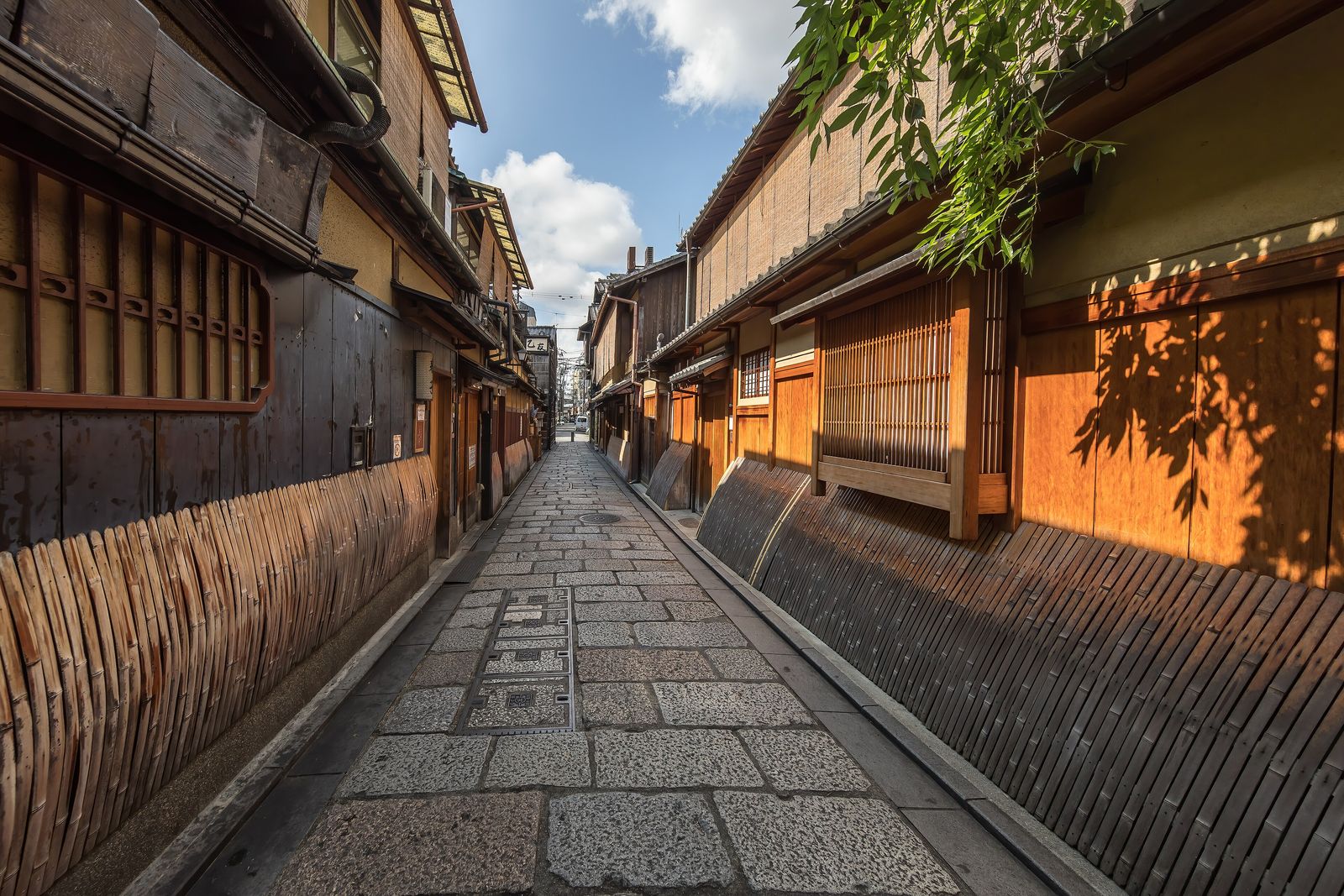 Photo: Basile Morin, CC BY-SA 4.0
What Is a Bamboo House? Bali's Bamboo Architecture Explained
How a fast-growing grass became the most beautiful building material in the tropics — the story of bamboo architecture and where to sleep in it.
Overwater & Floating Bungalows in the Jungle
The room that floats — how raft houses and overwater bungalows are built on jungle lakes and rivers, and the best places to sleep on the water.
 Photo: Dudley Miles, CC BY-SA 3.0
Eco-Lodges vs Jungle Airbnbs: Which to Book
A lodge gives you guides and dinner; an Airbnb gives you the place to yourself. An honest comparison to help you pick the right jungle stay.
 Photo: Derek Ramsey (Ram-Man), CC BY-SA 4.0
Find your own piece of the canopy.
Treehouses, bamboo houses and rainforest villas across 17 destinations — found, vetted and written up honestly.
Browse all destinations