What to Wear in the Jungle
Cotton rots, dark colours cook and sandals end in leeches — a practical guide to jungle clothing that keeps you cool, dry and un-bitten. Nobody warns you about this before the trip, and by day two most first-timers have figured out the hard way that the jungle punishes the wrong clothes faster than almost any other environment on Earth.
Why jungle clothing is its own category
Most travel packing advice assumes you'll be dry within a few hours of getting wet. The jungle doesn't work that way. Humidity in a tropical rainforest routinely sits above 80 percent, which means sweat doesn't evaporate the way it does in a dry climate — it just sits on your skin and in your clothes, sometimes for days. A shirt that would dry on a line in an hour back home can still be damp on a jungle porch the next morning. That single fact — that drying time is no longer optional, it's a design requirement — is the thread that runs through almost every piece of advice in this guide.
The second thing that makes jungle clothing its own category is what's actually out there waiting to bite, sting or attach to you. Mosquitoes carrying dengue or malaria depending on the region, ticks, chiggers, and the leeches that show up on damp trails after rain, especially in Southeast Asia. None of this is exotic or rare — it's the ordinary background of walking through dense, wet vegetation — and the right clothing is a genuinely effective first line of defence, arguably more effective than anything you spray on afterward.
The third factor is heat. A rainforest at sea level near the equator runs hot year-round, typically in the high 20s to low 30s Celsius (80s Fahrenheit) with no real seasonal relief the way a temperate climate gets one. Add humidity on top of that heat and the practical goal of jungle clothing isn't warmth or style — it's managing sweat, sun and bites simultaneously, in gear that still has to survive being stuffed wet into a dry bag every evening. Get that right and the discomfort of a hot, buggy trail mostly disappears. Get it wrong — cotton, dark colours, open sandals — and you'll spend the trip fighting your own clothes instead of enjoying the forest.
The jungle doesn't care what looks good in the packing photo. It cares whether your shirt is dry by breakfast.
Fabric: the one decision that matters most
If you take one piece of advice from this entire guide, make it this: leave the cotton at home. Cotton is what textile people call hydrophilic — it loves water, soaks it up, and then holds onto it. In a humid rainforest, a cotton T-shirt that gets sweat-soaked by mid-morning often still isn't fully dry by the next day's hike, which means you either start the day in damp clothing or you're down to your last dry shirt by day three. Wet cotton against skin for hours at a stretch is also a fast route to chafing and skin irritation, and in a hot, humid environment it's genuinely prone to mildew if it doesn't get a real chance to dry out between wears.
The alternative is quick-dry synthetic fabric — polyester, nylon, or blends built specifically for hiking and travel. These fabrics are hydrophobic: they don't absorb moisture the way cotton does, they wick sweat away from skin to the outer surface where it can evaporate, and they dry in a fraction of the time. Polyester in particular has a slight edge over nylon for wicking and breathability, which is why most technical hiking shirts and trekking trousers are polyester or a poly-nylon blend. A synthetic shirt rinsed out at the end of a hiking day will often be wearable again by morning; a cotton one frequently won't.
Merino wool is worth a mention too, mostly for socks rather than shirts — it manages moisture well and resists odour even after several days of wear, which matters more than it sounds like it should when you're three days into a lodge stay with no laundry service. For everything else, though, synthetic wins on drying speed alone, and drying speed is the metric that actually determines how comfortable your trip is.
It's worth saying plainly why this matters beyond comfort: damp clothing worn for days at a stretch is how rashes, chafing and low-grade skin infections start on a jungle trip, and it's almost entirely preventable with the right fabric choice. Guides who run multi-day treks in places like the Peruvian Amazon or Borneo will tell you the same thing in almost the same words — pack less, pack synthetic, and rinse what you have rather than packing five days of cotton that never quite dries between wears. A lightweight travel detergent packet or even plain soap and a sink at the lodge is usually enough to keep two or three shirts rotating through the week, and most lodges have a covered porch or drying line precisely because guests need one.
Good to know
Pack fewer items than you think you need, but make sure every one of them is quick-dry synthetic. Two or three technical shirts that you rinse and re-wear beat five cotton ones that never fully dry — and it saves real weight and pack space, which matters on the smaller charter flights and boat transfers that get you into a lot of jungle lodges in the first place.
Colour: what actually attracts bites
Clothing colour genuinely affects how many mosquitoes find you, though it's a secondary factor behind body heat, sweat and the carbon dioxide you exhale, not a magic shield on its own. Dark colours — black, navy, dark green, dark red — create strong visual contrast against foliage and absorb more heat and light, both of which make you easier for mosquitoes to spot and track. Lighter shades — white, khaki, pale grey, light tan, pastel tones — reflect more heat and blend into background light, making you comparatively less noticeable.
This doesn't mean you need to dress like you're heading into a desert safari. It means favouring mid-tone and light neutral colours over black or navy when you have a choice, particularly for the layer closest to your skin during the hottest, buggiest parts of the day — usually dawn and dusk, when mosquito activity peaks. Bright white has its own downside in genuinely thick forest, where it stands out visually to wildlife and can make you easier to see from a distance if you're trying to approach animals quietly, so most experienced guides land on khaki, olive, tan or light grey as the practical middle ground: pale enough to run cooler and attract fewer bites, muted enough not to spook a shy bird or primate before your guide gets you close.
None of this replaces actual bite prevention — treated clothing and repellent do far more work than colour choice alone — but it's a free adjustment that costs nothing extra and stacks with everything else in this guide.
Layers, top to bottom
Base layer: long sleeves, not tank tops
The instinct in 30-degree heat is to wear as little as possible. In the jungle, that instinct works against you. A lightweight, long-sleeved, quick-dry shirt covers more skin from both sun and insects than a T-shirt does, and a well-vented technical shirt in a breathable weave is barely warmer than short sleeves while cutting bite exposure dramatically. Look for shirts with roll-up sleeve tabs so you can convert to short sleeves on a hot, low-bug stretch of trail and roll back down as dusk approaches. A collar that stands up or buttons to the neck adds a bit more coverage on the back of the neck, one of the more commonly bitten spots on a hike.
Bottoms: convertible trousers over shorts
Shorts feel like the obvious hot-weather choice, but bare legs in dense undergrowth mean scratches, nettle-like plants, ticks and — on wet trails in parts of Southeast Asia — leeches. Lightweight, quick-dry trekking trousers, ideally the zip-off convertible style that turns into shorts when you actually want them, give you the option without committing either way. Look for trousers with a slightly tapered or elastic ankle cuff, which makes it easier to tuck them into socks or gaiters when leech or tick activity is high, and check the fabric is a genuine quick-dry synthetic rather than a cotton-poly blend that's mostly cotton.
Underlayers and socks
Synthetic or merino wool underwear, not cotton, for the same moisture reasons as everything else on this list — cotton underwear in humid heat is a fast route to chafing over a multi-day trip. For socks, merino wool or a wool-synthetic blend manages moisture and odour far better than cotton athletic socks, and taller hiking socks that can be pulled up over trouser cuffs add another layer of protection against ticks and leeches on overgrown trail sections.
Mid layer and evenings
Jungle nights are rarely cold, but higher-elevation cloud forest stays — in parts of Costa Rica's highlands or the Andean fringes of the Peruvian Amazon, for instance — can drop into genuinely cool territory after dark. A packable fleece or light synthetic jacket earns its space for those evenings and for early-morning boat rides, when wind chill over water makes a still-warm morning feel considerably colder.
Footwear
Footwear is where more first-time jungle travellers get it wrong than almost anywhere else in the packing list. Sandals, flip-flops and open trainers all leave the foot exposed to biting insects, uneven wet roots, and — again — leeches, which have no trouble finding a gap between strap and skin on a rain-soaked trail. The safer default is a closed, waterproof or quick-drying hiking shoe or boot with good ankle support and grippy soles for slick mud and wet roots.
Full waterproofing is a genuine trade-off, though. A fully waterproof boot keeps water out on a shallow stream crossing, but once water does get in — over the top, or through a seam after enough hours in the rain — it's slow to drain and slower to dry, leaving you hiking in a boot that's essentially a small pond for the rest of the day. Many experienced jungle guides prefer a non-waterproof, quick-drying trail shoe instead: it lets water in and out freely on a river crossing, drains fast, and dries out overnight, which matters more on a multi-day trek than staying bone-dry for the first ten minutes. Either approach works — the wrong choice is an open sandal or a heavy leather boot that never dries at all.
Gaiters are worth adding to the list specifically for leech-prone trails — parts of Borneo, the wetter stretches of Thailand's northern forests, and rainy-season trekking generally. A simple nylon or treated-fabric gaiter that seals the gap between boot top and trouser cuff is the single most effective piece of gear against leeches finding their way in from the ankle up, more effective in practice than any repellent applied to skin alone.
Bug protection: treating your clothes, not just your skin
Most travellers think of insect protection purely in terms of repellent applied to skin — DEET or picaridin sprayed on exposed arms and legs. That's necessary, but it's only half the picture. Treating the clothing itself with permethrin, an insecticide rather than a repellent, adds a second layer of protection that works differently and, for ticks especially, works better. The CDC notes that permethrin-treated clothing and gear, at a concentration of about 0.5 percent, repels and kills ticks, chiggers, mosquitoes and other biting insects on contact rather than simply discouraging them from landing, and studies among outdoor workers wearing treated clothing recorded meaningfully fewer tick bites than workers in untreated clothes.
You have two practical options: buy pre-treated technical clothing (a number of outdoor brands sell shirts, trousers and socks factory-treated with permethrin, effective through many washes) or treat your own gear with a permethrin spray roughly 24 to 48 hours before you pack, giving it time to dry fully. Permethrin is applied to fabric only, never directly to skin, and it's inert once dry — it doesn't wash off onto skin the way a skin-applied repellent would rub off. Combined with a skin-applied DEET or picaridin repellent on any exposed skin — hands, neck, face — this two-layer approach is the standard recommendation from health authorities for genuinely high-risk tropical destinations, and it's a lot more effective than either one on its own.
For a fuller breakdown of what to actually pack in your medical and repellent kit, and where malaria risk is and isn't a real factor by region, see our guides on malaria, vaccines and health for jungle travel and what to pack for a jungle trip.
Sun, rain and the gear that does double duty
Rainforest canopy blocks a surprising amount of direct sun on a forest trail, but that protection disappears the moment you're on a river, a boat, an open canopy walkway or a beach — all common stops on a jungle itinerary — and equatorial sun at those moments is intense enough to burn exposed skin fast. A wide-brimmed hat, ideally with a chin cord so it survives a breezy boat ride, and a lightweight long-sleeved shirt do more consistent sun protection work over a multi-day trip than reapplying sunscreen every couple of hours, though sunscreen on hands, face and neck is still worth carrying.
Rain is close to guaranteed at some point on almost any jungle trip, wet season or not — tropical rainforest earns the name because it rains, often in short, intense bursts rather than an all-day soak. A genuine waterproof rain jacket, not a water-resistant windbreaker, is worth the extra weight; look for one with pit zips or mesh venting so you don't just trade rain for trapped sweat underneath. A packable poncho is a lighter backup that also fits neatly over a daypack on a boat transfer, though it manages wind and sustained rain worse than a proper jacket.
A dry bag, or at minimum a set of heavy-duty zip-lock bags, deserves a place on every jungle packing list — not for clothing so much as for phones, cameras and passports on boat transfers, where an unexpected splash or downpour is closer to routine than exceptional.
Region-by-region notes
The core advice in this guide — quick-dry synthetics, light colours, covered legs, closed shoes, permethrin-treated clothing — holds everywhere, but a few regional details are worth knowing before you pack.
- Costa Rica: lodges range from lowland rainforest to cloud forest at real elevation, so pack one warm layer even on a beach-and-jungle combo trip — Monteverde and similar cloud-forest stays run noticeably cooler and damper than the Pacific coast.
- Brazil and the wider Amazon basin: humidity is about as high as jungle travel gets, so drying time matters more here than almost anywhere else — pack more spare synthetic layers than you think you need, and expect boat transfers to be a regular part of the day.
- Bali and Indonesia: volcanic terrain means trails can be steep as well as wet; grippy, closed footwear matters more than in flatter rainforest.
- Tulum and the Maya jungle: drier overall than the Amazon or Southeast Asia, but still hot and humid enough that cotton is the wrong call — and reef-safe sunscreen matters here specifically because of the cenotes and coastline nearby.
- Thailand and Southeast Asia generally: rainy-season trekking in the north brings out leeches on damp trails in real numbers — gaiters and tucked-in trouser cuffs are worth the extra five minutes each morning.
- Sri Lanka: similar leech considerations to Southeast Asia on wet-season rainforest trails, particularly in the hill country's cloud forest reserves.
- Hawai'i and Puerto Rico: genuinely lower disease risk than mainland tropical rainforest, but the same humidity and sun logic applies — quick-dry fabric and a real hat still make the difference between a comfortable hike and a miserable one.
A sample packing list
This is a practical starting point for a five- to seven-day jungle stay, not an exhaustive gear list — adjust quantities for trip length and whether the lodge offers laundry.
- 2–3 quick-dry, long-sleeved synthetic shirts, light or khaki-toned, permethrin-treated or treated before departure
- 1–2 pairs of convertible or lightweight trekking trousers, synthetic, not cotton
- 4–5 pairs of merino or synthetic hiking socks, tall enough to tuck trousers into
- Synthetic or merino underwear, not cotton
- 1 closed, quick-drying trail shoe or light hiking boot, already broken in before the trip
- 1 pair of gaiters if visiting a leech-prone region in wet season
- 1 genuine waterproof rain jacket with venting
- 1 packable fleece or light insulating layer for boat rides and cooler evenings
- 1 wide-brimmed hat with a chin cord
- Permethrin spray (if treating gear yourself) and a DEET or picaridin skin repellent
- A dry bag or heavy zip-lock bags for electronics and documents
- Swimwear, for lodges with a river landing, pool or waterfall stop
- One set of decent clothes for evenings — most jungle lodges are relaxed, not formal
Good to know
Break in any new hiking shoes well before the trip. A blister on day one of a multi-day trek is a far bigger problem in the jungle, where dry, clean socks aren't always guaranteed, than it would be on a normal city holiday.
What to leave at home
A few items come up again and again in packing lists that don't actually earn their space on a real jungle trip:
- Cotton anything — T-shirts, socks, underwear. It's the single most common mistake, and it's the one that causes the most day-to-day discomfort.
- Open sandals or flip-flops for hiking. Fine for the lodge deck after dark, wrong for any actual trail.
- All-black or all-dark outfits. Comfortable-looking in a packing photo, warmer and more bite-prone on the trail.
- Heavy, non-breathable rain gear. A thick rubberised poncho traps as much sweat as it keeps out rain.
- Jeans. Slow to dry, heavy when wet, and genuinely uncomfortable in sustained heat and humidity.
- A full suitcase of "just in case" outfits. Two or three good quick-dry layers, rinsed and reworn, beat a bag full of options you won't have time to dry between wears.
Common questions
Do I really need to buy special jungle clothing, or will regular hiking gear work?
Regular quick-dry hiking gear works fine — you don't need jungle-specific branding. What matters is the fabric (synthetic or merino, not cotton), the coverage (long sleeves and full-length trousers as a default), and treating it with permethrin if you're heading somewhere with real tick or mosquito risk. Most of what's in a decent hiking wardrobe already meets that bar.
Is it worth buying permethrin-treated clothing, or can I just use repellent spray on my skin?
Skin repellent alone leaves clothed areas of your body less protected, and ticks in particular tend to latch onto clothing before finding skin. Treated clothing and skin repellent work as a pair, not substitutes for each other, and health authorities generally recommend both for higher-risk regions.
What colour clothing is genuinely best for avoiding bites?
Light, muted colours — khaki, tan, pale grey, light olive — outperform black, navy and dark red, which run hotter and stand out more to mosquitoes. It's a secondary factor next to body heat and repellent use, but it's a free adjustment worth making when you're choosing what to pack.
Should I buy waterproof or non-waterproof hiking shoes for the jungle?
Both approaches work; the wrong choice is an open sandal. Waterproof boots keep light rain and shallow puddles out but drain slowly once they do get wet. Non-waterproof, quick-drying trail shoes let water in and out freely on river crossings and dry out faster overnight — many jungle guides prefer them for exactly that reason.
Do I need gaiters, or is that overkill?
Gaiters aren't necessary everywhere, but they're genuinely worth packing for leech-prone regions and wet-season trekking, particularly in Southeast Asia. They're the most effective single item against leeches finding their way in around the ankle.
How many changes of clothes do I actually need for a week in the jungle?
Fewer than you'd think, as long as everything is quick-dry synthetic. Two to three shirts and one or two pairs of trousers, rinsed and re-worn, cover most week-long stays comfortably — the fabric matters far more than the quantity.
Getting dressed for the jungle isn't complicated once the logic clicks: fabric that dries fast, colours that don't cook or attract bites, legs and arms covered by default, closed shoes with real grip, and a permethrin treatment doing quiet work in the background. None of it is expensive or hard to find — most of it is standard hiking gear you may already own. For the rest of what to bring along, our guide to what to pack for a jungle trip covers the non-clothing side of the bag, and malaria, vaccines and health for jungle travel goes deeper on the medical side of bite prevention by region. If you're still deciding where to go, is the jungle safe? An honest guide and how much does a jungle trip cost are good next reads, and the full destinations directory is the place to start comparing regions once your bag is sorted.
- CDC — About Permethrin-Treated Clothing and Gear — confirms permethrin's effectiveness against mosquitoes and ticks, application method and timing.
- NCBI/PMC — Bioabsorption and effectiveness of long-lasting permethrin-treated uniforms among outdoor workers — supports the reduction in tick bites from treated clothing.
- Consumer Reports — Permethrin-Treated Clothing May Disable Ticks — background on how permethrin incapacitates ticks on contact.
- Backpacking Light — Clothing for tropical rainforest — practical field discussion of cotton vs. synthetic fabric performance in humid rainforest conditions.
- Adventure Alternative — Borneo clothing advice for the jungle — regional guidance on layering, footwear and leech protection for Southeast Asian rainforest trekking.
- World Economic Forum — To avoid mosquito bites, wear the right colours — summary of research on clothing colour and mosquito attraction.
- Mosquito Joe — What colors attract mosquitoes? — supporting detail on dark colours, heat absorption and mosquito visual contrast.
More from the Journal.
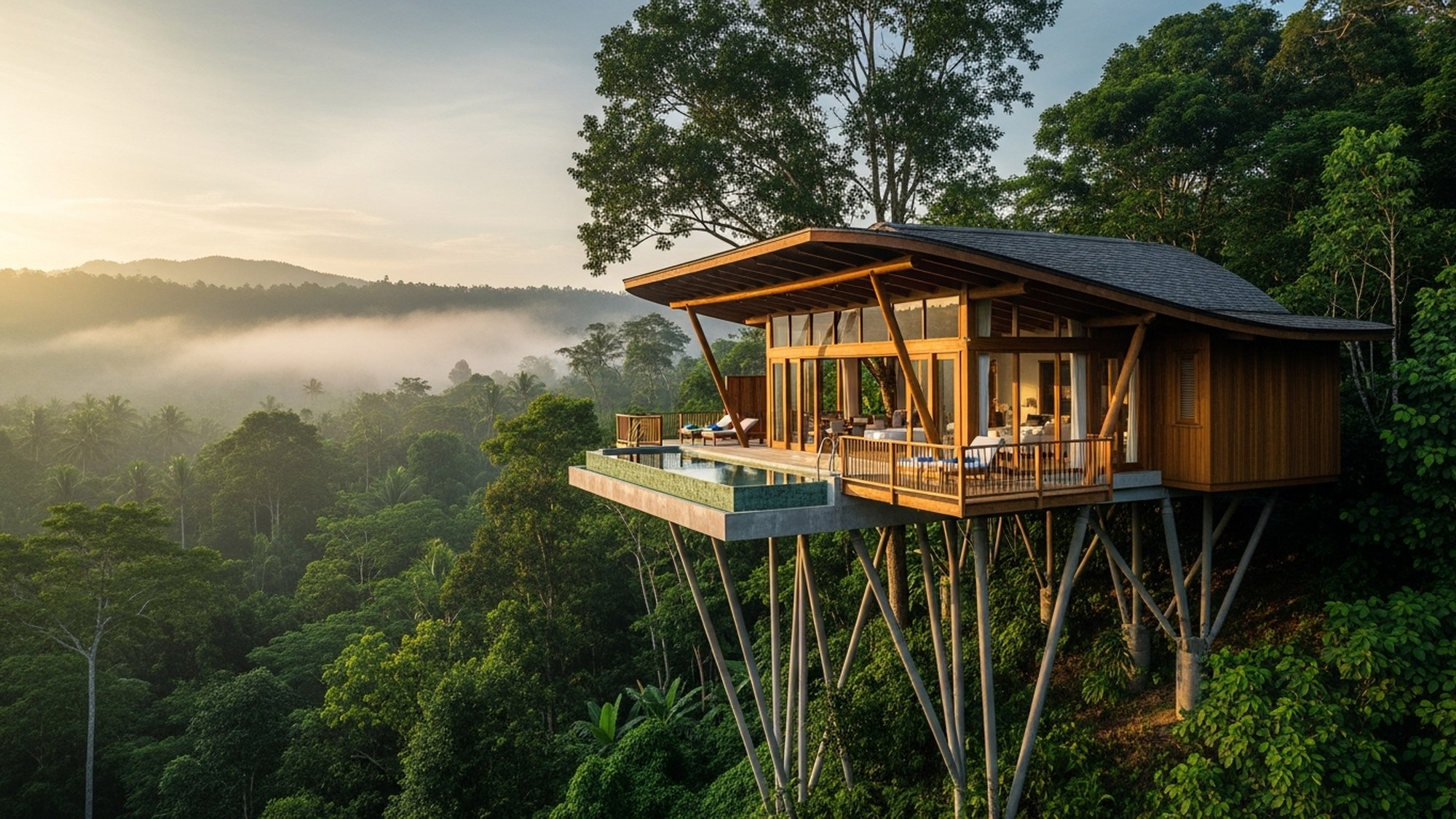
How to Start a Jungle Airbnb
The complete, honest guide to building and running a treehouse, bamboo house or rainforest villa — from choosing a country and the land laws to off-grid systems, budgets, and getting booked.
 Photo: Gregory Heath, CSIRO, CC BY 3.0
Why Jungle Stays Are Booming
The data behind the treehouse boom: four shifts in how the world travels are all converging on the forest — and it looks structural, not a fad.
 Photo: Vyacheslav Argenberg, CC BY 4.0
When to Visit the Jungle: A Season-by-Season Guide
There's no single best time to visit 'the jungle' — because it isn't one place. Here's when to go, region by region, with a month-by-month cheat sheet.
 Photo: Derek Ramsey (Ram-Man), CC BY-SA 4.0
Find your own piece of the canopy.
Treehouses, bamboo houses and rainforest villas across 17 destinations — found, vetted and written up honestly.
Browse all destinations