How Much Does a Jungle Trip Cost?
Ask five people what a week in the jungle costs and you'll get five different answers, and all five will be right. A hammock and a shared bathroom in Thailand can run under $30 a night. A private villa with its own plunge pool in Bali might be $150. A boat-access lodge deep in the Peruvian Amazon, with every meal and guide included because there's nowhere else to buy either, can land at $250 a night before you've paid to get there. None of these is the "real" price of a jungle trip, because there isn't one. What follows is an honest accounting of where the money actually goes, region by region, with real numbers from real properties and real cost-of-travel data — so you can build a budget that matches the trip you actually want, not a number someone made up to sound impressive.
The short version
For a full week — lodging, food, a few guided activities, ground transport once you land — a genuinely comfortable jungle trip runs somewhere between $700 and $2,500 per person, before international flights. Budget travelers who are happy with a fan instead of air conditioning and a shared kitchen instead of a restaurant can get a week well under $500. Travelers who want a private lodge, a dedicated guide and meals built into the rate should expect to land closer to $2,000–$3,500 for the week, sometimes more in the Amazon where there's no local alternative to the lodge's own kitchen and boat.
The single biggest thing that changes this number isn't the destination — it's how remote the stay is. A guesthouse in the hills above Bali's Ubud, reachable by scooter and surrounded by warungs selling $3 plates of nasi goreng, is a fundamentally cheaper trip than a lodge that's only reachable by a chartered boat up a tributary of the Amazon, where the lodge is the only restaurant, the only shop and the only way home. Both are real jungle trips. They are not the same trip financially, and conflating them is where most people's budget goes wrong before they've even booked a flight.
The jungle doesn't have one price tag. It has a dozen, and almost all of the difference between them comes down to one question: how far are you from anywhere else?
What actually moves the price
Before the region-by-region numbers, it's worth understanding the handful of variables that do almost all the work in either direction. Once you know what to look for, you can estimate a fair price for almost any jungle stay you're looking at, anywhere in the world.
Remoteness
This is the biggest lever by far. A stay you can drive to costs less than a stay you can only reach by boat or small plane, because everything the lodge uses — food, fuel, staff, supplies, spare parts — has to travel the same distance you do, and someone pays for that trip whether you notice it or not. This is why an Amazon lodge with a similar room count and similar comfort level to a Costa Rican eco-lodge can cost noticeably more per night: the logistics underneath it are simply harder.
What's bundled into the rate
A $40 room with breakfast only and a $180 all-inclusive package with three meals, a daily guided activity and boat or 4x4 transfers are not really comparable numbers until you price out what the $40 room would cost you to match — meals in town, a guide hired separately, transport arranged on your own. Off-grid and remote lodges tend to bundle almost everything into one rate because there's no separate marketplace to buy those things individually once you're there. Our guide to what to expect at an off-grid jungle stay goes deeper on this if you're weighing a remote property specifically.
Season
Dry season and peak season aren't always the same window, and they don't always push prices the same direction everywhere. In much of Central America and Southeast Asia, the dry season is also the high season, and rates climb accordingly — sometimes 20–40% above wet-season pricing for the same room. In parts of the Amazon, the wet season (roughly December through May in Peru) is when rivers rise enough for boats to reach lodges that are harder to access the rest of the year, which can actually push demand and prices up rather than down. It pays to ask a specific lodge which of its seasons is the expensive one rather than assuming.
Flights
This is the cost most people forget to budget honestly. International airfare to Brazil or Peru from North America or Europe routinely runs $700–$1,400 round-trip depending on origin and season, and that's before the connecting flight or long drive that gets you from the regional airport to the actual jungle. A trip that looks cheap on the lodge's website can still be an expensive trip once flights are honestly added in — which is exactly why comparing "cost per night" across destinations without factoring in how expensive it is to get there in the first place is a little misleading.
Guiding and activities
A night walk, a canopy tour, a river trip with a naturalist guide — these range from free (included in the room rate) to $40–$100 per person per activity when booked separately in town. Lodges that build guiding into the rate are usually a better value for anyone planning to do more than one or two activities a day, since a-la-carte tours add up fast.
Good to know
"All-inclusive" means different things at different price points. At a budget guesthouse it might mean breakfast and a shared kitchen. At a remote lodge it usually means every meal, non-alcoholic drinks, and at least one guided activity a day, because there's genuinely nowhere else to spend money once you arrive. Always ask exactly what's covered before comparing two nightly rates side by side — a $220 rate that includes three meals and a daily excursion can be cheaper than a $140 rate that includes neither.
Costa Rica: real numbers
Costa Rica is the destination most people compare everything else to, and it's a genuinely useful baseline because its tourism industry is mature enough to have real, publicly quoted pricing across every tier. On the ground, day-to-day budgets generally fall into three bands: roughly $50–$80 a day for hostels, local buses and small sodas (the local diners); $100–$200 a day for a comfortable mid-range hotel or eco-lodge, day tours and a rental car; and $250–$500 a day at the luxury end.
Those daily figures are useful for planning, but the more concrete number comes from an actual property. La Leona Ecolodge, on the edge of Corcovado National Park on the Osa Peninsula — one of the most biodiverse and genuinely remote corners of the country — publishes a package rate of $1,360 per person, double occupancy, for a five-night itinerary combining stays at La Leona and the nearby Danta Corcovado Lodge, with three meals a day included throughout. Worked out per night, that's roughly $270 per person, all-in, for a stay in a part of the country with no road access — you get there on foot or by boat, which is precisely the remoteness premium described above. Compare that to a mid-range eco-lodge closer to San José or the Arenal area, more reachable by car, where comfortable double rooms with breakfast commonly run $80–$160 a night — a meaningfully different number for a broadly similar level of comfort, explained almost entirely by how hard the property is to reach.
A realistic week in Costa Rica
- Budget: roughly $450–$650 per person — hostel or basic cabina, public buses, local sodas, one or two paid tours.
- Mid-range: roughly $900–$1,600 per person — comfortable eco-lodge with breakfast, a rental car or shared shuttles, a mix of included and booked activities.
- Remote / luxury: roughly $1,800–$3,000+ per person — a property like La Leona or one of the Osa Peninsula's higher-end lodges, most meals and activities bundled in.
None of this includes the flight in. Direct flights to San José from major US hub cities commonly run $350–$700 round-trip depending on season and origin, which is worth adding to any of the totals above before calling it a final number.
Bali: real numbers
Bali is, for most travelers, the cheapest of the major jungle destinations covered here, and it's cheap in a way that's easy to verify: current cost-of-travel breakdowns put budget travel at roughly $35–$55 a day — a basic guesthouse, local warung meals and a rented scooter — with mid-range travel landing around $120–$150 a day for nicer accommodation, restaurant meals and the occasional driver or tour. A realistic ten-day mid-range trip, flights excluded, tends to total somewhere in the $1,200–$1,500 range per person, which works out to well under $150 a day even with some comfort built in.
Where this shifts is the jungle-specific accommodation itself. A simple guesthouse or homestay in the rice-terrace and forest areas around Ubud can run $15–$40 a night. A villa with a private pool set into the greenery — the kind of stay that photographs like a much more expensive destination — is commonly available for $80–$180 a night outside of peak season, occasionally less. That gap between "looks expensive" and "is expensive" is one of the more useful things to know about Bali specifically: the island's building style and lush surroundings do a lot of visual work that the actual price doesn't always match.
A realistic week in Bali
- Budget: roughly $250–$400 per person — guesthouse, scooter rental, warung meals, minimal paid tours.
- Mid-range: roughly $700–$1,000 per person — a villa or boutique guesthouse, a driver for day trips, restaurant meals, a few guided activities.
- Luxury: roughly $1,500–$2,500+ per person — a private pool villa, a dedicated driver, spa and dining throughout.
Flights are Bali's real equalizer against the daily-cost advantage: from North America they're long and frequently $900–$1,400 round-trip, which can erase a meaningful chunk of what you save on the ground compared to a closer destination like Costa Rica. From Australia or much of Asia, by contrast, Bali is both the cheaper destination and the cheaper flight — worth factoring in honestly based on where you're actually flying from.
Thailand: real numbers
Thailand sits close to Bali on overall affordability and, for jungle-specific stays, is arguably the most budget-friendly of the destinations in this guide once you're away from Bangkok and the main beach resorts. In the northern jungle regions around Chiang Mai and Chiang Rai, and in the southern rainforest areas near Khao Sok National Park, guesthouse rooms commonly start under $20 a night, and a comfortable mid-range bungalow with a fan or basic air conditioning is often $30–$60. Floating raft houses on the lake at Khao Sok — a genuinely distinctive jungle stay — run a wide range depending on how private and how all-inclusive the package is, but sit broadly in line with mid-range lodge pricing elsewhere in this guide once meals and the boat transfer in are bundled together, since the lake access means there's no walk-in alternative once you're there.
Food and local transport are where Thailand pulls further ahead of Bali and Costa Rica on daily cost: street food and simple restaurant meals frequently run $2–$6, and long-distance buses and trains between regions are inexpensive relative to hiring drivers elsewhere. The practical effect is that a traveler willing to move around by public transport and eat where locals eat can stretch a Thailand jungle trip further than an equivalent budget would go in Costa Rica or the Amazon, even accounting for one or two splurges on a nicer lodge night.
A realistic week in Thailand
- Budget: roughly $200–$350 per person — guesthouses, street food, public transport, a couple of paid activities.
- Mid-range: roughly $500–$900 per person — nicer bungalows or a raft-house stay, some hired transport, restaurant meals throughout.
- Higher-end: roughly $1,200–$2,000+ per person — private jungle lodges, dedicated guides, more remote or exclusive properties.
For the best window to actually go, our guide on the best time to visit the Southeast Asia jungle covers how the region's dry and wet seasons line up with both comfort and price.
The Amazon: real numbers
The Amazon — whether you're going through Peru or Brazil — is consistently the most expensive of the destinations in this guide, and the reason is the remoteness principle from earlier taken to its logical extreme. Most Amazon lodges worth staying at are boat-access only, sometimes hours upriver from the nearest town with an airport, which means every guest, every meal and every spare part for the generator has to travel that same river. There is, in the truest sense, no way to do the Amazon cheaply by cutting the lodge out — a genuinely independent, unguided stay in the deep rainforest isn't a realistic or safe option the way an independent guesthouse stay is in Bali or Thailand.
What you get in exchange is a genuinely all-inclusive rate: multi-day packages at established lodges like Treehouse Lodge near Iquitos, Peru bundle accommodation, all meals, a naturalist guide, and daily excursions — canopy walks, night caiman spotting, piranha fishing, visits to local communities — into one price, because that's the only way the model works this far from anywhere else. Multi-day Amazon packages out of Iquitos commonly run from a few hundred dollars for a shorter two- or three-day trip at a simpler lodge up toward $1,500–$2,500+ per person for four to six nights at a more comfortable, higher-end property — a wide range that mostly tracks comfort level and lodge remoteness rather than what's included, since almost everything is included at every tier.
A realistic week in the Amazon
- Simpler lodge, shorter stay: roughly $600–$1,000 per person for three to four nights, most meals and one daily excursion included.
- Established mid-range lodge: roughly $1,200–$2,000 per person for five to six nights, fully inclusive of meals, guiding and transfers from the regional airport.
- Premium or particularly remote lodge: $2,500–$4,000+ per person for a comparable stretch, reflecting a more difficult journey in and a higher staff-to-guest ratio.
Add flights carefully here: getting to Iquitos or Manaus from outside the region typically means a long-haul flight into a national capital, then a domestic connection, and international legs to South America commonly run $700–$1,400 round-trip on their own before the domestic hop. It's the destination in this guide where flights most often end up costing as much as, or more than, the lodge itself.
What's included, and what always costs extra
Regardless of destination, a handful of costs tend to sit outside the headline room rate no matter where you book, and budgeting for them up front avoids the most common source of jungle-trip sticker shock.
Almost always extra
- International and domestic flights — frequently the single largest line item in the entire trip, and the one most commonly left out of a mental budget built around nightly lodge rates.
- Park entrance fees — national parks and reserves in Costa Rica, Peru and elsewhere charge separate entry fees, typically $10–$30 per person per day, on top of any lodge or tour cost.
- Alcohol — even fully "all-inclusive" lodge packages routinely exclude alcoholic drinks, which are sold separately and priced at a premium given how far the bottles traveled to get there.
- Travel insurance and any pre-trip vaccinations or antimalarials — genuinely worth budgeting for rather than treating as optional; our guide to malaria, vaccines and jungle health covers what's actually needed where.
- Gear you don't already own — proper rain protection, a headlamp, a dry bag. Our packing guide lists exactly what's worth buying versus what most people already have.
- Tips for guides and lodge staff — a real and expected cost at guided lodges nearly everywhere, and one that's easy to forget until the last night of the trip.
Usually included at mid-range and up
- All meals at remote or off-grid properties, since there's typically nowhere else nearby to eat.
- At least one guided activity a day at lodges positioned around wildlife or a national park.
- Airport or town transfers, particularly at properties reachable only by lodge-arranged boat or 4x4.
- Basic water purification or bottled/filtered water, standard at almost every established property regardless of price tier.
Budget, mid-range and luxury: a week at each tier
Pulling the regional numbers together, here's roughly what a full week looks like at each tier, per person, excluding international flights:
Budget (roughly $250–$650 for the week)
A guesthouse or basic cabina with a fan, shared or simple private bathroom, local food, public transport or a rented scooter, and one or two paid activities. Realistic in Thailand, Bali and much of Costa Rica; genuinely difficult in the deep Amazon, where the lodge model makes true budget independent travel rare.
Mid-range (roughly $700–$2,000 for the week)
A comfortable eco-lodge or villa, breakfast or all meals included depending on remoteness, a mix of included and booked activities, and either a rental car, a driver, or lodge-arranged transfers. This is where most first-time jungle travelers land, and it's a genuinely comfortable, well-guided trip at every destination in this guide.
Luxury or remote-premium (roughly $1,800–$4,000+ for the week)
A high-end or particularly remote lodge — a Corcovado boat-access property, a premium Amazon lodge, a private-pool Bali villa with a dedicated staff — with nearly everything bundled into the rate: meals, guiding, transfers and often spa or wellness add-ons. The premium here buys two real things: comfort, and access to places a mid-range traveler generally can't reach at all.
For families weighing which tier actually makes sense with kids in tow, our family jungle guide covers where the extra spend genuinely buys convenience and where it doesn't. Solo travelers should also check our guide to traveling the jungle alone, since single-occupancy rates can shift these numbers meaningfully in either direction depending on the property.
How to save money without cutting the wrong corners
There's a real difference between saving money and quietly making your trip worse, and the jungle is not a great place to learn that difference the hard way. A few adjustments genuinely lower the cost without touching safety or comfort in any way that matters:
- Travel just outside peak season. The shoulder weeks right before or after the busiest dry-season stretch often carry noticeably lower rates with only a modest tradeoff in weather.
- Book direct with the lodge when you can. Smaller, independently run properties frequently offer better rates or added extras — an activity, a transfer — booking direct rather than through a large aggregator.
- Choose one splurge night, not seven. A week mixing a few budget or mid-range nights with one genuinely special stay — the overwater room, the remote lodge — usually beats a week of uniform mid-tier spending for how memorable it ends up being.
- Ask what's actually included before comparing rates. As covered above, a higher nightly rate that includes three meals and daily guiding can be the actual cheaper option once you price out doing those things separately.
- Don't skimp on the guide. Of everything on this list, a knowledgeable local guide is the one expense that consistently pays for itself in what you actually see and understand — this is not the place to economize.
Where you should not cut costs: water purification, basic travel insurance, and any recommended vaccination or antimalarial regimen for your specific itinerary. These are inexpensive relative to the rest of the trip and meaningfully change the risk profile of an otherwise low-risk trip — our companion piece on whether the jungle is actually safe puts the real numbers on that risk in context.
Common questions
What's the cheapest jungle destination to visit?
Thailand and Bali are generally the most affordable of the major jungle destinations, with daily budgets that can run under $50 for a genuinely comfortable trip if you eat locally and use public or shared transport. The Amazon is consistently the most expensive, mainly because of how remote most lodges are rather than any difference in luxury.
Is it cheaper to book a package or arrange everything separately?
It depends entirely on the destination. In Bali and Thailand, where independent travel is easy and infrastructure is good, arranging things separately is often cheaper. In the Amazon and at remote Costa Rican lodges like those on the Osa Peninsula, a bundled package is usually the only realistic option and is often better value than it looks, since it includes meals and guiding you'd otherwise have to arrange at a premium once you're already there.
How much should I budget for flights on top of the trip cost?
For most travelers flying internationally to Costa Rica, Brazil or Peru, budget $700–$1,400 round-trip depending on origin and season, plus any domestic connecting flight to reach a regional gateway like Iquitos or Manaus. Flights to Bali from North America or Europe run similarly high given the distance; from Australia or elsewhere in Asia, they're often significantly cheaper.
Do all-inclusive jungle lodges actually save money?
Often, yes — particularly at remote properties where there's no realistic alternative to buying meals and activities separately. Before assuming a higher nightly rate is worse value, price out what a comparable day of meals, a guide and transport would cost booked individually; the gap is frequently smaller than it looks, or reversed entirely.
Is a week in the jungle a realistic budget trip?
Yes, particularly in Thailand, Bali and much of Costa Rica, where a full week comfortably furnished with local food, guesthouse stays and a couple of paid activities can run under $500–$650 per person before flights. The Amazon is the exception where a truly budget version of the trip is genuinely hard to construct given the lodge-dependent access.
What single expense most often gets left out of people's budgets?
Park entrance fees and tips, consistently. Both are small individually — typically $10–$30 a day for park fees, and a modest daily amount for guide and staff tips — but they're easy to forget when a trip is planned around nightly lodge rates and flight costs alone, and they add up meaningfully over a full week.
The honest takeaway across every destination in this guide is the same: the jungle is not inherently an expensive kind of travel, and it's not inherently a cheap one either. The number depends far more on how remote your stay is and what's bundled into the rate than on which rainforest you're actually standing in. Start with the full destinations directory to compare properties directly, and once you've settled on where, our guide on how to book a jungle Airbnb covers exactly what to check before you commit your money to a listing.
- La Leona Ecolodge — real package pricing for a five-night Osa Peninsula / Corcovado National Park stay, used for the per-night remote-lodge figure in Costa Rica.
- Explore Costa Rica — How Much Does a Trip to Costa Rica Cost? — budget, mid-range and luxury daily cost breakdowns for Costa Rica.
- Nomadic Matt — Costa Rica Travel: How Much Does It Cost? — additional daily budget ranges and cost drivers for Costa Rica travel.
- Kala — Bali Trip Cost 2026: Budget Breakdown — daily budget, mid-range and luxury cost figures for Bali.
- Bali.com — Bali Trip Cost 2026: Daily Budget, Hotels & Prices by Travel Style — accommodation and daily cost ranges by travel style in Bali.
- Rainforest Cruises — Treehouse Lodge, Peru Amazon: Itineraries & Prices — real Amazon lodge itineraries and inclusions used for the Peru Amazon section.
- Budget Your Trip — Costa Rica — comparative daily and weekly expense data for Costa Rica.
More from the Journal.
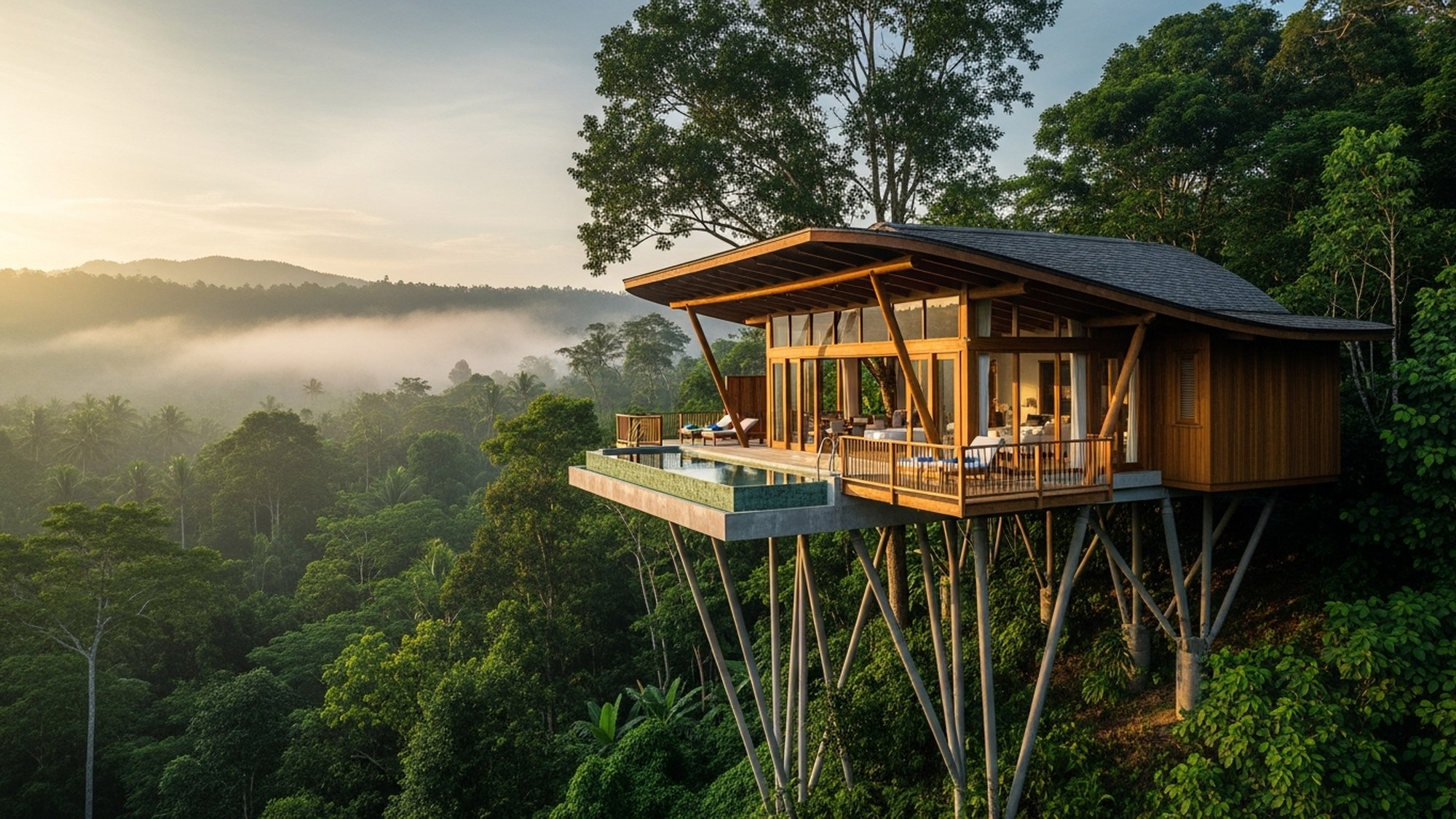
How to Start a Jungle Airbnb
The complete, honest guide to building and running a treehouse, bamboo house or rainforest villa — from choosing a country and the land laws to off-grid systems, budgets, and getting booked.
 Photo: Gregory Heath, CSIRO, CC BY 3.0
Why Jungle Stays Are Booming
The data behind the treehouse boom: four shifts in how the world travels are all converging on the forest — and it looks structural, not a fad.
 Photo: Vyacheslav Argenberg, CC BY 4.0
When to Visit the Jungle: A Season-by-Season Guide
There's no single best time to visit 'the jungle' — because it isn't one place. Here's when to go, region by region, with a month-by-month cheat sheet.
 Photo: Derek Ramsey (Ram-Man), CC BY-SA 4.0
Find your own piece of the canopy.
Treehouses, bamboo houses and rainforest villas across 17 destinations — found, vetted and written up honestly.
Browse all destinations