Frogs of the Rainforest
The rainforest at night is mostly a wall of sound, and a surprising amount of that sound is frogs — a layered chorus of chirps, whistles, clicks and honks that starts at dusk and runs until dawn. Switch on a torch and the singers turn out to be some of the most beautiful animals on Earth: a green frog with blazing red eyes clinging to a leaf, a frog the colour of a warning sign no bigger than your thumbnail, a frog you can see straight through to its own beating heart. Rainforest frogs are easier to find than almost any other headline wildlife, once you know to look at night and near water. This is a guide to the ones worth looking for, what their colours actually mean, and how to find them without harming them.
Why frogs and the rainforest belong together
Amphibians need moisture — most breathe partly through their skin, which has to stay damp to work — so the warm, wet, permanently humid rainforest is close to their ideal world. The result is astonishing diversity: the tropics hold the great majority of the world's frog species, and a single well-watered rainforest can be home to dozens or even hundreds, filling every niche from the canopy to the leaf litter to the streams. Unlike temperate frogs, which mostly cluster around ponds, many rainforest frogs have abandoned open water entirely, breeding in the tiny pools that collect in bromeliad leaves, in foam nests over streams, or by skipping the tadpole stage altogether and hatching fully formed froglets from eggs laid on land.
For a visitor, this abundance is good news twice over. Frogs are genuinely easy to find — far easier than a jaguar or most mammals — because they're numerous, they announce themselves by calling, and many are active at a predictable time and place: after dark, near water. And they're one of the great rewards of the single best wildlife activity most lodges offer, the guided night walk, when the forest hands over an entire cast of animals that simply isn't there by day. If you want the wider picture of what a rainforest trip will show you, our overview of the wildlife you'll actually see puts frogs alongside the birds, monkeys and insects you'll meet on the same walk.
The red-eyed tree frog
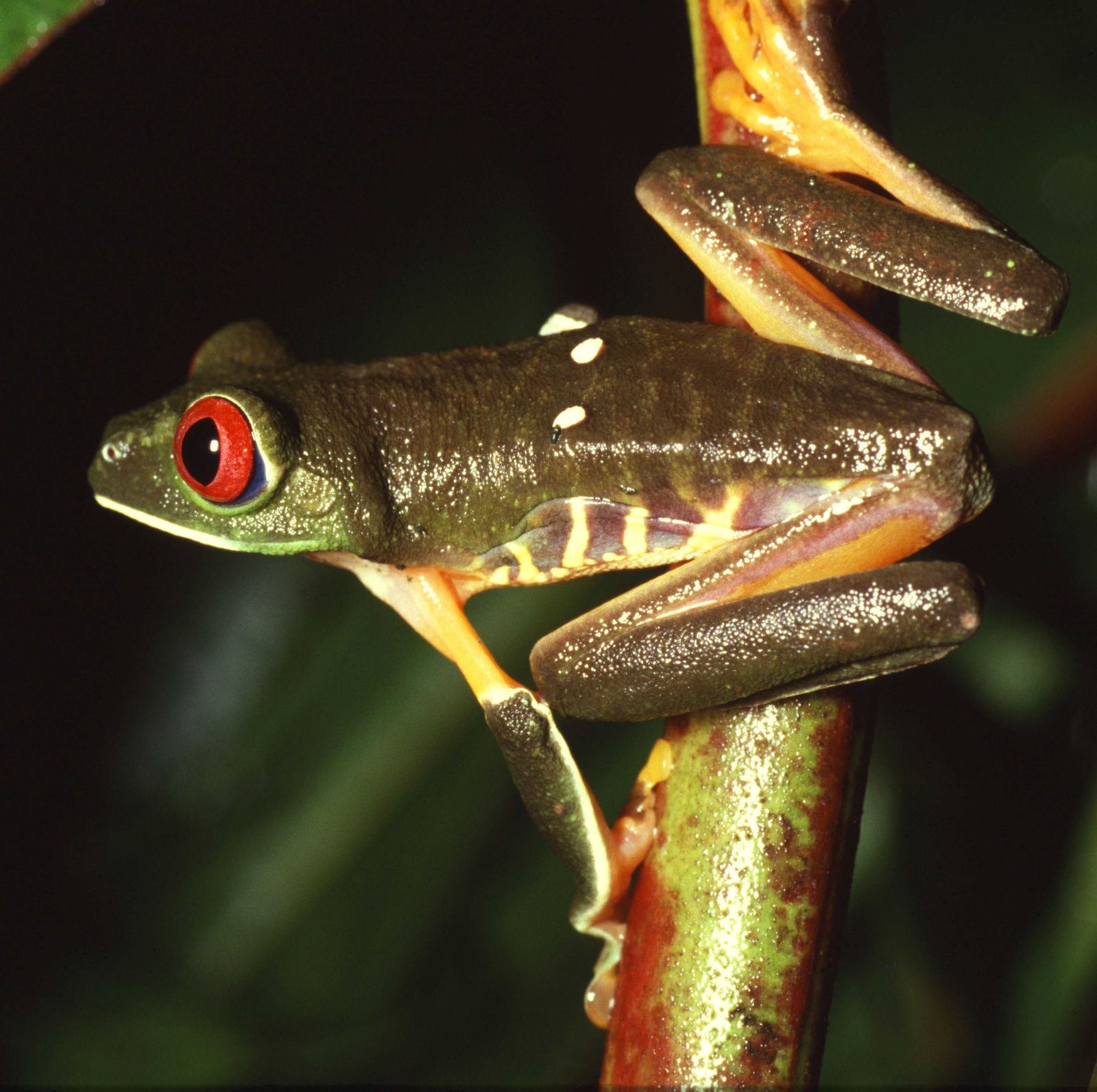
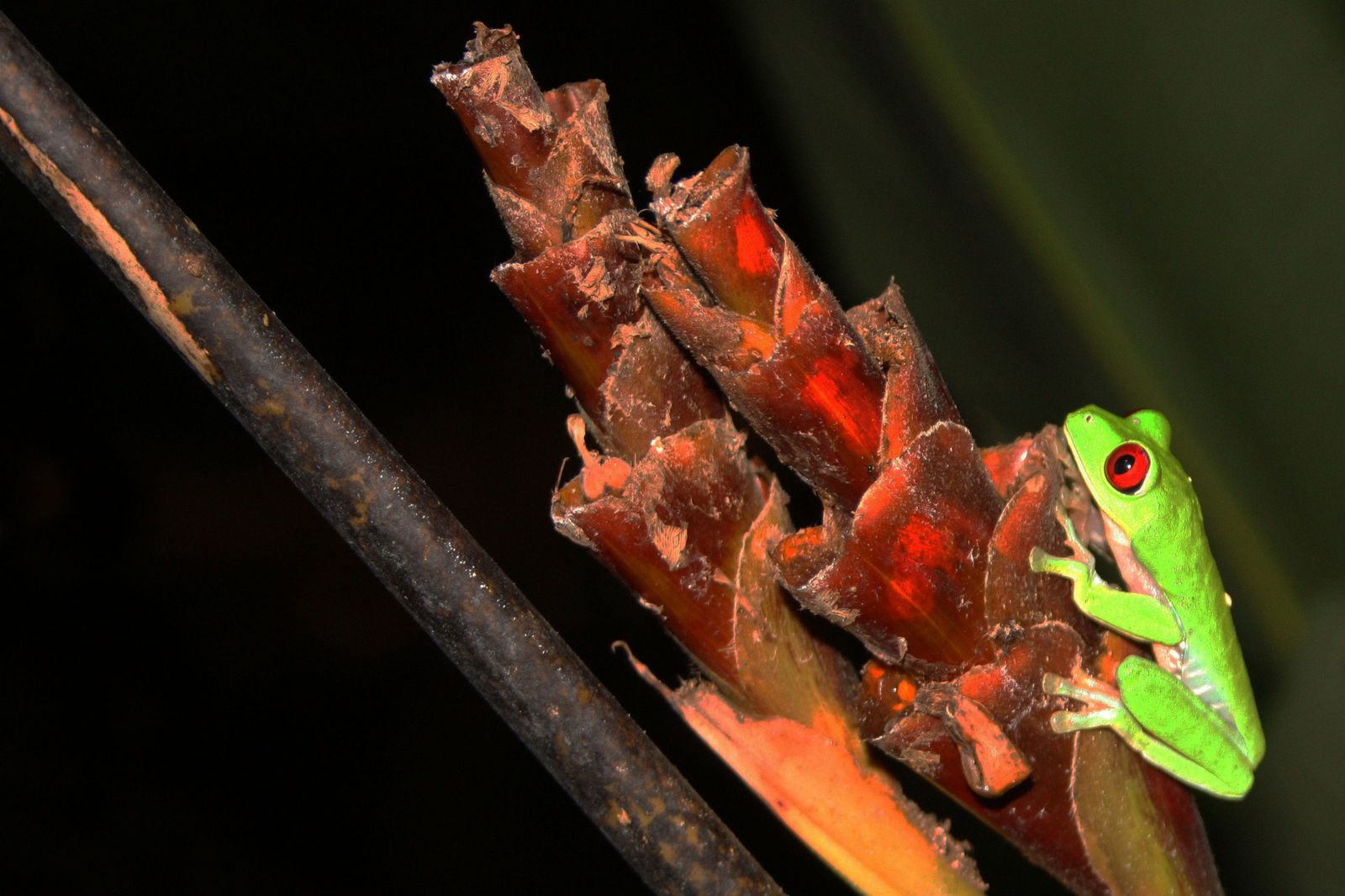
No animal sells the Central American rainforest harder than the red-eyed tree frog, Agalychnis callidryas — the vivid green frog with a cream belly, blue-and-yellow barred flanks, bright orange feet and, above all, huge scarlet eyes, that stares out from a thousand posters and postcards. It is real, it is common across the lowland rainforests from southern Mexico to Panama, and with a guide and a torch it's one of the more findable of all the famous rainforest animals.
The obvious question its appearance raises — is something that colourful poisonous? — has a surprising answer: no. The red-eyed tree frog is harmless. All that colour is a bluff. By day the frog tucks its bright flanks and feet away and sleeps as a plain green leaf-shaped lump, essentially invisible. If a predator finds it anyway and prods it, the frog snaps its huge red eyes open and flashes its brilliant blue-and-orange sides — a sudden, startling burst of colour called a deimatic or "startle" display, meant to freeze or spook the attacker for the fraction of a second the frog needs to leap away. The colour isn't a warning of poison; it's a jump-scare.
Their private lives are worth knowing, too. Red-eyed tree frogs are nocturnal and arboreal, and they breed by laying clutches of eggs on leaves that overhang water. When the tadpoles are ready — and, remarkably, sometimes early if a snake or wasp starts attacking the clutch, a behaviour researchers have documented in detail — they hatch and drop straight down into the pool below. It's the kind of story a good night-walk guide will tell you while the frog itself sits obligingly on a leaf at eye level.
Poison dart frogs and the meaning of colour
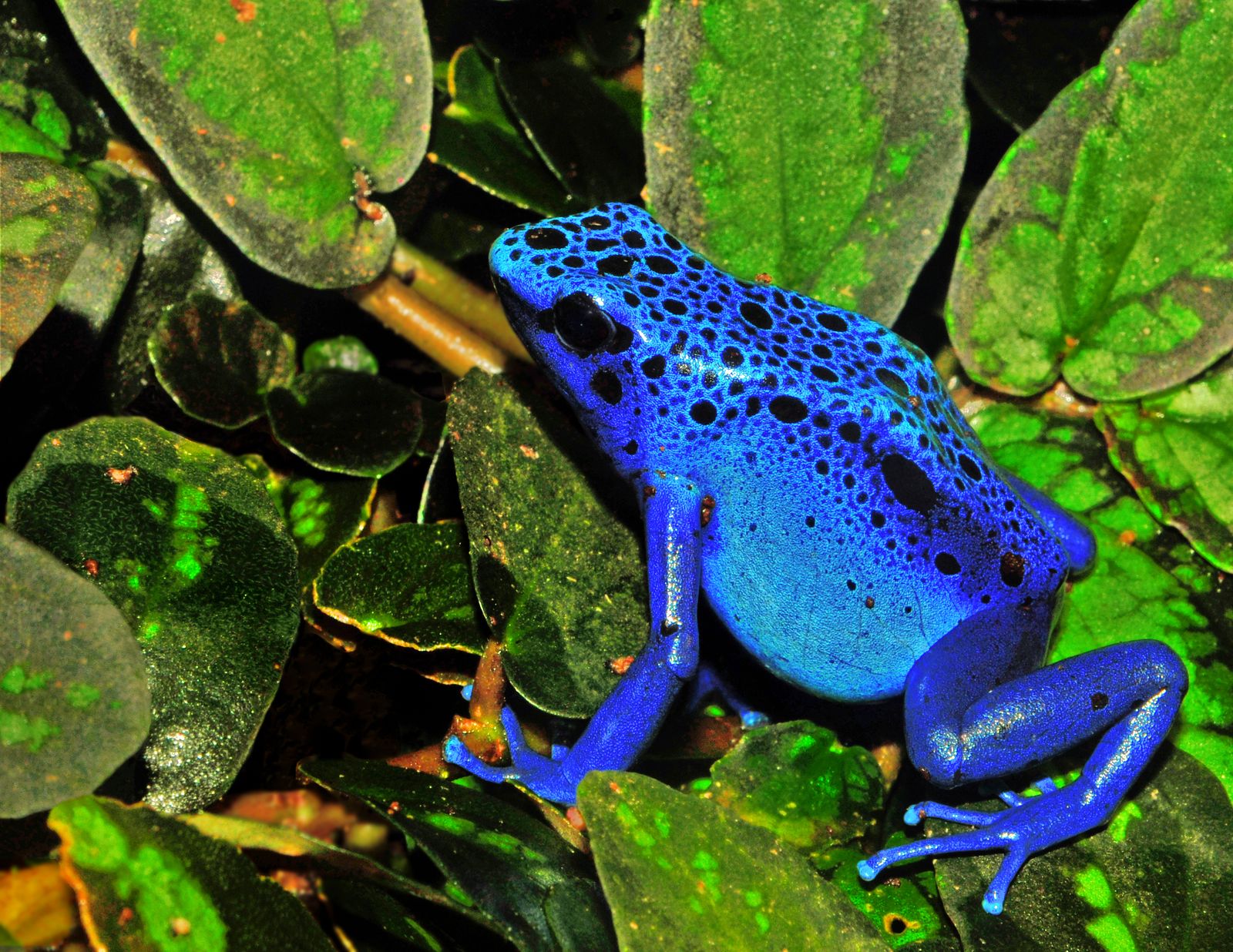
The poison dart frogs — the family Dendrobatidae — are the ones where the bright colour does mean what you fear. Small, often jewel-bright in blue, red, yellow, orange or green, and active by day rather than hiding at night, they are walking warning labels: their colours advertise that they're toxic and best left alone, the honest-signalling strategy biologists call aposematism. A predator that tries one learns fast and avoids anything that looks similar, which is exactly what the frog's conspicuous colour is for.
Two things about that toxicity often surprise people. The first is that the frogs don't make most of it themselves — they acquire it from their diet, sequestering potent alkaloids from the ants, mites and other small invertebrates they eat in the wild. A poison dart frog raised in captivity on fruit flies, cut off from that dietary source, grows up essentially non-toxic, which is why they can be kept safely in butterfly houses and vivariums. The second is the range: most dart frogs carry a toxicity that would make you ill rather than kill you, but a few species — above all the golden poison frog, Phyllobates terribilis, of Colombia's Pacific forests — are among the most poisonous animals alive, carrying enough toxin in their skin to be genuinely dangerous. The family's name comes from exactly this: a small number of these species were used by the Emberá and other Indigenous peoples of the Chocó to poison blowgun darts.
They're also devoted parents by amphibian standards. Many dart frogs guard their eggs, and after the tadpoles hatch a parent will carry them, one or a few at a time, piggyback up into the canopy to deposit each in its own tiny pool of water in a bromeliad — returning, in some species, to feed the growing tadpoles unfertilised eggs. For a frog barely bigger than a fingernail, it's an extraordinary amount of care, and it's happening in the leaf litter and bromeliads of any healthy Central or South American rainforest you walk through.
Glass frogs and see-through skin
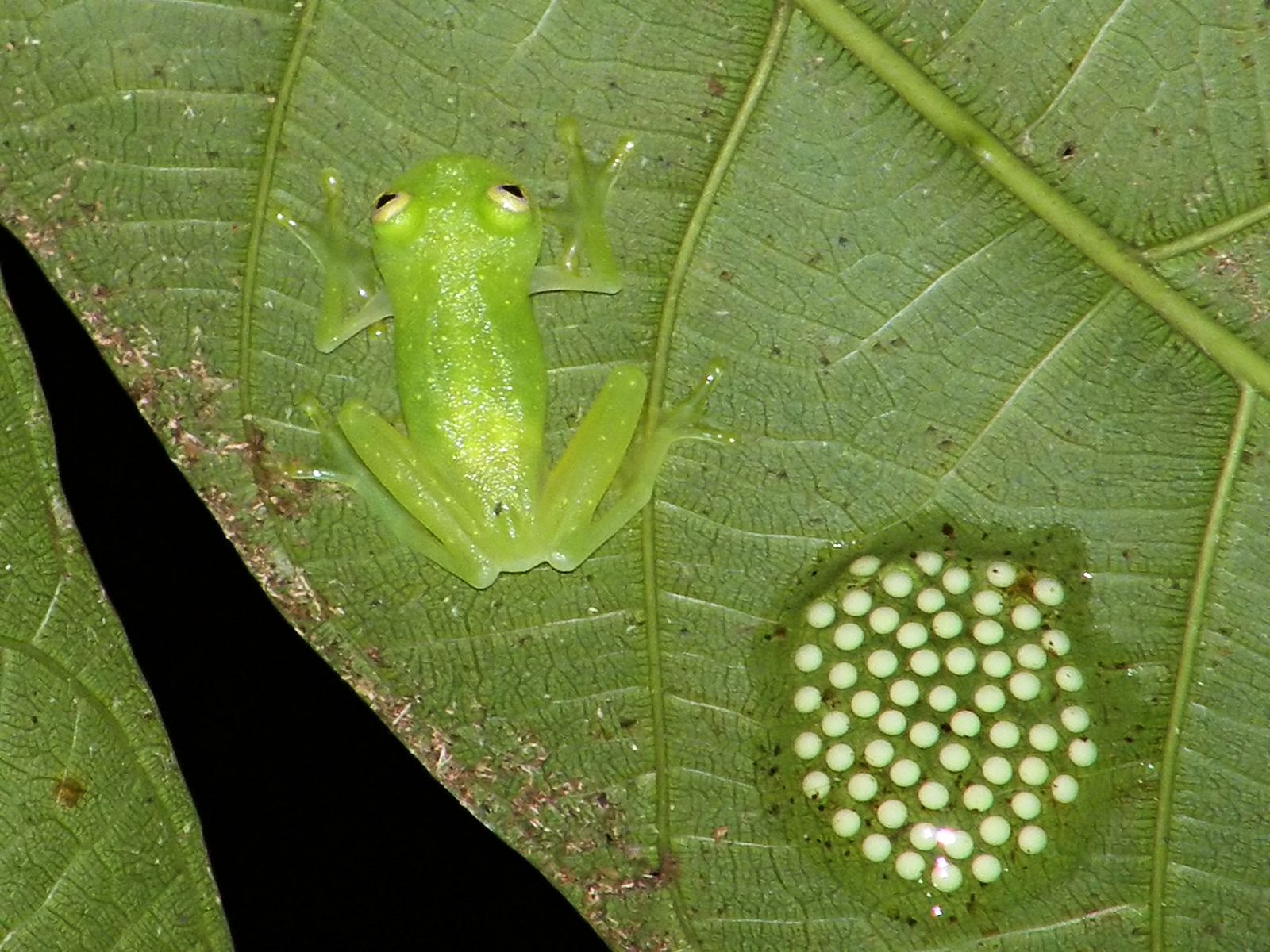
If the dart frogs want to be seen, the glass frogs — family Centrolenidae — want the opposite, and they've taken it to a startling extreme. Their skin, especially on the belly, is translucent: turn one over, or look up at one sitting on a leaf above you, and you can see its internal organs through the skin, the heart visibly beating, the gut and bones faintly outlined. It's one of the strangest sights in the animal kingdom, and it's a camouflage strategy — a semi-transparent frog is far harder for a predator to pick out against a backlit leaf, its outline dissolving into the light coming through the foliage.
The science has recently gotten even stranger. Researchers found that some glass frogs become more transparent while they sleep by pulling most of their red blood cells out of circulation and hiding them, packed away in the liver, so the blood doesn't give them away — then releasing the cells again when they wake and need to be active. It's a trick that would cause dangerous clots in almost any other animal, and how the frogs manage it is now of genuine interest to human medicine.
Glass frogs live along forest streams in Central and South America, and the males of many species are attentive fathers, guarding a clutch of eggs stuck to a leaf overhanging the water until the tadpoles hatch and drop in. They're small, well hidden and most active at night, which makes finding one — usually by a guide's torch catching a translucent shape on the underside of a streamside leaf — one of the real prizes of a night walk. Look for them wherever you find clear forest streams, which is where they breed.
The coquí and the frogs you hear but never see
Not every great rainforest frog is a visual spectacle. In Puerto Rico, the sound of the forest — and, for many Puerto Ricans, the sound of home itself — is the coquí, a tiny Eleutherodactylus frog named for the loud, two-note "ko-KEE" call the males sing through the night. There are many coquí species on the island, but the common coquí is a national symbol, its call as bound up with Puerto Rican identity as any bird or flag. Hearing the chorus swell after dark in El Yunque is one of the defining experiences of the Caribbean's only tropical rainforest in the U.S. system.
The coquí is also a good introduction to one of the rainforest's quieter marvels: frogs that have skipped water entirely. Coquís lay their eggs on land, in damp leaf litter or plants, and the eggs hatch not into tadpoles but into fully formed miniature froglets — direct development, no pond required. It's an adaptation that lets frogs colonise a forest far from open water, and it's part of why the rainforest chorus comes from every direction at once rather than just from the streams. Much of what you'll hear on any night walk anywhere in the tropics is exactly this: dozens of species calling from the leaf litter and the canopy, most of which you will never actually see, and which are no less a part of the forest for that.
How to find them on a night walk
Go after dark, with a guide and a torch
Most rainforest frogs are nocturnal, so the single most important thing is to look at night. The guided night walk that most lodges offer is purpose-built for this: a good local guide knows which leaves the frogs favour, can pick a translucent glass frog off the underside of a streamside leaf you'd never have checked, and — crucially — knows the species well enough to tell you what you're looking at. A head torch keeps your hands free, and a narrow beam picks up the eyeshine of frogs on leaves. Our full guide to the rainforest night walk covers what else the dark reveals, from spiders to snakes to sleeping birds.
Follow the water and the calls
Frogs concentrate near water — streams, ponds, the pools in bromeliads, damp leaf litter — because that's where most of them breed. And they'll tell you where they are: learn to walk toward the calls, and let a rising chorus after rain lead you to the action. The best frogging nights are warm and humid, often just after or during light rain, when the whole forest seems to be singing at once.
Look, don't handle
Frogs absorb substances directly through their permeable skin, which means sunscreen, insect repellent and the oils and salts on human hands can genuinely harm them. The rule on a responsible night walk is to look and photograph but not touch, and to let the guide manage any closer encounter. This isn't only about the poison dart frogs — even harmless species are hurt by handling — and a good guide will enforce it.
Where the frogging is best
Frogs are abundant across every tropical destination in our directory, but a few stand out for diversity, access or a signature species.
Costa Rica and Panama
Costa Rica is the classic frog destination: the lowland Caribbean forests around Sarapiquí and La Selva, and the Osa Peninsula, are famously frog-rich and geared up for night walks, and the red-eyed tree frog is close to a mascot. Neighbouring Panama shares much of the same fauna and adds its own celebrated species. Between them, this is the easiest place in the world to see the headline frogs well.
The Amazon — Peru, Ecuador, Brazil
The western Amazon's sheer amphibian diversity is unmatched, and a river-based lodge night walk in Peru or Ecuador will turn up species found nowhere else. The trade-off is that the forest is vaster and the standout individual species less concentrated than in Costa Rica — you go for the diversity and the wildness rather than a single guaranteed poster frog.
Puerto Rico and the Chocó
For the coquí chorus, El Yunque in Puerto Rico is the place, an accessible rainforest with the Caribbean's most famous frog soundtrack. And for the dart frogs at their most extreme, Colombia's Pacific Chocó — one of the wettest, most biodiverse regions on Earth — is the heartland of the family, though it's a genuinely remote corner to reach.
Good to know
Some lodges and gardens keep frog ponds or small vivariums where local species, including captive-raised (and therefore non-toxic) dart frogs, can be seen and photographed up close in daylight. As with butterfly houses, purists may prefer a wild sighting, but a well-run frog garden is a genuinely useful way to see and learn several species you might otherwise only hear — and to get the photograph a moving frog on a night walk rarely allows.
Frogs in trouble, and watching them responsibly
It's impossible to write honestly about rainforest frogs without noting that amphibians are the most threatened group of animals on the planet. A devastating fungal disease, chytridiomycosis, has swept through tropical amphibian populations over recent decades, driving steep declines and a number of outright extinctions — including, famously, the golden toad of Costa Rica's Monteverde cloud forest, last seen in 1989. Habitat loss, climate change and the pet trade add to the pressure. The frogs you'll see on a night walk are survivors of a genuinely difficult time for their kind.
That makes responsible watching more than good manners. Not handling frogs — because human skin chemicals and, potentially, the spread of disease between sites both matter — is a real conservation act, not just etiquette. So is choosing lodges and guides that run night walks with the animals' welfare in mind, keeping lights and handling to a minimum, and supporting the protected forests where these frogs still thrive. Our guide to sustainable jungle travel covers how to make sure your trip is part of the reason the chorus keeps singing. The frogs are one of the surest, most joyful sightings the rainforest offers — and among the most worth protecting.
Common questions
Are red-eyed tree frogs poisonous?
No. Despite their vivid colours, red-eyed tree frogs are harmless. Their bright flanks, orange feet and red eyes are a "startle" display — flashed suddenly to spook a predator so the frog can escape — not a warning of toxicity. The frogs you should never handle for toxicity reasons are the poison dart frogs, whose colours are an honest advertisement of poison.
Do poison dart frogs make their own poison?
Mostly no — they acquire it from their diet, sequestering toxic alkaloids from the ants, mites and other tiny invertebrates they eat in the wild. Cut off from that diet, captive-raised dart frogs grow up essentially non-toxic, which is why they can be safely kept in vivariums and gardens. A wild dart frog, however, should never be handled.
Can you really see through a glass frog?
Yes. Glass frogs have translucent skin, especially on the belly, through which you can see the heart beating and the internal organs. It's a camouflage adaptation — a semi-transparent frog is hard to spot against a backlit leaf. Some species become even more transparent while sleeping by temporarily hiding most of their red blood cells in the liver.
What's the best way to see rainforest frogs?
Take a guided night walk near water. Most rainforest frogs are nocturnal and concentrate around streams, ponds and damp vegetation, and a knowledgeable local guide with a torch will find and identify species you'd walk straight past. Warm, humid nights, especially during or just after light rain, are best, when the chorus is loudest and the frogs are most active.
Is it safe to touch a frog if I'm careful?
It's best not to, for the frog's sake more than yours. Frogs absorb substances through their permeable skin, so sunscreen, insect repellent and the salts and oils on human hands can harm even non-toxic species. Responsible night walks are look-don't-touch, both to protect the animals and to avoid spreading disease between them.
Where to go from here
Frogs are the easiest headline wildlife the rainforest offers, and they come out on the same night the rest of the nocturnal forest does. Pair this with our guide to the rainforest night walk to know what else the dark holds, and with the butterflies of the rainforest for the daytime shift — between the two, a single lodge gives you a full day-and-night wildlife itinerary. To choose that lodge, start with the full destination directory or browse rainforest eco-lodges with their own streams and trails, where the chorus starts the moment the sun goes down.
- Smithsonian's National Zoo — Red-eyed tree frog — range, startle-colour defence and breeding biology.
- AmphibiaWeb (University of California, Berkeley) — species biology and the global amphibian diversity picture.
- Encyclopædia Britannica — Poison frog — aposematism, diet-derived toxicity and the golden poison frog.
- Taboada et al., Science (2022) — glass frog transparency — how glass frogs hide red blood cells to become more transparent while sleeping.
- USDA Forest Service — El Yunque National Forest — the coquí and the Caribbean's tropical rainforest.
- Amphibian Survival Alliance — chytrid disease, amphibian declines and conservation.
More from the Journal.
 Photo: shankar s. from Dubai, united arab emirates, CC BY 2.0
Where to See Sloths in the Wild
The internet's favourite animal is real, wild and findable — where to reliably see sloths, how to spot them, and the stays that put you closest.
 Photo: Michael Barera, CC BY-SA 4.0
The Monkeys of the Rainforest
Howlers waking you at dawn, capuchins raiding the deck — a field guide to the primates you will meet on a jungle stay, and where to meet which.
 Photo: Charles Miller from Basingstoke, United Kingdom, CC BY 2.0
Toucans & the Tropical Birds You'll See
The rainforest is the richest bird habitat on earth. Toucans, macaws, quetzals and hummingbirds — what to look for, and the best places to look.
 Photo: Derek Ramsey (Ram-Man), CC BY-SA 4.0
Find your own piece of the canopy.
Treehouses, bamboo houses and rainforest villas across 17 destinations — found, vetted and written up honestly.
Browse all destinations