Snakes of the Jungle
Snakes are the animal people most often name when they say they're nervous about the jungle, and the gap between that fear and the reality is wider than almost any other in travel. The rainforest genuinely is full of snakes — more species than almost anywhere on Earth — and yet most visitors spend a week in it and see none, or one, glimpsed for a moment as it pours off a trail. This is an honest accounting: which snakes are actually out there, how rarely you'll meet one, the small handful that warrant real respect, and the simple, boring habits that keep an encounter a story rather than an incident. The goal isn't to talk you out of a healthy caution. It's to right-size it.
The odds of seeing one
Start with the reality most first-timers find hard to believe: seeing a snake in the rainforest is uncommon, and seeing a dangerous one, up close, unprovoked, is genuinely rare. Snakes are secretive, superbly camouflaged, and as keen to avoid you as you are to avoid them — most can feel your footfalls coming through the ground and are gone before you arrive. A great many rainforest visitors go home having seen no snake at all, and count the one glimpse of a vine snake in a bush or a boa asleep on a branch, if they get it, as a highlight rather than a fright.
The corollary is that the traveler who wants to see snakes usually has to work for it, on a night walk with a sharp-eyed guide, which tells you plenty about how hard the animals are to find. This is worth holding onto when the fear talks: the rainforest is not a place where snakes drop from every branch. It's a place where a large number of shy, well-hidden animals go to considerable lengths not to be found, and mostly succeed. Our broader look at whether the jungle is safe puts snakes in proportion against the risks that actually send travelers to a clinic, which are overwhelmingly mundane — stomach bugs, mosquito-borne illness, a slip on a wet trail.
The harmless majority: boas, vine snakes and the rest
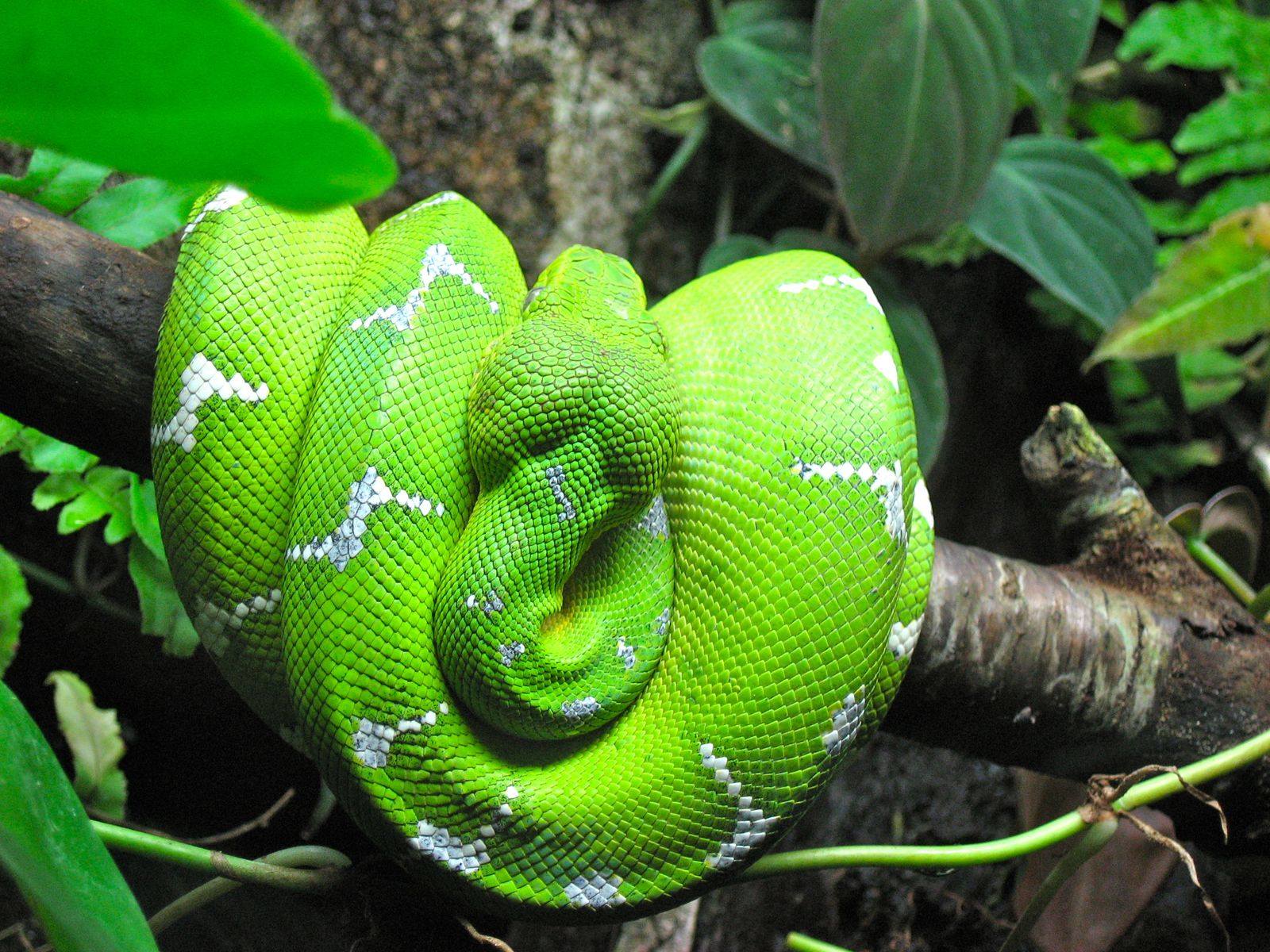
Most rainforest snakes — the large majority of species — are non-venomous or harmless to humans, and some of them are among the most beautiful animals in the forest. The hero image at the top of this page is one: an emerald tree boa, Corallus caninus, a non-venomous constrictor of the Amazon that drapes itself in a distinctive stack of coils over a branch, bright green with white lightning marks, and hunts by ambush, sensing the body heat of passing prey with pits along its lips. It is completely harmless to you and one of the great sights of the South American canopy.
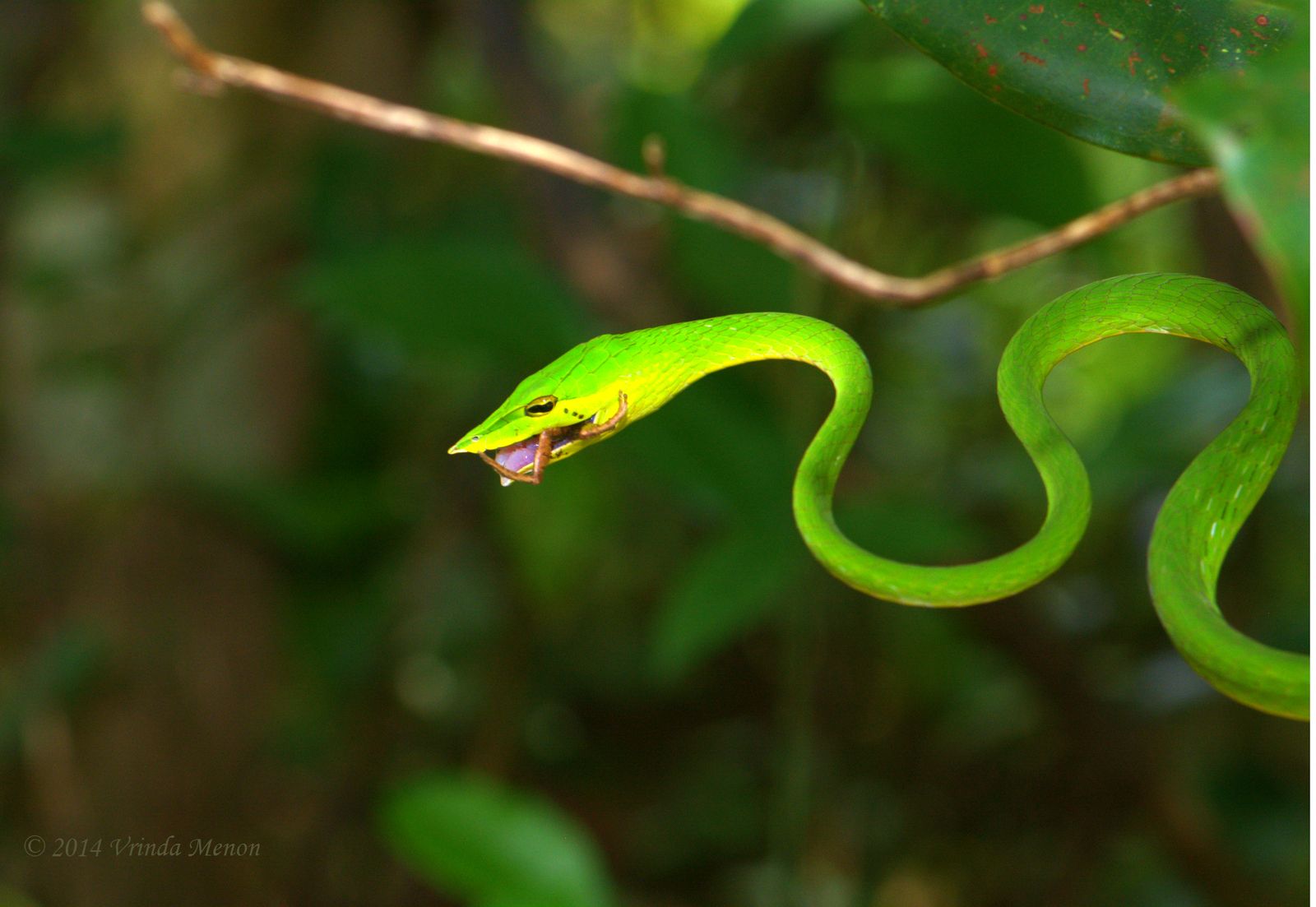
The green vine snake is another you might actually spot, precisely because its camouflage is so good it sometimes gives itself away: impossibly slender, bright green or brown, it stretches motionless between twigs pretending to be a vine, with unusual forward-facing eyes that give it binocular vision for judging strikes at lizards and frogs. The American vine snakes are rear-fanged and very mildly venomous, which in practice means harmless to a human — they'd struggle to deliver a meaningful bite and have no interest in trying. Add the boa constrictor, the many species of harmless colubrids — cat-eyed snakes, tree snakes, ground snakes — hunting frogs and rodents through the leaf litter and branches, and you have the overwhelming bulk of what lives in the forest: an intricate, mostly benign community of predators keeping everything else in balance.
The ones that warrant respect
A short, honest list of the snakes that genuinely matter, not to frighten you but because knowing them is exactly what lets you relax about the rest.
The fer-de-lance
If there is one snake to know in the American tropics, it's the fer-de-lance, Bothrops asper (and its close relatives) — a large, terrestrial pit viper that is responsible for the majority of serious snakebites across Central America and much of South America. It matters not because it's especially aggressive but because of a combination of traits: it's common, it lives on the forest floor and around the edges of farms and villages where people walk, it's superbly camouflaged in leaf litter, and it will stand its ground and strike if nearly stepped on. Almost every guide in the region treats it with careful respect, and it's the single best argument for the closed boots and the watch-where-you-step habit this guide keeps returning to.
Eyelash vipers and other arboreal pit vipers
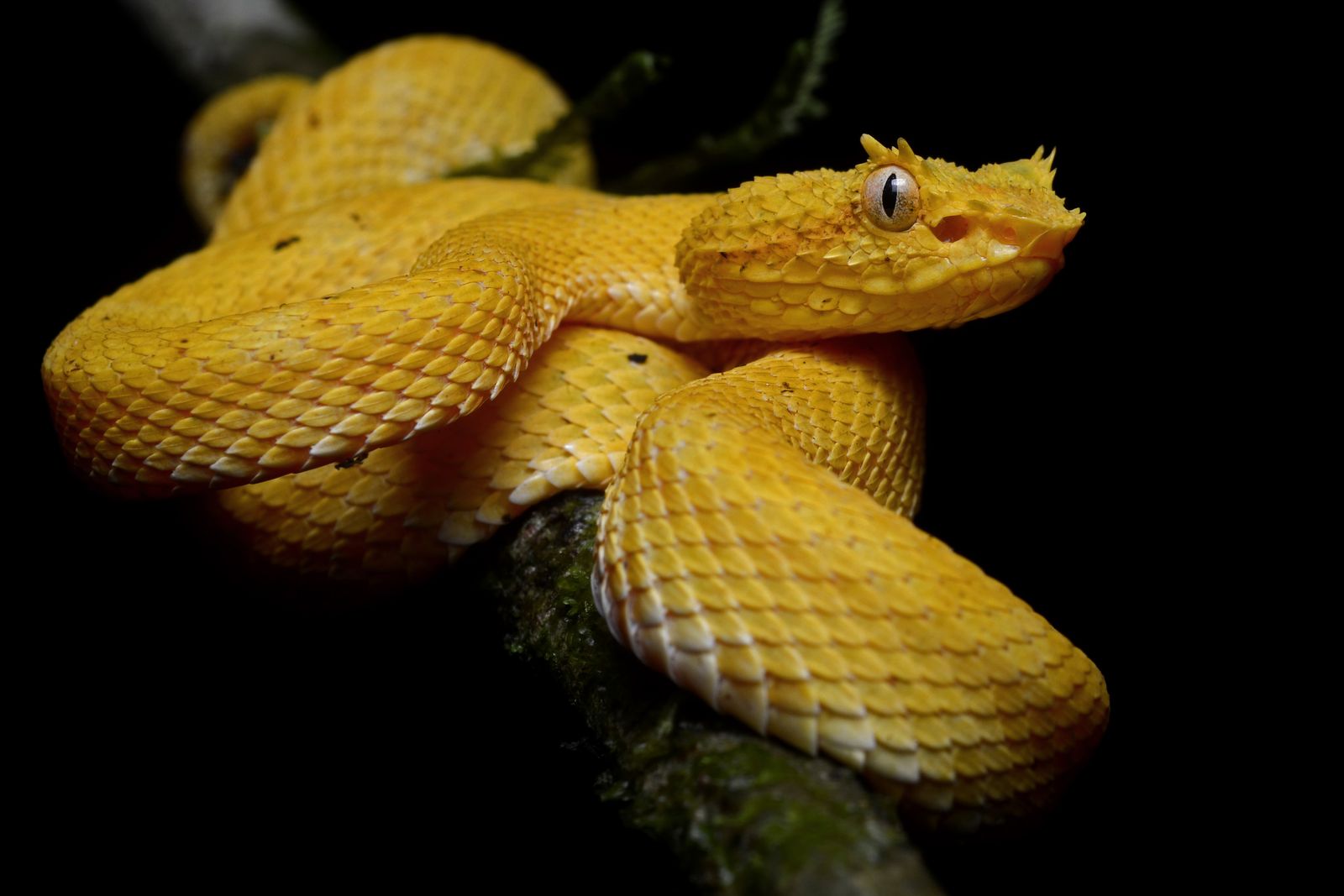
The eyelash viper, a small arboreal pit viper named for the raised scales over its eyes, is the other one you're realistically most likely to encounter, because it does something inconvenient: it sits still, coiled among leaves, flowers and fruit — sometimes exactly the plants a person reaches into. It comes in a range of colours, from the vivid golden form in this guide to mossy green, and its venom, while rarely lethal to a healthy adult, is a serious matter. The lesson it teaches is specific and easy: look before you put a hand into foliage, onto a branch, or around fruit, especially at night.
Coral snakes
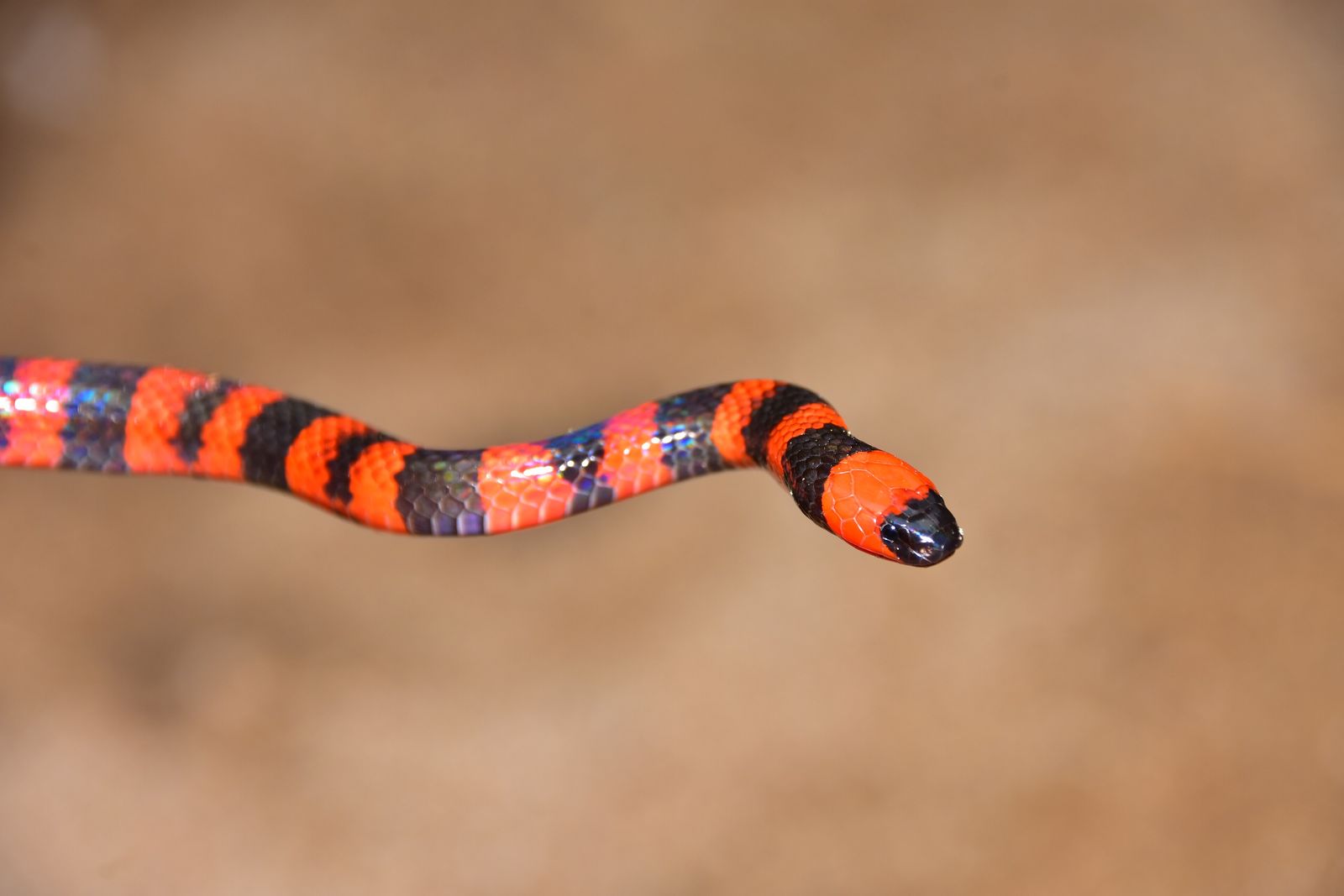
The coral snakes are the tropics' famous warning-coloured elapids — brilliantly banded in red, black and yellow or white — and their venom is potently neurotoxic. The reassuring part is their temperament and anatomy: coral snakes are reclusive, spend most of their time hidden in leaf litter and soil, have small mouths and short fangs, and bite people only very rarely, almost always when someone tries to pick one up. The rule they illustrate is the simplest of all: never handle a snake, and never assume a brightly coloured one is a harmless mimic — the folk rhymes about which bands touch which are unreliable across the tropics.
Big constrictors and, in Asia, the cobras
The green anaconda of the Amazon and Pantanal wetlands is the heaviest snake in the world and a genuine apex predator, but it's aquatic, elusive, and no realistic threat to a person following a guide; seeing one is a bucket-list event, not a danger. In the rainforests of Southeast Asia, the cast changes — reticulated pythons, an array of pit vipers, and the king cobra among them — but the same principles hold: they're shy, sightings are uncommon, and trouble comes almost exclusively from handling or surprising them.
The snakes worth respecting are worth respecting for one reason above all — they're camouflaged and easy to step on or reach past. Watch your feet and your hands, and you've addressed almost the entire risk.
Region by region
The specific snakes change with the forest, even if the sensible behaviour doesn't.
Central America — Costa Rica, Panama, Belize
The most-visited rainforests are also among the best studied for snakes. Costa Rica alone hosts well over a hundred snake species, the great majority harmless; the ones to respect are the fer-de-lance on the ground and the eyelash viper in the vegetation. The upside of visiting a region this geared to nature tourism is that guides are expert, clinics stock antivenom, and night walks let you enjoy the snakes safely rather than fear them.
The Amazon — Peru, Ecuador, Brazil, Colombia
The Amazon basin has the highest snake diversity of all, from the emerald tree boa and anaconda to a long list of pit vipers and harmless species. Sightings on a river-based lodge trip are still uncommon, but the quality when they come — a boa on a branch caught in a torch beam from a boat — is unmatched. The same fer-de-lance-group vipers are the terrestrial ones to mind.
Southeast Asia — Borneo, Bali, Thailand
A different fauna, the same rules. Borneo and the wider region hold pythons, an array of green and brown pit vipers that, like the eyelash viper, sit in vegetation, and the occasional cobra. Leech socks and closed footwear earn their place here for more than one reason, and a guide's local knowledge is, as everywhere, the best safety tool you have.
How dangerous is it, really?
Here's the honest, two-sided answer. Snakebite is a serious global health problem — the World Health Organization classifies it as a neglected tropical disease that kills and disables large numbers of people every year. But look at who is actually bitten, and the picture that matters to a traveler comes into focus: the overwhelming burden falls on rural agricultural communities — farmers, herders and labourers working barefoot or in sandals in fields and around homes, often far from medical care, frequently at night. That is a profile almost the exact opposite of a visitor walking known trails in closed boots, with a guide, near a lodge with clinic access.
For a tourist following sensible precautions, the realistic risk of a serious snakebite is very low — low enough that it should inform your footwear and your habits, not your decision to go. The people who do get bitten while traveling are disproportionately those who broke the one cardinal rule and tried to handle, catch, photograph too closely, or kill a snake. Leave the snakes alone and the statistics are firmly on your side. This is the same calibration our health guide applies to the risks worth actually preparing for; see malaria, vaccines and jungle health for the ones — mosquito-borne, mostly — that deserve more of your attention than snakes do.
The simple rules that keep you safe
Wear closed footwear and watch where you step
The single most effective precaution is boots or closed shoes, ideally over the ankle, on any trail — because the fer-de-lance and most terrestrial vipers strike low, and most bites are on the foot or lower leg. Pair that with the simple habit of watching where you put your feet, staying on the trail, and stepping onto logs and rocks rather than blindly over them, where a snake may be resting on the far side. Our guides to what to pack and what to wear in the jungle cover footwear in detail; for snakes specifically, closed and over-the-ankle is the whole message.
Watch where you put your hands
The arboreal vipers make this the second rule: don't reach blindly into foliage, onto branches or ledges, or around fruit and flowers, especially at night. Look first. This is where eyelash-viper encounters happen, and looking before reaching removes almost all of that risk at zero cost.
Use a light at night, and never handle a snake
Carry a torch or head torch after dark and use it to scan the ground and vegetation ahead — snakes are active at night and far harder to see. And the cardinal rule, the one that prevents the majority of tourist bites: never try to touch, catch, corner, pose with or kill a snake. If you find one, admire it, photograph it from a respectful distance, and let it be. Give any snake room to leave, and it almost always will.
Let the guide lead
A good local guide knows the species, reads the ground, spots what you'd miss, and manages any encounter calmly — which is exactly why the guided night walk, far from being the risky option, is the safest and most rewarding way to actually see snakes. Their expertise is the best safety equipment you'll have.
If the worst happens
A bite is very unlikely, but knowing the basics costs nothing and dissolves a lot of the free-floating fear. The modern first-aid consensus is calmer and simpler than the dramatic folklore: keep the person as still and calm as possible, since panic and exertion speed venom through the body; keep the bitten limb roughly at heart level and immobilised, as you would a fracture; remove rings, watches and anything tight before swelling starts; note the time and, if you can do so safely and from a distance, the snake's appearance to help identify the antivenom needed; and get to medical care as quickly as possible, because effective treatment — antivenom — is a hospital matter, not a field one.
Just as important is what not to do, because the old techniques actively cause harm: do not cut the wound, do not try to suck out venom, do not apply a tight tourniquet, do not pack it in ice, and do not give the person alcohol. None of these help and several make things worse. This is also a good argument, as our health guide stresses, for travel insurance that covers medical evacuation on any trip that takes you far from a hospital — the coverage that turns a remote emergency into a manageable one.
Why the snakes matter
It's worth ending on the reason to be glad the snakes are there at all. As predators of rodents and other small animals, snakes are a load-bearing part of the rainforest's machinery — take them out and the balance tips in ways that ripple through the whole system, including in ways that affect people, since rodent populations and the diseases they carry are among the things snakes quietly keep in check. The beautiful boa on a branch and the fer-de-lance you're being careful to avoid are doing the same essential job.
Seen that way, the goal of everything above isn't to survive the snakes but to coexist with them for a week without incident, which is entirely achievable and, for most visitors, effortless. The forests that still hold a full complement of snakes are healthy forests, and the traveler who comes away with one good, respectful snake sighting and no drama has had the encounter exactly as it should go. If the animals fascinate more than they worry you, the night walk is where to meet them, and our guide to the frogs of the rainforest — many of them a snake's dinner — is the natural companion piece.
Common questions
How likely am I to see a snake in the rainforest?
Less likely than you'd think. Snakes are secretive and well camouflaged, and many visitors see none or only a fleeting glimpse over a week. People who specifically want to see snakes usually rely on a guided night walk to find them, which tells you how hard the animals are to spot. A dangerous snake at close range, unprovoked, is genuinely rare.
What's the most dangerous snake I might encounter?
In the American tropics, the fer-de-lance (Bothrops asper and relatives) — a common, well-camouflaged, ground-dwelling pit viper responsible for most serious bites in the region, mainly because it lives where people walk and will stand its ground. The eyelash viper, which sits in vegetation, is the other one to know. In Southeast Asia, various pit vipers and the occasional cobra play the equivalent role. All are avoidable with closed boots and careful hands and feet.
Should snakes stop me from visiting the jungle?
No. For a traveler in closed footwear, on known trails, with a guide, and near a lodge with clinic access, the risk of a serious snakebite is very low. The heavy burden of snakebite falls on rural agricultural workers, often barefoot and far from care — a very different situation from a guided trip. Sensible habits, not avoidance, are the right response.
What should I do if I see a snake on the trail?
Stop, keep your distance, and give it room to move away — which it almost always will. Never try to touch, catch, corner, pose with or kill it, since that's how the large majority of tourist bites happen. Admire and photograph it from well back, and let your guide manage the encounter.
What's the correct first aid for a snakebite?
Keep the person calm and still, immobilise the bitten limb at about heart level, remove anything tight like rings before swelling starts, note the time and the snake's appearance if you safely can, and get to a hospital fast — antivenom is the real treatment. Do not cut the wound, suck out venom, apply a tourniquet, use ice, or give alcohol; those old methods cause harm.
Where to go from here
The best way to turn snake fear into snake fascination is to see one safely, with someone who knows it — so pair this with our guide to the rainforest night walk, and read is the jungle safe? for the honest, right-sized picture of every rainforest risk, not just this one. To choose a base with expert guides and good trail infrastructure, start with the full destination directory or browse rainforest eco-lodges built around exactly this kind of wildlife-first, guide-led experience.
- World Health Organization — Snakebite envenoming — global burden, who is most affected, and first-aid and treatment guidance.
- Encyclopædia Britannica — Fer-de-lance (Bothrops) — habitat, behaviour and medical importance in the American tropics.
- Encyclopædia Britannica — Coral snake — venom, reclusive habits and the unreliability of colour-band folk rules.
- Animal Diversity Web — Corallus caninus (emerald tree boa) — non-venomous arboreal biology and heat-sensing predation.
- CDC / NIOSH — Venomous snakes — prevention behaviour and first-aid do's and don'ts.
- Smithsonian Tropical Research Institute — Neotropical snake diversity and ecology background.
More from the Journal.
 Photo: shankar s. from Dubai, united arab emirates, CC BY 2.0
Where to See Sloths in the Wild
The internet's favourite animal is real, wild and findable — where to reliably see sloths, how to spot them, and the stays that put you closest.
 Photo: Michael Barera, CC BY-SA 4.0
The Monkeys of the Rainforest
Howlers waking you at dawn, capuchins raiding the deck — a field guide to the primates you will meet on a jungle stay, and where to meet which.
 Photo: Charles Miller from Basingstoke, United Kingdom, CC BY 2.0
Toucans & the Tropical Birds You'll See
The rainforest is the richest bird habitat on earth. Toucans, macaws, quetzals and hummingbirds — what to look for, and the best places to look.
 Photo: Derek Ramsey (Ram-Man), CC BY-SA 4.0
Find your own piece of the canopy.
Treehouses, bamboo houses and rainforest villas across 17 destinations — found, vetted and written up honestly.
Browse all destinations